

Question 91
View the Exhibits and examine the structure of the COSTS and PROMOTIONS tables.
You want to display PROD_IDS whose promotion cost is less than the highest cost PROD_ID in a promotion time interval.
Examine this SQL statement:

Exhibit 1.

Exhibit 2.

What will be the result?
You want to display PROD_IDS whose promotion cost is less than the highest cost PROD_ID in a promotion time interval.
Examine this SQL statement:
Exhibit 1.
Exhibit 2.
What will be the result?
Question 92
Examine the description of the SALES1 table:

SALES2 is a table with the same description as SALES1.
Some sales data is duplicated in both tables.
You want to display the rows from the SALES1 table which are not present in the SALES2 table.
Which set operator generates the required output?
SALES2 is a table with the same description as SALES1.
Some sales data is duplicated in both tables.
You want to display the rows from the SALES1 table which are not present in the SALES2 table.
Which set operator generates the required output?
Question 93
Examine these commands:
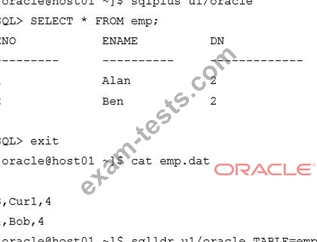
Which two statements are true about the sqlldr execution? (Choose two.)
Which two statements are true about the sqlldr execution? (Choose two.)
Question 94
In one of your databases, you create a user, HR, and then execute this command:
GRANT CREATE SESSION TO hr WITH ADMIN OPTION;
Which three actions can HR perform? (Choose three.)
GRANT CREATE SESSION TO hr WITH ADMIN OPTION;
Which three actions can HR perform? (Choose three.)
Question 95
View the Exhibits and examine the structure of the COSTS and PROMOTIONS tables.
You want to display PROD_IDS whose promotion cost is less than the highest cost PROD_ID in a promotion time interval.
Examine this SQL statement:
Exhibit 1.
Exhibit 2.
What will be the result?
You want to display PROD_IDS whose promotion cost is less than the highest cost PROD_ID in a promotion time interval.
Examine this SQL statement:
Exhibit 1.
Exhibit 2.
What will be the result?