

Question 76
Which statement is true regarding the default behavior of the ORDER BY clause?
Question 77
View the Exhibit and examine the structure in the DEPARTMENTS tables. (Choose two.)
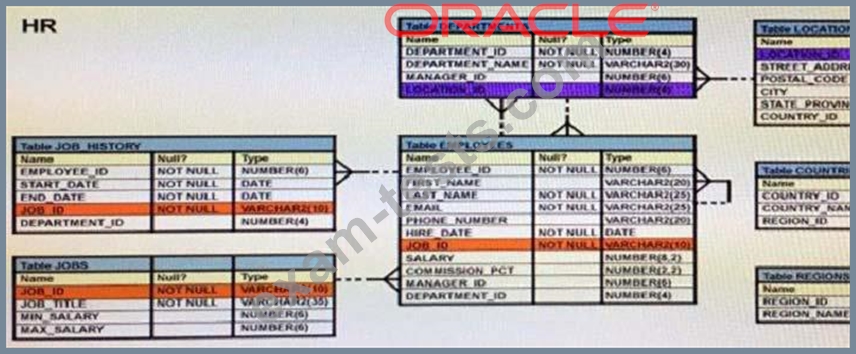
Examine this SQL statement:
SELECT department_id "DEPT_ID", department_name, 'b' FROM
departments
WHERE departments_id=90
UNION
SELECT department_id, department_name DEPT_NAME, 'a' FROM
departments
WHERE department_id=10
Which two ORDER BY clauses can be used to sort output?
Examine this SQL statement:
SELECT department_id "DEPT_ID", department_name, 'b' FROM
departments
WHERE departments_id=90
UNION
SELECT department_id, department_name DEPT_NAME, 'a' FROM
departments
WHERE department_id=10
Which two ORDER BY clauses can be used to sort output?
Question 78
Examine the data in the ENPLOYEES table:
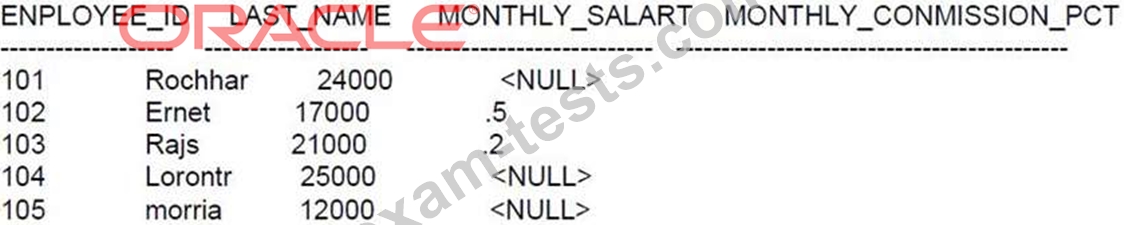
Which statement will compute the total annual compensation tor each employee?
Which statement will compute the total annual compensation tor each employee?
Question 79
Examine the data in the EMP table:
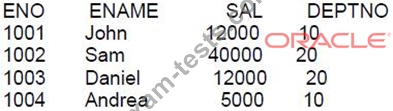
You execute this query:
SELECT deptno AS "Department", AVG(sal) AS AverageSalary, MAX(sal) AS "Max Salary"
FROM emp
WHERE sal >= 12000
GROUP BY "Department "
ORDER BY AverageSalary;
Why does an error occur?
You execute this query:
SELECT deptno AS "Department", AVG(sal) AS AverageSalary, MAX(sal) AS "Max Salary"
FROM emp
WHERE sal >= 12000
GROUP BY "Department "
ORDER BY AverageSalary;
Why does an error occur?
Question 80
See the Exhibit and examine the structure of the PROMOTIONS table:
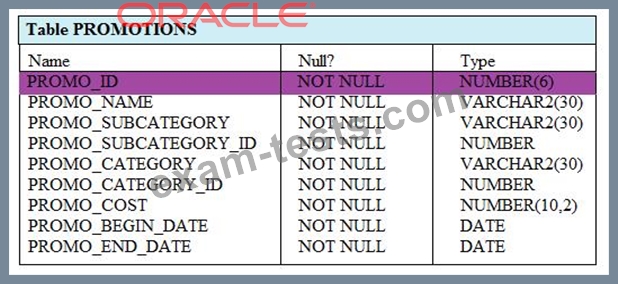
Using the PROMOTIONS table,
you need to find out the average cost for all promos in the range $0-2000 and $2000-5000 in category A.
You issue the following SQL statements:
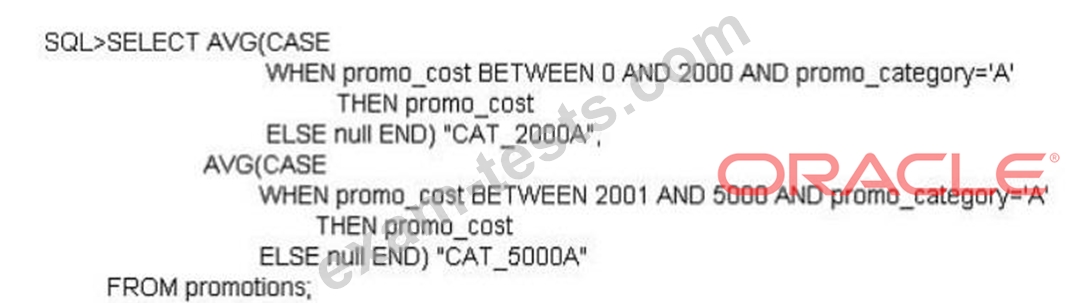
What would be the outcome?
Using the PROMOTIONS table,
you need to find out the average cost for all promos in the range $0-2000 and $2000-5000 in category A.
You issue the following SQL statements:
What would be the outcome?