

Question 16
The following are the steps for a correlated subquery, listed in random order:
1. The WHEREclause of the outer query is evaluated.
2. The candidate row is fetched from the table specified in the outer query.
3. The procedure is repeated for the subsequent rows of the table, till all the rows are processed.
4. Rows are returned by the inner query, after being evaluated with the value from the candidate row in the outer query.
Identify the option that contains the steps in the correct sequence in which the Oracle server evaluates a correlated subquery.
1. The WHEREclause of the outer query is evaluated.
2. The candidate row is fetched from the table specified in the outer query.
3. The procedure is repeated for the subsequent rows of the table, till all the rows are processed.
4. Rows are returned by the inner query, after being evaluated with the value from the candidate row in the outer query.
Identify the option that contains the steps in the correct sequence in which the Oracle server evaluates a correlated subquery.
Question 17
Table EMPLOYEES contains columns including EMPLOYEE_ID, JOB_ID and SALARY.
Only the EMPLOYEE_ID column is indexed.
Rows exist for employees 100 and 200.
Examine this statement:

Which two statements are true? (Choose two.)
Only the EMPLOYEE_ID column is indexed.
Rows exist for employees 100 and 200.
Examine this statement:
Which two statements are true? (Choose two.)
Question 18
You have been asked to create a table for a banking application.
One of the columns must meet three requirements:
1: Be stored in a format supporting date arithmetic without using conversion functions
2: Store a loan period of up to 10 years
3: Be used for calculating interest for the number of days the loan remains unpaid Which data type should you use?
One of the columns must meet three requirements:
1: Be stored in a format supporting date arithmetic without using conversion functions
2: Store a loan period of up to 10 years
3: Be used for calculating interest for the number of days the loan remains unpaid Which data type should you use?
Question 19
View the exhibit and examine the structure of the STOREStable.
STORES table
Name Null? Type
----------------- ----- -------------
STORE_ID NUMBER
NAME VARCHAR2(100)
ADDRESS VARCHAR2(200)
CITY VARCHAR2(100)
COUNTRY VARCHAR2(100)
START_DATE DATE
END_DATE DATE
PROPERTY_PRICE NUMBER
You want to display the NAME of the store along with the ADDRESS, START_DATE, PROPERTY_PRICE, and the projected property price, which is 115% of property price.
The stores displayed must have START_DATEin the range of 36 months starting from 01-Jan-2000 and above.
Which SQL statement would get the desired output?
STORES table
Name Null? Type
----------------- ----- -------------
STORE_ID NUMBER
NAME VARCHAR2(100)
ADDRESS VARCHAR2(200)
CITY VARCHAR2(100)
COUNTRY VARCHAR2(100)
START_DATE DATE
END_DATE DATE
PROPERTY_PRICE NUMBER
You want to display the NAME of the store along with the ADDRESS, START_DATE, PROPERTY_PRICE, and the projected property price, which is 115% of property price.
The stores displayed must have START_DATEin the range of 36 months starting from 01-Jan-2000 and above.
Which SQL statement would get the desired output?
Question 20
Examine this SQL statement:
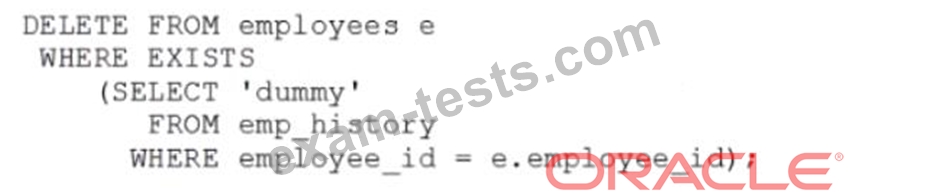
Which two are true?
Which two are true?