

Question 216
The PRODUCTStable has the following structure.
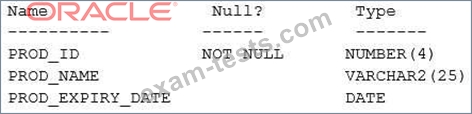
Evaluate the following two SQL statements:
SQL>SELECT prod_id, NVL2 (prod_expiry_date, prod_expiry_date + 15, ' ') FROM products; SQL>SELECT prod_id, NVL (prod_expiry_date, prod_expiry_date + 15) FROM products; Which statement is true regarding the outcome?
Evaluate the following two SQL statements:
SQL>SELECT prod_id, NVL2 (prod_expiry_date, prod_expiry_date + 15, ' ') FROM products; SQL>SELECT prod_id, NVL (prod_expiry_date, prod_expiry_date + 15) FROM products; Which statement is true regarding the outcome?
Question 217
Which statement is true regarding external tables?
Question 218
Examine the structure proposed for the TRANSACTIONStable:
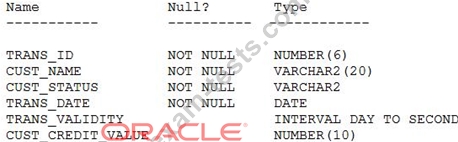
Which two statements are true regarding the storage of data in the above table structure? (Choose two.)
Which two statements are true regarding the storage of data in the above table structure? (Choose two.)
Question 219
Examine the structure of the BOOKS_TRANSACTIONS table:

You want to display the member IDs, due date, and late fee as $2 for all transactions.
Which SQL statement must you execute?
You want to display the member IDs, due date, and late fee as $2 for all transactions.
Which SQL statement must you execute?
Question 220
View the exhibits and examine the structures of the COSTSand PROMOTIONStables.
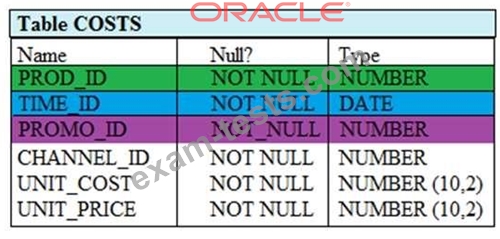
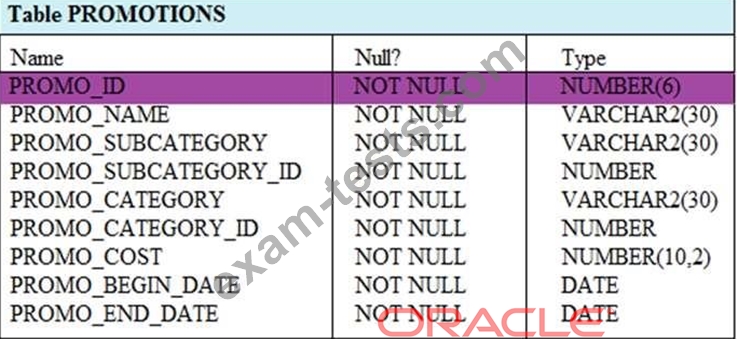
Evaluate the following SQL statement:
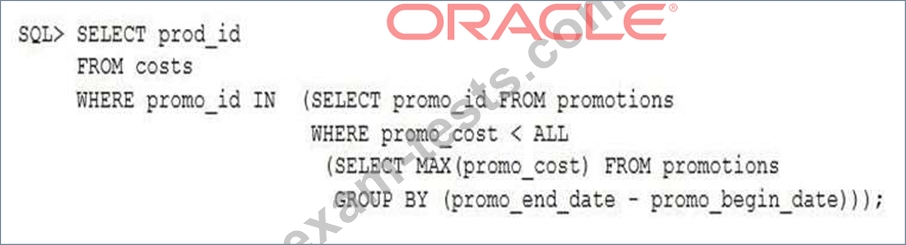
What would be the outcome of the above SQL statement?
Evaluate the following SQL statement:
What would be the outcome of the above SQL statement?