

Question 11
Which statement is true about transactions?
Question 12
View the Exhibit and examine the structure in the EMPLOYEES tables.
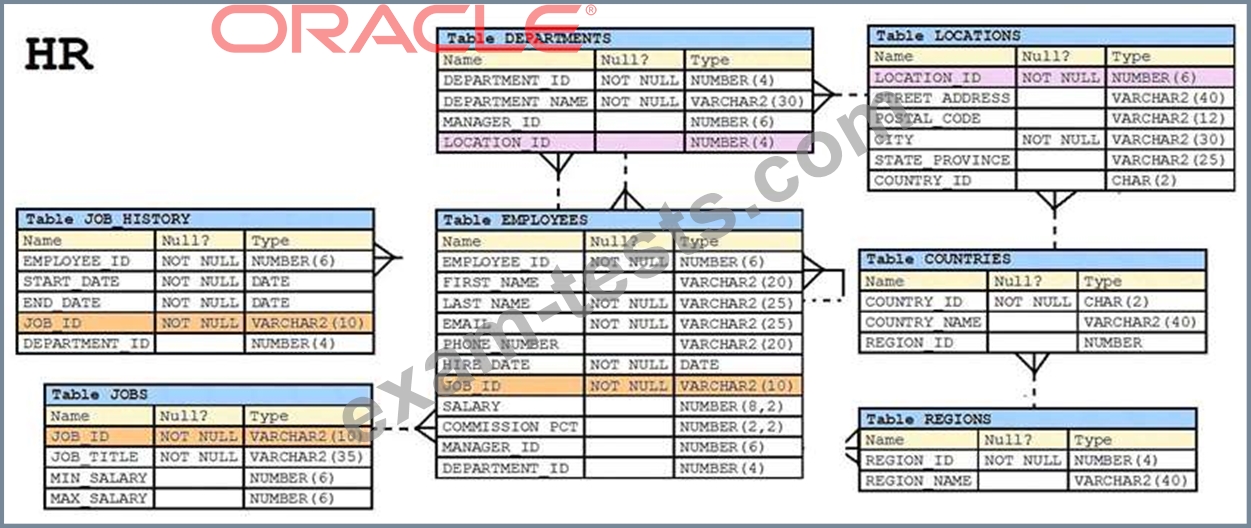
Evaluate the following SQL statement:
SELECT employee_id, department_id
FROM employees
WHERE department_id= 50 ORDER BY department_id
UNION
SELECT employee_id, department_id
FROM employees
WHERE department_id= 90
UNION
SELECT employee_id, department_id
FROM employees
WHERE department_id= 10;
What would be the outcome of the above SQL statement?
Evaluate the following SQL statement:
SELECT employee_id, department_id
FROM employees
WHERE department_id= 50 ORDER BY department_id
UNION
SELECT employee_id, department_id
FROM employees
WHERE department_id= 90
UNION
SELECT employee_id, department_id
FROM employees
WHERE department_id= 10;
What would be the outcome of the above SQL statement?
Question 13
Table EMPLOYEES contains columns including EMPLOYEE_ID, JOB_ID and SALARY.
Only the EMPLOYEE_ID column is indexed.
Rows exist for employees 100 and 200.
Examine this statement:

Which two statements are true? (Choose two.)
Only the EMPLOYEE_ID column is indexed.
Rows exist for employees 100 and 200.
Examine this statement:
Which two statements are true? (Choose two.)
Question 14
Examine the description of the ORDERStable:

Examine the description of the INVOICEStable:

Examine this query:

Which three rows will it return? (Choose three.)
5 01-MAR-2019
Examine the description of the INVOICEStable:
Examine this query:
Which three rows will it return? (Choose three.)
5 01-MAR-2019
Question 15
View the Exhibit and examine the structure of the EMP table which is not partitioned and not an index- organized table. (Choose two.)

Evaluate this SQL statement:
ALTER TABLE emp
DROP COLUMN first_name;
Which two statements are true?
Evaluate this SQL statement:
ALTER TABLE emp
DROP COLUMN first_name;
Which two statements are true?