

Question 71
You need to calculate the number of days from 1st January 2019 until today.
Dates are stored in the default format of DD-MON-RR.
Which two queries give the required output? (Choose two.)
SELECT TO_CHAR(SYSDATE, 'DD-MON-YYYY') - '01-JAN-2019' FROM DUAL;
Dates are stored in the default format of DD-MON-RR.
Which two queries give the required output? (Choose two.)
SELECT TO_CHAR(SYSDATE, 'DD-MON-YYYY') - '01-JAN-2019' FROM DUAL;
Question 72
View the Exhibit and examine the structure of the ORDERS table.
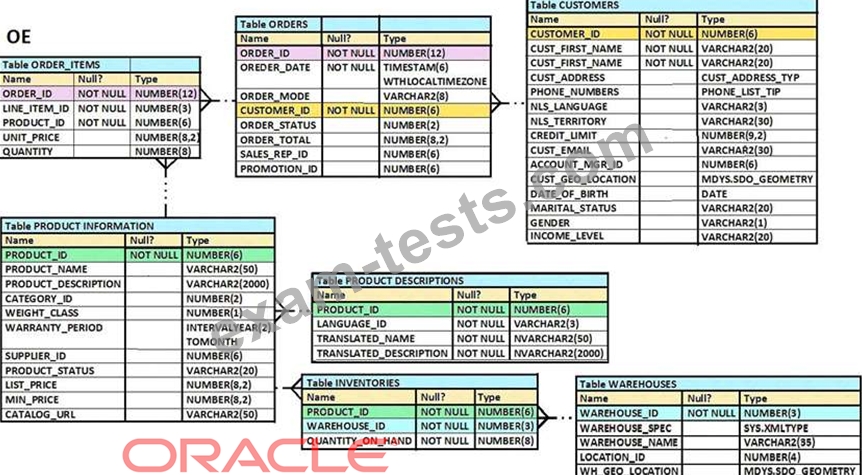
You must select ORDER_ID and ORDER_DATE for all orders that were placed after the last order placed by CUSTOMER_ID 101.
Which query would give you the desired result?
You must select ORDER_ID and ORDER_DATE for all orders that were placed after the last order placed by CUSTOMER_ID 101.
Which query would give you the desired result?
Question 73
View the Exhibit and examine the structure in the EMPLOYEEStables.

Evaluate the following SQL statement:
SELECT employee_id, department_id
FROM employees
WHERE department_id= 50 ORDER BY department_id
UNION
SELECT employee_id, department_id
FROM employees
WHERE department_id= 90
UNION
SELECT employee_id, department_id
FROM employees
WHERE department_id= 10;
What would be the outcome of the above SQL statement?
Evaluate the following SQL statement:
SELECT employee_id, department_id
FROM employees
WHERE department_id= 50 ORDER BY department_id
UNION
SELECT employee_id, department_id
FROM employees
WHERE department_id= 90
UNION
SELECT employee_id, department_id
FROM employees
WHERE department_id= 10;
What would be the outcome of the above SQL statement?
Question 74
View the exhibit and examine the structure of the EMPLOYEEStable.
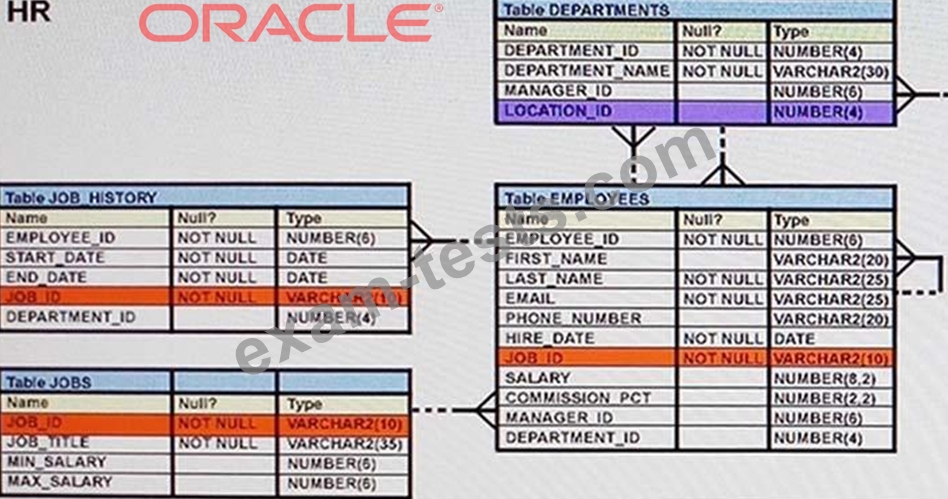
You want to display all employees and their managers having 100 as the MANAGER_ID. You want the output in two columns: the first column would have the LAST_NAMEof the managers and the second column would have LAST_NAMEof the employees.
Which SQL statement would you execute?
SELECT m.last_name "Manager", e.last_name "Employee"
You want to display all employees and their managers having 100 as the MANAGER_ID. You want the output in two columns: the first column would have the LAST_NAMEof the managers and the second column would have LAST_NAMEof the employees.
Which SQL statement would you execute?
SELECT m.last_name "Manager", e.last_name "Employee"
Question 75
Which two statements are true regarding the EXISTS operator used in the correlated subqueries? (Choose two.)