

Question 71
Examine the structure of the PROMOTIONS table:

Management requires a report of unique promotion costs in each promotion category.
Which query would satisfy this requirement?
Management requires a report of unique promotion costs in each promotion category.
Which query would satisfy this requirement?
Question 72
View the Exhibit and examine the structure of the EMPLOYEES table.
You want to display all employees and their managers having 100 as the MANAGER_ID. You want the output in two columns: the first column would have the LAST_NAME of the managers and the second column would have LAST_NAME of the employees.
Which SQL statement would you execute?

You want to display all employees and their managers having 100 as the MANAGER_ID. You want the output in two columns: the first column would have the LAST_NAME of the managers and the second column would have LAST_NAME of the employees.
Which SQL statement would you execute?
Question 73
You execute these commands:
CREATE TABLE customers (customer_id INTEGER, customer_name VARCHAR2 (20) ) TNSERT INTO customers VALUES (1, 'Customer 1 ' ) ; SAVEPOTNT post_insert; INSERT INTO customers VALUES (2, 'Customer 2');
<TODO>
SELECT COUNT(*) FROM customers;
Which two, used independently, can replace <todo> so the query returns 1?
CREATE TABLE customers (customer_id INTEGER, customer_name VARCHAR2 (20) ) TNSERT INTO customers VALUES (1, 'Customer 1 ' ) ; SAVEPOTNT post_insert; INSERT INTO customers VALUES (2, 'Customer 2');
<TODO>
SELECT COUNT(*) FROM customers;
Which two, used independently, can replace <todo> so the query returns 1?
Question 74
View the Exhibit and examine the structure in the DEPARTMENTS tables. (Choose two.)
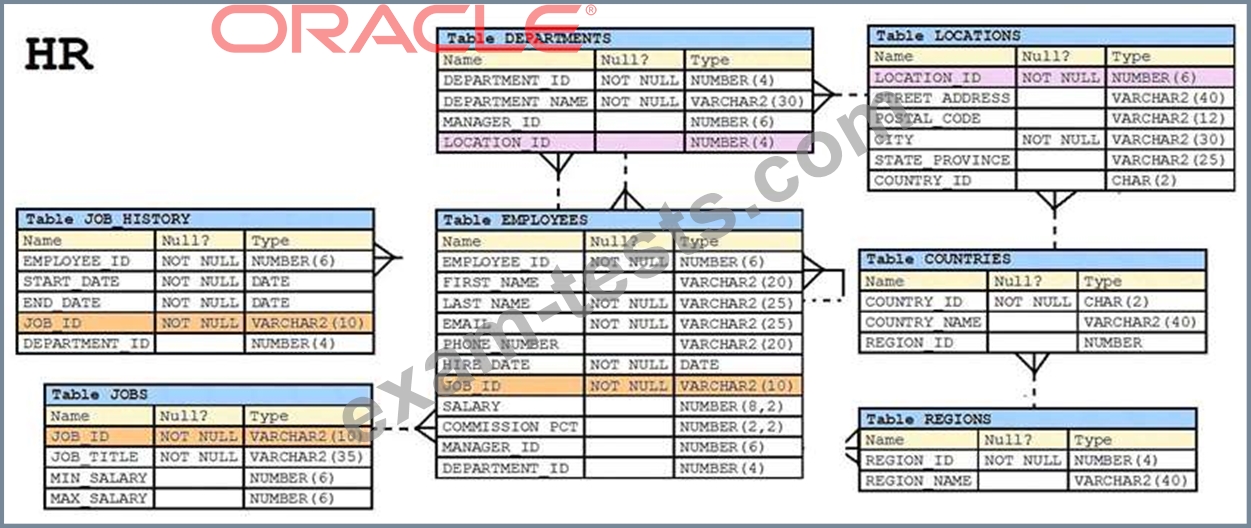
Examine this SQL statement:
SELECT department_id "DEPT_ID", department_name, 'b'
FROM departments
WHERE departments_id=90
UNION
SELECT department_id, department_name DEPT_NAME, 'a'
FROM departments
WHERE department_id=10
Which two ORDER BY clauses can be used to sort the output? (Choose two.)
Examine this SQL statement:
SELECT department_id "DEPT_ID", department_name, 'b'
FROM departments
WHERE departments_id=90
UNION
SELECT department_id, department_name DEPT_NAME, 'a'
FROM departments
WHERE department_id=10
Which two ORDER BY clauses can be used to sort the output? (Choose two.)
Question 75
BOOK_SEQ is an existing sequence in your schema.
Which two CREATE TABLE commands are valid?
A)

B)

C)

D)

E)

Which two CREATE TABLE commands are valid?
A)
B)
C)
D)
E)