

Question 6
Given the content of the employee.txt file:
Every worker is a master.
Given that the employee.txt file is accessible and the file allemp.txt does NOT exist, and the code fragment:
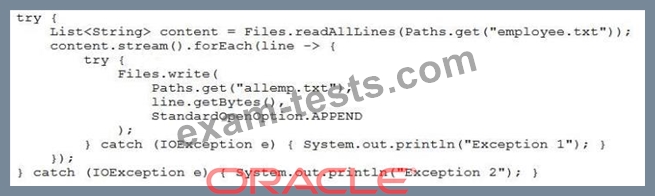
What is the result?
Every worker is a master.
Given that the employee.txt file is accessible and the file allemp.txt does NOT exist, and the code fragment:
What is the result?
Question 7
Given:
class RateOfInterest {
public static void main (String[] args) {
int rateOfInterest = 0;
String accountType = "LOAN";
switch (accountType) {
case "RD";
rateOfInterest = 5;
break;
case "FD";
rateOfInterest = 10;
break;
default:
assert false: "No interest for this account"; //line n1
}
System.out.println ("Rate of interest:" + rateOfInterest);
}
}
and the command:
java -ea RateOfInterest
What is the result?
class RateOfInterest {
public static void main (String[] args) {
int rateOfInterest = 0;
String accountType = "LOAN";
switch (accountType) {
case "RD";
rateOfInterest = 5;
break;
case "FD";
rateOfInterest = 10;
break;
default:
assert false: "No interest for this account"; //line n1
}
System.out.println ("Rate of interest:" + rateOfInterest);
}
}
and the command:
java -ea RateOfInterest
What is the result?
Question 8
Given:
public class Customer {
private String fName;
private String lName;
private static int count;
public customer (String first, String last) {fName = first, lName =
last;
++count;}
static { count = 0; }
public static int getCount() {return count; }
}
public class App {
public static void main (String [] args) {
Customer c1 = new Customer("Larry", "Smith");
Customer c2 = new Customer("Pedro", "Gonzales");
Customer c3 = new Customer("Penny", "Jones");
Customer c4 = new Customer("Lars", "Svenson");
c4 = null;
c3 = c2;
System.out.println (Customer.getCount());
}
}
What is the result?
public class Customer {
private String fName;
private String lName;
private static int count;
public customer (String first, String last) {fName = first, lName =
last;
++count;}
static { count = 0; }
public static int getCount() {return count; }
}
public class App {
public static void main (String [] args) {
Customer c1 = new Customer("Larry", "Smith");
Customer c2 = new Customer("Pedro", "Gonzales");
Customer c3 = new Customer("Penny", "Jones");
Customer c4 = new Customer("Lars", "Svenson");
c4 = null;
c3 = c2;
System.out.println (Customer.getCount());
}
}
What is the result?
Question 9
Given the code fragment:
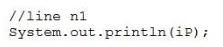
Which code fragment, when inserted at line n1, enables the code to print /First.txt?
Which code fragment, when inserted at line n1, enables the code to print /First.txt?
Question 10
Given the code fragment:
Map<Integer, String> books = new TreeMap<>();
books.put (1007, "A");
books.put (1002, "C");
books.put (1001, "B");
books.put (1003, "B");
System.out.println (books);
What is the result?
Map<Integer, String> books = new TreeMap<>();
books.put (1007, "A");
books.put (1002, "C");
books.put (1001, "B");
books.put (1003, "B");
System.out.println (books);
What is the result?