

Question 51
View the exhibit for the structure of the STUDENTand FACULTYtables.
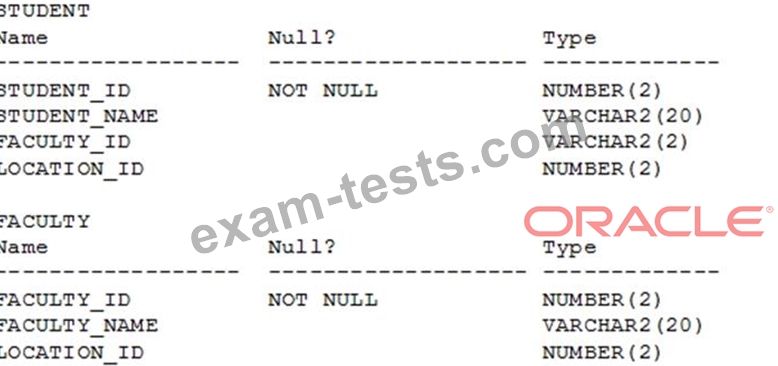
You need to display the faculty name followed by the number of students handled by the faculty at the base location.
Examine the following two SQL statements:
Statement 1
SQL>SELECT faculty_name, COUNT(student_id)
FROM student JOIN faculty
USING (faculty_id, location_id)
GROUP BY faculty_name;
Statement 2
SQL>SELECT faculty_name, COUNT(student_id)
FROM student NATURAL JOIN faculty
GROUP BY faculty_name;
Which statement is true regarding the outcome?
You need to display the faculty name followed by the number of students handled by the faculty at the base location.
Examine the following two SQL statements:
Statement 1
SQL>SELECT faculty_name, COUNT(student_id)
FROM student JOIN faculty
USING (faculty_id, location_id)
GROUP BY faculty_name;
Statement 2
SQL>SELECT faculty_name, COUNT(student_id)
FROM student NATURAL JOIN faculty
GROUP BY faculty_name;
Which statement is true regarding the outcome?
Question 52
Which two statements cause changes to the data dictionary?
Question 53
View the Exhibit and examine the structure of ORDERS and CUSTOMERS tables. (Choose the best answer.)
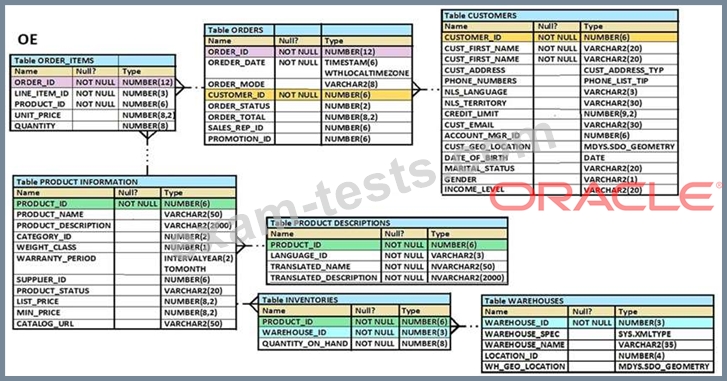
You executed this UPDATE statement:
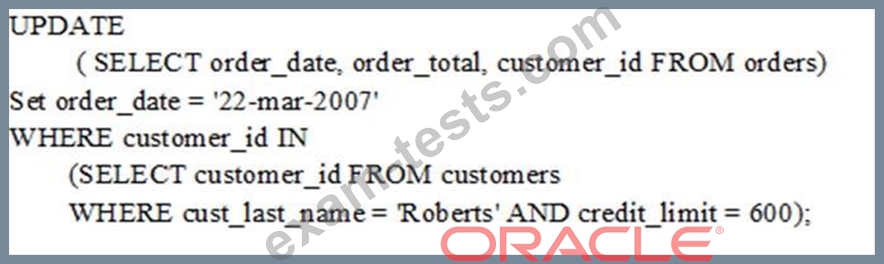
Which statement is true regarding the execution?
You executed this UPDATE statement:
Which statement is true regarding the execution?
Question 54
View the Exhibit and examine the structure of the SALES and PRODUCTS tables. (Choose two.)
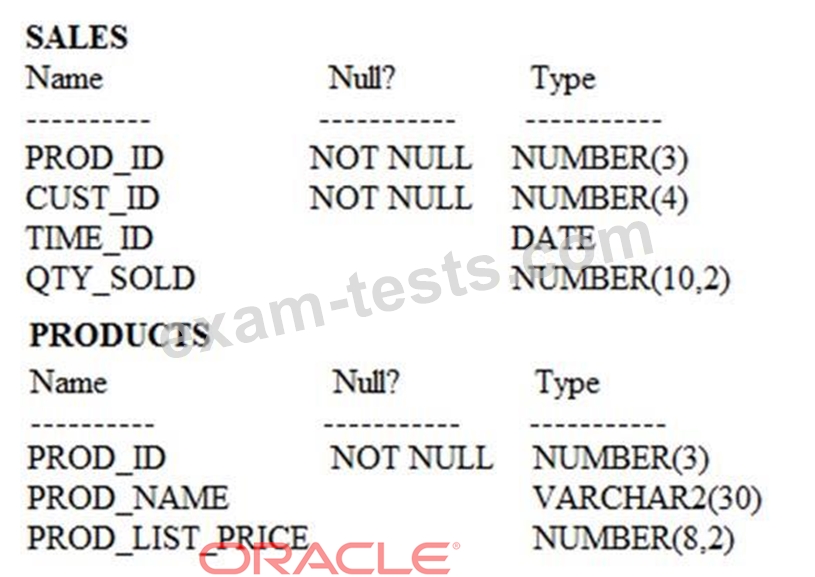
In the SALES table, PROD_ID is the foreign key referencing PROD_ID in the PRODUCTS table. You must list each product ID and the number of times it has been sold.
Examine this query which is missing a JOIN operator:
SQL > SELECT p.prod_id, count(s.prod_id)
FROM products p ______________ sales s
ON p.prod_id = s.prod_id
GROUP BY p.prod_id;
Which two JOIN operations can be used to obtain the required output?
In the SALES table, PROD_ID is the foreign key referencing PROD_ID in the PRODUCTS table. You must list each product ID and the number of times it has been sold.
Examine this query which is missing a JOIN operator:
SQL > SELECT p.prod_id, count(s.prod_id)
FROM products p ______________ sales s
ON p.prod_id = s.prod_id
GROUP BY p.prod_id;
Which two JOIN operations can be used to obtain the required output?
Question 55
In which three situations does a transaction complete? (Choose three.)