

Question 86
The PRODUCTStable has the following structure.
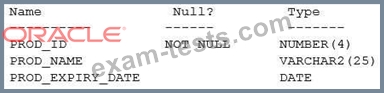
Evaluate the following two SQL statements:
SQL>SELECT prod_id, NVL2 (prod_expiry_date, prod_expiry_date + 15, ' ') FROM products; SQL>SELECT prod_id, NVL (prod_expiry_date, prod_expiry_date + 15) FROM products; Which statement is true regarding the outcome?
Evaluate the following two SQL statements:
SQL>SELECT prod_id, NVL2 (prod_expiry_date, prod_expiry_date + 15, ' ') FROM products; SQL>SELECT prod_id, NVL (prod_expiry_date, prod_expiry_date + 15) FROM products; Which statement is true regarding the outcome?
Question 87
Which two are true about the MERGE statement?
Question 88
Examine the description or the BOOKS_TRANSACTIONS table:

FOR customers whose income level has a value, you want to display the first name and due amount as 5% of their credit limit. Customers whose due amount is null should not be displayed.
Which query should be used?
FOR customers whose income level has a value, you want to display the first name and due amount as 5% of their credit limit. Customers whose due amount is null should not be displayed.
Which query should be used?
Question 89
View the Exhibits and examine PRODUCTSand SALES tables.
Exhibit 1
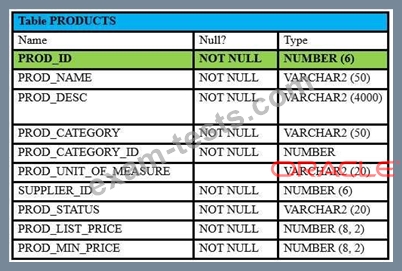
Exhibit 2

You issue the following query to display product name the number of times the product has been sold:

What happens when the above statement is executed?
Exhibit 1
Exhibit 2
You issue the following query to display product name the number of times the product has been sold:
What happens when the above statement is executed?
Question 90
Which two queries will result in an error?