

Question 211
Which three statements are true about built-in data types?
Question 212
Examine this SQL statement:

Which two are true?
Which two are true?
Question 213
Which two statements are true about the DUAL table?
Question 214
View the Exhibit and examine the structures of the employees and departments tables.
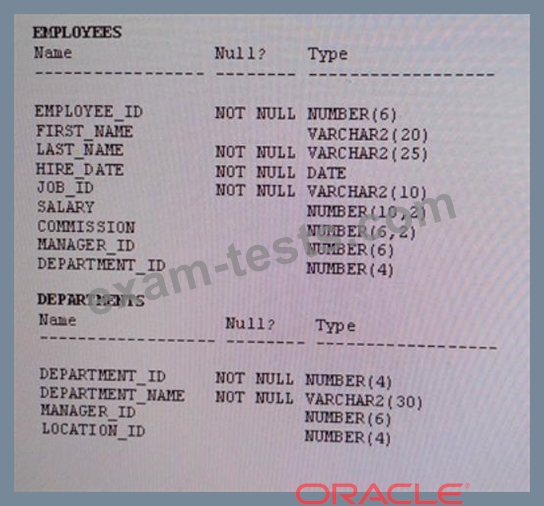
You must update the employees table according to these requirements::
-Update only those employees who work in Boston or Seattle (locations 2900 and 2700).
-Set department_id for these employees to the department id corresponding to London (locationid 2100).
-Set the employees' salary in iocation_id 2100 to 1.1 times the average salary of their department.
-Set the employees' commission In location_id 2100 to 1.5 times the average commission of their department.
You issue this command:
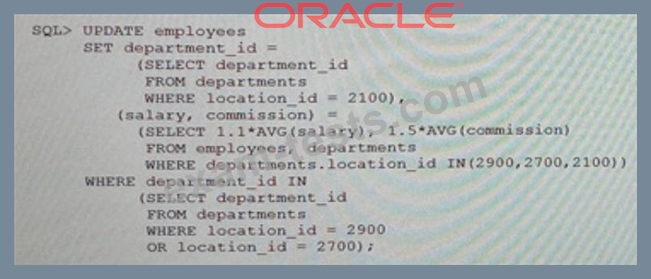
What is the result?
You must update the employees table according to these requirements::
-Update only those employees who work in Boston or Seattle (locations 2900 and 2700).
-Set department_id for these employees to the department id corresponding to London (locationid 2100).
-Set the employees' salary in iocation_id 2100 to 1.1 times the average salary of their department.
-Set the employees' commission In location_id 2100 to 1.5 times the average commission of their department.
You issue this command:
What is the result?
Question 215
Examine this query:
SELECT employee_id,first_name,salary
FROM employees
WHERE hire_date>'&1';
Which two methods should you use to prevent prompting for a hire date value when this query is executed?
SELECT employee_id,first_name,salary
FROM employees
WHERE hire_date>'&1';
Which two methods should you use to prevent prompting for a hire date value when this query is executed?