

Question 1
Which two statements are true regarding Spring and Spring Boot Testing? (Choose two.)
Question 2
Which two statements are correct regarding Spring Boot auto-configuration customization? (Choose two.)
Question 3
Refer to the exhibit.
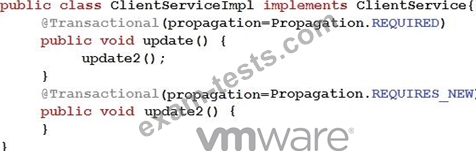
Assume that the application is using Spring transaction management which uses Spring AOP internally.
Choose the statement that describes what is happening when the update1 method is called? (Choose the best answer.)
Assume that the application is using Spring transaction management which uses Spring AOP internally.
Choose the statement that describes what is happening when the update1 method is called? (Choose the best answer.)
Question 4
Which two statements are correct regarding the @EnableAutoConfiguration annotation? (Choose two.)
Question 5
Which two use cases can be addressed by the method level security annotation @PreAuthorize? (Choose two.)
The two statements that are true regarding Spring and Spring Boot Testing are:
B. Integration and slice testing are both supported. Spring and Spring Boot provide support for integration testing, which involves testing the application in a realistic environment that closely resembles the production environment. Spring Boot also provides support for slice testing, which allows you to test specific slices of the application, such as web layers or data layers.
E. @SpringBootTest or @SpringJUnitConfig can be used for creating an ApplicationContext. Both @SpringBootTest and @SpringJUnitConfig can be used to create an ApplicationContext in a Spring-based application, which is necessary for testing Spring-based components and features. @SpringBootTest is typically used for integration testing, while @SpringJUnitConfig is used for unit testing.