

Question 1
Refer to the exhibit. An engineer has configured a spoke to connect to a FlexVPN hub. The tunnel is up, but pings fail when the engineer attempts to reach host 192.168.200.10 behind the spoke, and traffic is sourced from host 192.168.100.3, which is behind the FlexVPN server.
Based on packet captures, the engineer discovers that host 192.168.200.10 receives the icmp echo and sends an icmp reply that makes it to the inside interface of the spoke. Based on the output in the exhibit captured on the spoke by the engineer, which action resolves this issue?
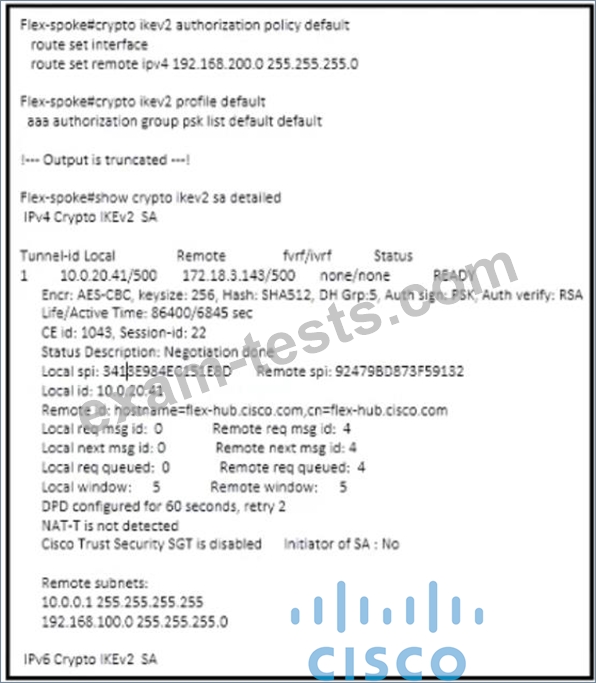
Based on packet captures, the engineer discovers that host 192.168.200.10 receives the icmp echo and sends an icmp reply that makes it to the inside interface of the spoke. Based on the output in the exhibit captured on the spoke by the engineer, which action resolves this issue?
Question 2
A network engineer is configuring a server. The router will terminate encrypted VPN connections on g0/0, which is in the VRF "Internet". The clear-text traffic that must be encrypted before being sent out traverses g0/1, which is in the VRF "Internal". Which two VRF-specific configurations allow VPN traffic to traverse the VRF-aware interfaces? (Choose two.)
Question 3
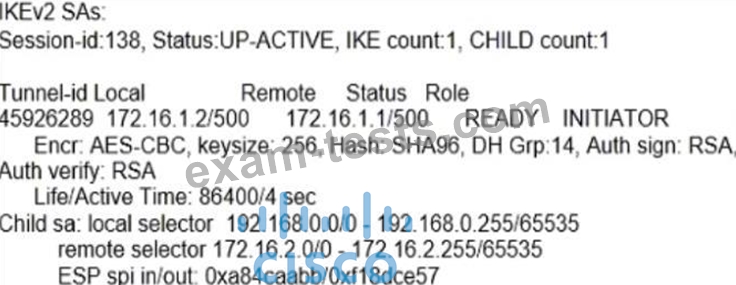
Refer to the exhibit. A Cisco ASA is configured as a client to a router running as a FlexVPN server. The router is configured with a virtual template to terminate FlexVPN clients. Traffic between networks 192.168.0.0/24 and 172.16.20.0/24 does not work as expected. Based on the show crypto ikev2 sa output collected from the Cisco ASA in the exhibit, what is the solution to this issue?
Question 4
Users are getting untrusted server warnings when they connect to the URL https://asa.lab from their browsers. This URL resolves to 192.168.10.10, which is the IP address for a Cisco ASA configured for a clientless VPN. The VPN was recently set up and issued a certificate from an internal CA server. Users can connect to the VPN by ignoring the message, however, when users access other webservers that use certificates issued by the same internal CA server, they do not experience this issue. Which action resolves this issue?
Question 5
Refer to the exhibit.
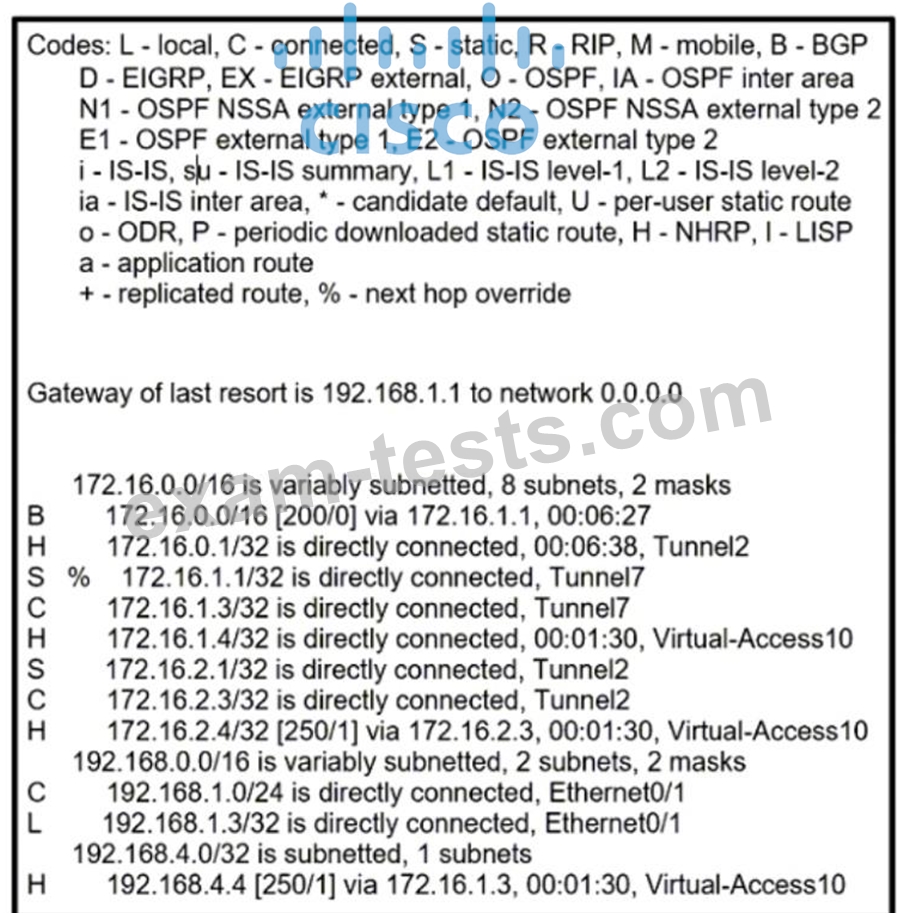
Given the output of the show ip route command, which remote access VPN technology is in use?
Given the output of the show ip route command, which remote access VPN technology is in use?