

Question 6
Refer to the exhibit.
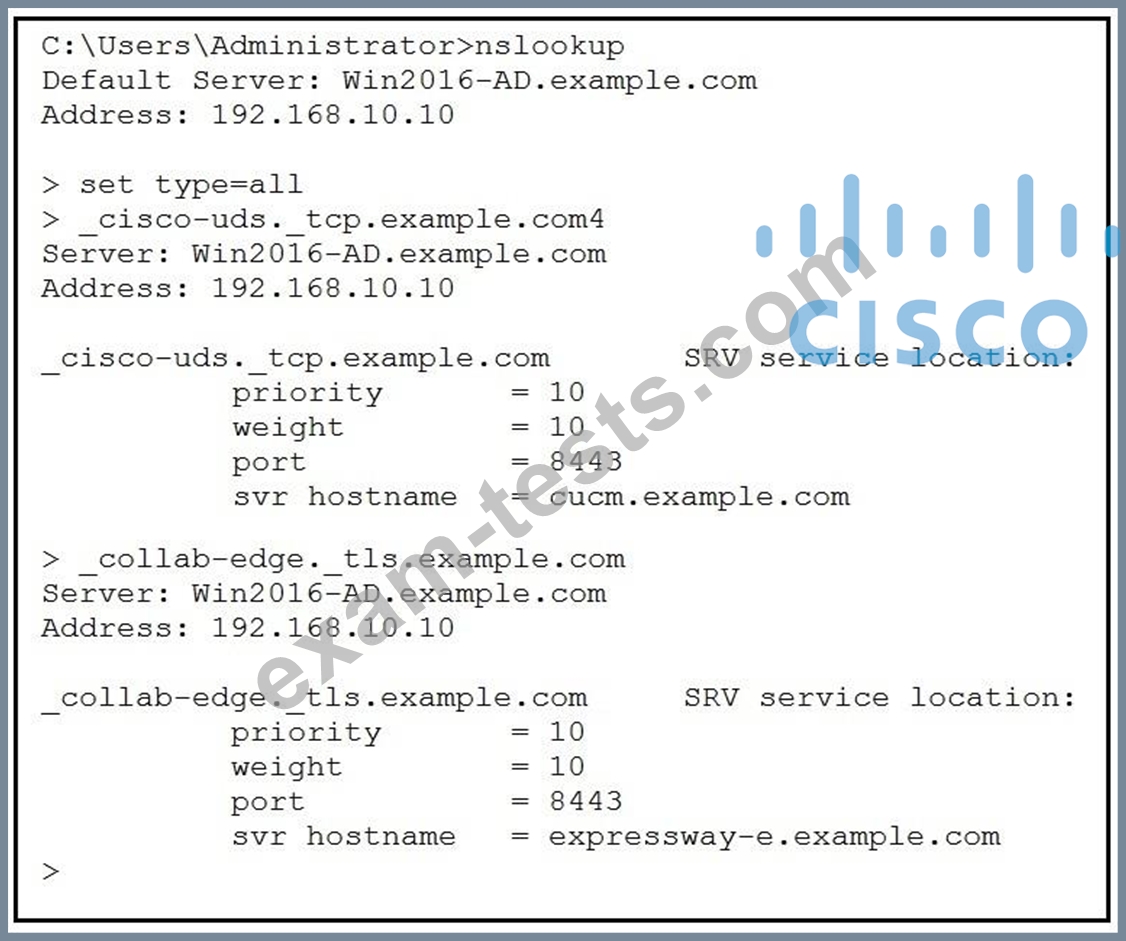
When a Jabber user attempts to connect from outside of the organization, the user enters the login information as "[email protected]" and receives the error "Cannot find your services Automatically". The engineer tries to resolve SRV records used by Jabber.
DNS A record "expressway-e.example.com" points to the Expressway-E IP and "cucm.example.com" points to the Cisco Unified Communications Manager.
Which change resolves the DNS problem?
When a Jabber user attempts to connect from outside of the organization, the user enters the login information as "[email protected]" and receives the error "Cannot find your services Automatically". The engineer tries to resolve SRV records used by Jabber.
DNS A record "expressway-e.example.com" points to the Expressway-E IP and "cucm.example.com" points to the Cisco Unified Communications Manager.
Which change resolves the DNS problem?
Question 7
An Expressway-E is configured using a single NIC with NAT.
How must the Expressway-C traversal client zone be configured to connect to the Expressway-E?
How must the Expressway-C traversal client zone be configured to connect to the Expressway-E?
Question 8
Refer to the exhibit.
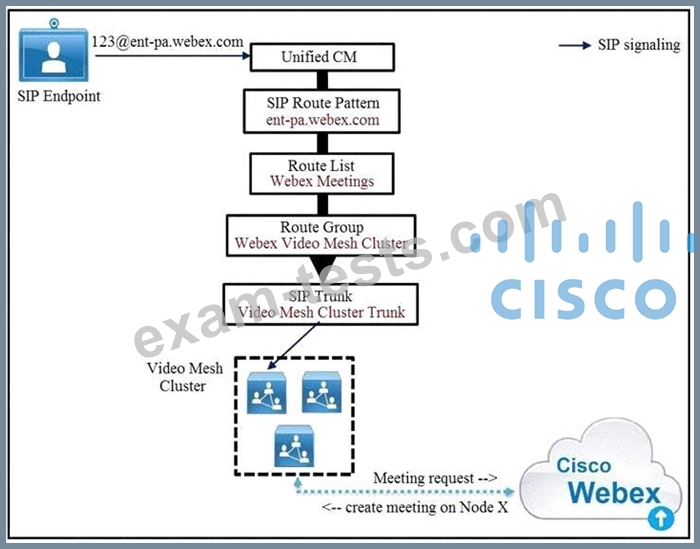
Cisco Unified Communications Manager routes the call via the Webex Meetings route list and route group to the Video Mesh cluster Node#1 in the Video Mesh cluster is hosting the meeting and has reached full capacity, but other nodes in the cluster still have spare capacity.
What happens to the participant's call?
Cisco Unified Communications Manager routes the call via the Webex Meetings route list and route group to the Video Mesh cluster Node#1 in the Video Mesh cluster is hosting the meeting and has reached full capacity, but other nodes in the cluster still have spare capacity.
What happens to the participant's call?
Question 9
Which statement about scheduling Expressway backups is true?
Question 10
In a Mobile and Remote Access deployment, where must communications be encrypted with TLS?