

Question 106
Refer to the exhibit.

The LTM devices LTM3 and LTM2 have four Traffic Groups defined with approximately the sar of failover objects defined in each group.
- Traffic Groups A and C have Default Device set to LTM1
- Traffic Groups Band D have Default Device set to LTM2.
- Traffic Groups B and C do NOT have Auto Failback enabled. TrafficGroups A and D have Auto Failback enabled with a timeout value of 60 seconds.
- Traffic Groups A and D have Auto Fallback enabled with a timeout value of 60 seconds.
Both LTM devices are healthy and able to pass traffic for any Traffic Group.
LTM1 loses connectivity on interface 1.4. The LTM Specialists notified 60 seconds after the interface goes down.
What is the state of the Traffic Groups on each LTM device?
The LTM devices LTM3 and LTM2 have four Traffic Groups defined with approximately the sar of failover objects defined in each group.
- Traffic Groups A and C have Default Device set to LTM1
- Traffic Groups Band D have Default Device set to LTM2.
- Traffic Groups B and C do NOT have Auto Failback enabled. TrafficGroups A and D have Auto Failback enabled with a timeout value of 60 seconds.
- Traffic Groups A and D have Auto Fallback enabled with a timeout value of 60 seconds.
Both LTM devices are healthy and able to pass traffic for any Traffic Group.
LTM1 loses connectivity on interface 1.4. The LTM Specialists notified 60 seconds after the interface goes down.
What is the state of the Traffic Groups on each LTM device?
Question 107
In an iApp, which configuration protects against accidental changes to an application Services configuration?
Question 108
-- Exhibit -
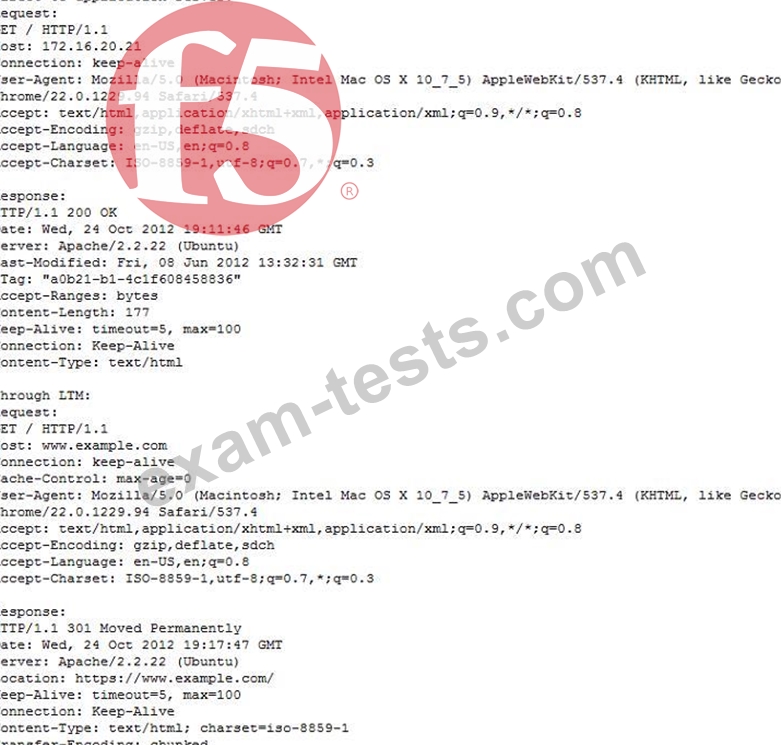
-- Exhibit --
Refer to the exhibit.
An LTM Specialist has created a virtual server to balance connections to a pool of application servers and offload SSL decryption. Clients connect to the application at https://www.example.com/. The virtual server is configured with a clientssl profile but no serverssl profile. The application servers are listening on ports 80 and
443. Users are unable to connect to the application through the virtual server but are able to connect directly to the application server.
What is the root cause of the error?
-- Exhibit --
Refer to the exhibit.
An LTM Specialist has created a virtual server to balance connections to a pool of application servers and offload SSL decryption. Clients connect to the application at https://www.example.com/. The virtual server is configured with a clientssl profile but no serverssl profile. The application servers are listening on ports 80 and
443. Users are unable to connect to the application through the virtual server but are able to connect directly to the application server.
What is the root cause of the error?
Question 109
An LTM Specialist has just manually failed the active LTM device over to the standby LTM device. The LTM Specialist notices the newly active LTM device is NOT currently receiving traffic. The LTM Specialist verifies the newly active device is responding to ARP but still no traffic is hitting the virtual servers. The LTM Specialist also notices that the virtual servers eventually start responding.
What should be added to the configuration to resolve the problem?
What should be added to the configuration to resolve the problem?
Question 110
A 8IG-IP device is replaced with an RMA device. The BIG-IP Administrator renews the license and tries to restore the configuration from a previously generated UCS archive on the RMA device. The device configuration is NOT fully loading. What is causing the configuration load to fail?