Which of the following is a correct flow of the stages in an incident handling and response (IH&R) process?
Correct Answer: B
The correct flow of stages in an Incident Handling and Response (IH&R) process typically follows a structured approach that begins with Preparation, which is crucial for an effective response to incidents. This is followed by Incident Recording, where details of the incident are documented. Incident Triage is the next stage, where incidents are prioritized based on their impact. Containment strategies are then employed to limit the spread of the incident. Eradication involves removing the threat from the affected systems. Recovery is the process of restoring systems to normal operation. Finally, Post-Incident Activities involve learning from the incident and improving future response efforts. References: The stages of the IH&R process are outlined in various EC-Council resources, including the EC-Council's Certified Incident Handler (E|CIH) program and related training materials, which emphasize the importance of a structured and methodical approach to incident handling and response123.
Question 2
Which of the following attack can be eradicated by converting all non-alphanumeric characters to HTML character entities before displaying the user input in search engines and forums?
Correct Answer: C
Converting all non-alphanumeric characters to HTML character entities is a common defense against Cross-Site Scripting (XSS) attacks. Here's how it works: * User Input Sanitization: When user input is received, the system converts characters like <, >, &, ', and " into their corresponding HTML entities (e.g., <, >, &, ', and "). * Preventing Script Execution: By converting these characters, the system prevents potentially malicious scripts from being executed in the browser of anyone viewing the content. * Maintaining Data Integrity: This process allows user-generated content to be displayed without altering the intended message while ensuring the content cannot harm other users or the system. References: * EC-Council's Certified SOC Analyst (C|SA) course material covers various cybersecurity threats, including XSS attacks, and the methods used to mitigate them. * The study guides and resources provided by EC-Council for the SOC Analyst certification include detailed explanations of XSS attacks and the importance of sanitizing user input to prevent such vulnerabilities1234
Question 3
Which of the following service provides phishing protection and content filtering to manage the Internet experience on and off your network with the acceptable use or compliance policies?
Correct Answer: C
OpenDNS provides extensive phishing protection and content filtering services. It operates by enforcing internet use policies on and off the network, ensuring that users adhere to acceptable use and compliance policies. Here's how OpenDNS achieves this: * Phishing Protection: OpenDNS uses predictive security to anticipate and prevent threats before they can reach the network. It does this by using DNS to enforce security, which is often quicker and more effective than traditional methods. * Content Filtering: OpenDNS allows the network administrator to block unwanted content categories, thus enforcing compliance with organizational policies. This is done through DNS queries, which are checked against OpenDNS's database to ensure they comply with the set policies. * Off-Network Protection: OpenDNS's roaming client allows the same level of protection and filtering even when devices are not connected to the company network, ensuring consistent enforcement of policies. References: * EC-Council's Certified SOC Analyst (C|SA) program provides training and certification for SOC analysts, covering the fundamentals of SOC operations, including phishing protection and content filtering 1. * Additional resources and study guides from the EC-Council elaborate on the role of SOC analysts and the tools they use, including services like OpenDNS for maintaining network security and integrity 23.
Question 4
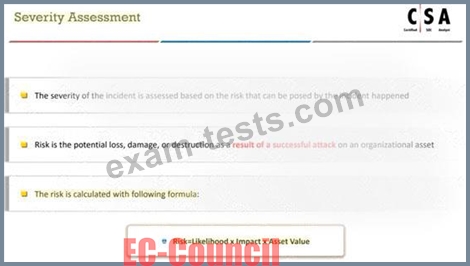
Which of the following formula represents the risk?
Correct Answer: D
Question 5
Which of the following fields in Windows logs defines the type of event occurred, such as Correlation Hint, Response Time, SQM, WDI Context, and so on?
Correct Answer: B
The Task Category in Windows logs is used to define the type of event that has occurred. It is a subcategory within the event itself that provides additional context about the event, such as whether it is a Correlation Hint, Response Time, SQM, WDI Context, etc. This categorization helps in filtering and identifying events based on their nature and type. References: The information is verified as per the SOC Analyst documents and learning resources provided by EC-Council, which emphasize the importance of understanding log management and correlation within a SOC environment12. Additionally, the definition and role of the Task Category field in Windows logs are supported by technical documentation and resources that describe the structure and use of Windows event logs34.