David is a SOC analyst in Karen Tech. One day an attack is initiated by the intruders but David was not able to find any suspicious events. This type of incident is categorized into?
Correct Answer: D
A false negative incident in the context of a Security Operations Center (SOC) is when an actual attack or intrusion occurs, but the SOC analyst fails to detect any suspicious events or indicators of compromise. This means that the security measures in place did not work as intended, and the attack went unnoticed. In David's case, since an attack was initiated and he was not able to find any suspicious events, it is categorized as a false negative incident. This is a critical type of incident because it indicates a failure in the detection capabilities of the SOC, potentially allowing the intruder to cause harm without being detected. References: The categorization of incidents is a fundamental part of the SOC Analyst's role, as outlined in the EC-Council's Certified SOC Analyst (CSA) training and certification program. The program covers the different types of incidents that can be encountered in a SOC, including true positives, false positives, true negatives, and false negatives, and how to identify and respond to each12345.
Question 42
Which of the following threat intelligence helps cyber securityprofessionals such as security operations managers, network operations center and incident responders to understand how the adversaries are expected to perform the attack on the organization, and the technical capabilities and goals of the attackers along with the attack vectors?
Correct Answer: B
Operational Threat Intelligence is focused on the specifics of imminent orongoing attacks. It provides insights into the nature of the threat, the identity of the attackers (if known), their motivation, capabilities, and objectives, as well as the tactics, techniques, and procedures (TTPs) they are likely to use. This type of intelligence is crucial for security operations managers, network operations center personnel, and incident responders because it allows them to understand and anticipate the attackers' moves, prepare specific defenses, and respond effectively to incidents. References: The EC-Council's Certified Threat Intelligence Analyst (C|TIA) program covers the use of Operational Threat Intelligence within a SOC environment. The program emphasizes the importance of understanding and utilizing threat intelligence to predict and mitigate cyber threats. The Certified SOC Analyst (C|SA) training also discusses the role of threat intelligence in SOC operations, including Operational Threat Intelligence12. Reference: https://info-savvy.com/types-of-threat-intelligence/
Question 43
SecureTech Solutions, a managed security service provider (MSSP), is optimizing its log management architecture to enhance log storage, retrieval, and analysis efficiency. The SOC team needs logs stored in a structured or semi-structured format for easy parsing, querying, and correlation. They choose a format that organizes data in a text file in a tabular structure, where each log entry is stored in rows and columns, and that supports easy export to databases or spreadsheet analysis while maintaining readability. Which log format should they choose?
Correct Answer: A
CSV is a structured, tabular text format where each record is a row and fields are separated by commas, making it easy to parse, import into spreadsheets, and export into databases. The scenario specifically calls for a text file with rows and columns, readability, and easy export to databases or spreadsheet-based analysis- these are classic CSV strengths. Cloud storage is a storage location/architecture, not a log format. Syslog is a transport and message format family used for sending event messages from systems and network devices; it is often semi-structured but not inherently "rows and columns" in a tabular file structure. A database is a storage system rather than a file format; while logs can be stored in databases, the question asks specifically for a text file format. In SOC practice, CSV is commonly used for exporting specific datasets for reporting, offline analysis, and sharing with stakeholders, especially when interoperability is needed. For high-scale SIEM ingestion, formats like JSON are often preferred, but given the explicit requirement for a tabular text file compatible with spreadsheets, CSV is the correct choice.
Question 44
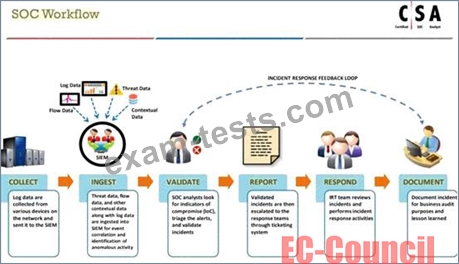
What is the correct sequence of SOC Workflow?
Correct Answer: D
Question 45
A mid-sized healthcare organization is facing frequent phishing and ransomware attacks. They lack an internal SOC and want proactive threat detection and response capabilities. Compliance with HIPAA regulations is essential. The organization seeks a solution that includes both monitoring and rapid response to incidents. Which service best meets their needs?
Correct Answer: C
Managed Detection and Response (MDR) best fits because it typically includes proactive threat hunting, continuous monitoring, and direct incident containment actions-exactly what an organization without an internal SOC needs when facing active phishing and ransomware threats. MDR providers usually operate with EDR/XDR-style telemetry, enabling rapid endpoint isolation, malicious process containment, and guided remediation, which is critical for ransomware where time-to-containment determines impact. An MSSP focused on log monitoring and escalation may provide visibility and alerting but often stops at notifying or ticketing rather than performing containment actions, which can slow response. A self-hosted SIEM with in- house analysts contradicts the constraint "lack an internal SOC" and requires significant staffing and engineering to be effective. A cloud SIEM with MSSP-managed services can be viable, but the question emphasizes proactive detection and response; MDR is the most directly aligned service model for hands-on containment and active hunting. For HIPAA, MDR also supports incident documentation, monitoring evidence, and response coordination, which helps meet regulatory expectations for safeguarding and incident handling.