You are working at Tech Solutions, a global technology firm. Your team detects an adversary attempting to bypass authentication controls and escalate privileges within the enterprise network. To counter the threat, you implement credential encryption, behavioral analytics, and process isolation. Your approach follows a structured framework that systematically maps defensive techniques to known adversarial tactics, allowing you to anticipate and mitigate evolving cyber threats. Which framework did you choose to apply in this scenario?
Correct Answer: B
MITRE D3FEND is specifically designed to map defensive techniques to offensive adversary behaviors and tactics. In SOC and detection engineering, it provides a structured defensive ontology: you can identify an adversary technique (credential access, privilege escalation, defense evasion) and then select defensive countermeasures such as credential hardening, process isolation, monitoring/behavior analytics, and access control enforcement. The scenario describes a framework that "systematically maps defensive techniques to known adversarial tactics," which aligns directly with D3FEND's purpose. The other options are broader governance or maturity models rather than a defensive technique-mapping framework. Systems Security Engineering CMM and Cybersecurity Capability Maturity Models focus on process maturity and organizational capability development, not on mapping defensive controls to adversary behavior at a technique level. NIST CSF 2.0 is a high-level cybersecurity risk management framework organized around functions (govern, identify, protect, detect, respond, recover); it guides program structure but does not provide the same granular defensive technique taxonomy. Therefore, MITRE D3FEND is the correct choice for a structured, technique-to-defense mapping approach.
Question 117
In a large corporation, the HR department receives an urgent email from someone impersonating a high-level executive, requesting immediate transfer of sensitive employee data. The email includes an official-looking document and a phone number for verification. Feeling pressured, the HR manager calls the number and "confirms" the request, then transfers the data. Investigation later confirms the email was fraudulent and the executive had no knowledge of the request. What type of attack did the HR department face?
Correct Answer: C
This is a social engineering attack because the adversary manipulated human trust and urgency to induce an unauthorized action: the transfer of sensitive employee data. The attacker used impersonation, authority pressure (executive pretext), and a controlled "verification" channel (the attacker's phone number) to make the request appear legitimate. These are hallmark social engineering techniques, and in many organizations this is categorized under business email compromise (BEC) or executive impersonation fraud. Credential theft is not the primary outcome described; the attacker did not need passwords if they could convince HR to release data directly. Web-based intrusion and application exploit refer to technical exploitation of systems, which is not indicated. From a SOC response perspective, handling social engineering incidents includes immediate containment (stop further transfers, notify legal/HR, preserve email evidence), scoping who else received similar requests, and implementing process controls: out-of-band verification using known trusted channels, call-back procedures, dual approval for sensitive requests, and training to recognize urgency-based manipulation. Therefore, "Social engineering attack" is the correct classification.
Question 118
You are working as a SOC analyst in a multinational company with multiple data centers and remote offices. Security logs are stored locally at each site, making it difficult to correlate incidents across different locations. Recently, an advanced persistent threat (APT) compromised multiple servers, but due to multiple sources of logs and inconsistent monitoring, the attack was detected only after significant data exfiltration. To improve visibility, streamline log analysis, and enable faster incident response, you need to implement a solution that aggregates logs from all sources into a unified system. Which solution will you implement?
Correct Answer: A
Centralized logging is the foundation for enterprise-wide visibility and correlation. When logs remain local at each site, SOC analysts lose the ability to quickly pivot across systems, detect multi-stage attacks, and correlate signals (for example, an identity compromise at one location leading to lateral movement and exfiltration at another). Centralizing logs into a SIEM or log analytics platform standardizes ingestion, parsing, retention, and search, enabling consistent detections and faster triage. It also improves incident response by providing a single source of truth for timelines and scoping. Distributed logging and local logging keep data fragmented; even if collection exists, the lack of central correlation slows investigations and increases blind spots-exactly what the scenario describes. "Event tracing" is typically an internal diagnostic /telemetry method (often application or OS-level tracing) and is not the overarching architectural solution for aggregating logs across multiple sites. For SOC operations, centralized logging also supports governance and compliance by enforcing retention, access controls, and audit trails, and it enables consistent alerting and reporting across the entire environment.
Question 119
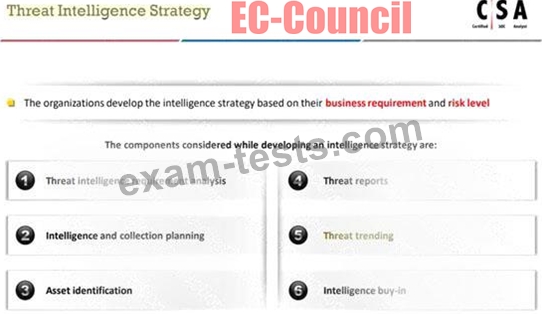
Shawn is a security manager working at Lee Inc Solution. His organization wants to develop threat intelligent strategy plan. As a part of threat intelligent strategy plan, he suggested various components, such as threat intelligence requirement analysis, intelligence and collection planning, asset identification, threat reports, and intelligence buy-in. Which one of the following components he should include in the above threat intelligent strategy plan to make it effective?
Correct Answer: B
Question 120
Which of the following Windows features is used to enable Security Auditing in Windows?
Correct Answer: C
To enable Security Auditing in Windows, the Local Group Policy Editor is used. This feature allows administrators to configure security policies and audit settings on a local computer. Here's how you can enable Security Auditing using the Local Group Policy Editor: * Press Win + R, type gpedit.msc, and press Enter to open the Local Group Policy Editor. * Navigate to Computer Configuration -> Windows Settings -> Security Settings -> Local Policies -> Audit Policy. * Here, you will find a list of audit policies that you can configure for both success and failure events. * By enabling these policies, you can specify which security-related events you want to audit, such as account logon events, object access, policy change, privilege use, and more. References: The process described above is aligned with the best practices and guidelines provided by Microsoft and other authoritative sources on Windows security auditing, such as: * Microsoft's official documentation on Security Auditing1. * Guides on how to enable Security Auditing in Active Directory environments2. * Articles detailing the essentials of Windows event log security auditing3. These references are part of the learning resources for the EC-Council SOC Analyst course and provide comprehensive information on the subject.