
- Home
- Cisco Certification
- 350-701 Exam
- Cisco.350-701.v2022-07-08.q453 Practice Test

Question 171
Which two activities can be done using Cisco DNA Center? (Choose two)
Correct Answer: B,E
Cisco DNA Center has four general sections aligned to IT workflows:
Design: Design your network for consistent configurations by device and by site. Physical maps and logical topologies help provide quick visual reference. The direct import feature brings in existing maps, images, and topologies directly from Cisco Prime Infrastructure and the Cisco Application Policy Infrastructure Controller Enterprise Module (APIC-EM), making upgrades easy and quick. Device configurations by site can be consolidated in a "golden image" that can be used to automatically provision new network devices. These new devices can either be pre-staged by associating the device details and mapping to a site. Or they can be claimed upon connection and mapped to the site.
Policy: Translate business intent into network policies and apply those policies, such as access control, traffic routing, and quality of service, consistently over the entire wired and wireless infrastructure. Policy-based access control and network segmentation is a critical function of the Cisco Software-Defined Access (SDAccess) solution built from Cisco DNA Center and Cisco Identity Services Engine (ISE). Cisco AI Network Analytics and Cisco Group-Based Policy Analytics running in the Cisco DNA Center identify endpoints, group similar endpoints, and determine group communication behavior. Cisco DNA Center then facilitates creating policies that determine the form of communication allowed between and within members of each group. ISE then activates the underlying infrastructure and segments the network creating a virtual overlay to follow these policies consistently. Such segmenting implements zero-trust security in the workplace, reduces risk, contains threats, and helps verify regulatory compliance by giving endpoints just the right level of access they need.
Provision: Once you have created policies in Cisco DNA Center, provisioning is a simple drag-and-drop task.
The profiles (called scalable group tags or "SGTs") in the Cisco DNA Center inventory list are assigned a policy, and this policy will always follow the identity. The process is completely automated and zero-touch. New devices added to the network are assigned to an SGT based on identity-greatly facilitating remote office setups.
Assurance: Cisco DNA Assurance, using AI/ML, enables every point on the network to become a sensor, sending continuous streaming telemetry on application performance and user connectivity in real time. The clean and simple dashboard shows detailed network health and flags issues. Then, guided remediation automates resolution to keep your network performing at its optimal with less mundane troubleshooting work.
The outcome is a consistent experience and proactive optimization of your network, with less time spent on troubleshooting tasks.
Cisco DNA Center has four general sections aligned to IT workflows:
Design: Design your network for consistent configurations by device and by site. Physical maps and logical topologies help provide quick visual reference. The direct import feature brings in existing maps, images, and topologies directly from Cisco Prime Infrastructure and the Cisco Application Policy Infrastructure Controller Enterprise Module (APIC-EM), making upgrades easy and quick. Device configurations by site can be consolidated in a "golden image" that can be used to automatically provision new network devices. These new devices can either be pre-staged by associating the device details and mapping to a site. Or they can be claimed upon connection and mapped to the site.
Policy: Translate business intent into network policies and apply those policies, such as access control, traffic routing, and quality of service, consistently over the entire wired and wireless infrastructure. Policy-based access control and network segmentation is a critical function of the Cisco Software-Defined Access (SDAccess) solution built from Cisco DNA Center and Cisco Identity Services Engine (ISE). Cisco AI Network Analytics and Cisco Group-Based Policy Analytics running in the Cisco DNA Center identify endpoints, group similar endpoints, and determine group communication behavior. Cisco DNA Center then facilitates creating policies that determine the form of communication allowed between and within members of each group. ISE then activates the underlying infrastructure and segments the network creating a virtual overlay to follow these policies consistently. Such segmenting implements zero-trust security in the workplace, reduces risk, contains threats, and helps verify regulatory compliance by giving endpoints just the right level of access they need.
Provision: Once you have created policies in Cisco DNA Center, provisioning is a simple drag-and-drop task.
The profiles (called scalable group tags or "SGTs") in the Cisco DNA Center inventory list are assigned a policy, and this policy will always follow the identity. The process is completely automated and zero-touch. New devices added to the network are assigned to an SGT based on identity-greatly facilitating remote office setups.
Assurance: Cisco DNA Assurance, using AI/ML, enables every point on the network to become a sensor, sending continuous streaming telemetry on application performance and user connectivity in real time. The clean and simple dashboard shows detailed network health and flags issues. Then, guided remediation automates resolution to keep your network performing at its optimal with less mundane troubleshooting work.
The outcome is a consistent experience and proactive optimization of your network, with less time spent on troubleshooting tasks.
Reference:
Cisco DNA Center has four general sections aligned to IT workflows:
Design: Design your network for consistent configurations by device and by site. Physical maps and logical topologies help provide quick visual reference. The direct import feature brings in existing maps, images, and topologies directly from Cisco Prime Infrastructure and the Cisco Application Policy Infrastructure Controller Enterprise Module (APIC-EM), making upgrades easy and quick. Device configurations by site can be consolidated in a "golden image" that can be used to automatically provision new network devices. These new devices can either be pre-staged by associating the device details and mapping to a site. Or they can be claimed upon connection and mapped to the site.
Policy: Translate business intent into network policies and apply those policies, such as access control, traffic routing, and quality of service, consistently over the entire wired and wireless infrastructure. Policy-based access control and network segmentation is a critical function of the Cisco Software-Defined Access (SDAccess) solution built from Cisco DNA Center and Cisco Identity Services Engine (ISE). Cisco AI Network Analytics and Cisco Group-Based Policy Analytics running in the Cisco DNA Center identify endpoints, group similar endpoints, and determine group communication behavior. Cisco DNA Center then facilitates creating policies that determine the form of communication allowed between and within members of each group. ISE then activates the underlying infrastructure and segments the network creating a virtual overlay to follow these policies consistently. Such segmenting implements zero-trust security in the workplace, reduces risk, contains threats, and helps verify regulatory compliance by giving endpoints just the right level of access they need.
Provision: Once you have created policies in Cisco DNA Center, provisioning is a simple drag-and-drop task.
The profiles (called scalable group tags or "SGTs") in the Cisco DNA Center inventory list are assigned a policy, and this policy will always follow the identity. The process is completely automated and zero-touch. New devices added to the network are assigned to an SGT based on identity-greatly facilitating remote office setups.
Assurance: Cisco DNA Assurance, using AI/ML, enables every point on the network to become a sensor, sending continuous streaming telemetry on application performance and user connectivity in real time. The clean and simple dashboard shows detailed network health and flags issues. Then, guided remediation automates resolution to keep your network performing at its optimal with less mundane troubleshooting work.
The outcome is a consistent experience and proactive optimization of your network, with less time spent on troubleshooting tasks.
Design: Design your network for consistent configurations by device and by site. Physical maps and logical topologies help provide quick visual reference. The direct import feature brings in existing maps, images, and topologies directly from Cisco Prime Infrastructure and the Cisco Application Policy Infrastructure Controller Enterprise Module (APIC-EM), making upgrades easy and quick. Device configurations by site can be consolidated in a "golden image" that can be used to automatically provision new network devices. These new devices can either be pre-staged by associating the device details and mapping to a site. Or they can be claimed upon connection and mapped to the site.
Policy: Translate business intent into network policies and apply those policies, such as access control, traffic routing, and quality of service, consistently over the entire wired and wireless infrastructure. Policy-based access control and network segmentation is a critical function of the Cisco Software-Defined Access (SDAccess) solution built from Cisco DNA Center and Cisco Identity Services Engine (ISE). Cisco AI Network Analytics and Cisco Group-Based Policy Analytics running in the Cisco DNA Center identify endpoints, group similar endpoints, and determine group communication behavior. Cisco DNA Center then facilitates creating policies that determine the form of communication allowed between and within members of each group. ISE then activates the underlying infrastructure and segments the network creating a virtual overlay to follow these policies consistently. Such segmenting implements zero-trust security in the workplace, reduces risk, contains threats, and helps verify regulatory compliance by giving endpoints just the right level of access they need.
Provision: Once you have created policies in Cisco DNA Center, provisioning is a simple drag-and-drop task.
The profiles (called scalable group tags or "SGTs") in the Cisco DNA Center inventory list are assigned a policy, and this policy will always follow the identity. The process is completely automated and zero-touch. New devices added to the network are assigned to an SGT based on identity-greatly facilitating remote office setups.
Assurance: Cisco DNA Assurance, using AI/ML, enables every point on the network to become a sensor, sending continuous streaming telemetry on application performance and user connectivity in real time. The clean and simple dashboard shows detailed network health and flags issues. Then, guided remediation automates resolution to keep your network performing at its optimal with less mundane troubleshooting work.
The outcome is a consistent experience and proactive optimization of your network, with less time spent on troubleshooting tasks.
Cisco DNA Center has four general sections aligned to IT workflows:
Design: Design your network for consistent configurations by device and by site. Physical maps and logical topologies help provide quick visual reference. The direct import feature brings in existing maps, images, and topologies directly from Cisco Prime Infrastructure and the Cisco Application Policy Infrastructure Controller Enterprise Module (APIC-EM), making upgrades easy and quick. Device configurations by site can be consolidated in a "golden image" that can be used to automatically provision new network devices. These new devices can either be pre-staged by associating the device details and mapping to a site. Or they can be claimed upon connection and mapped to the site.
Policy: Translate business intent into network policies and apply those policies, such as access control, traffic routing, and quality of service, consistently over the entire wired and wireless infrastructure. Policy-based access control and network segmentation is a critical function of the Cisco Software-Defined Access (SDAccess) solution built from Cisco DNA Center and Cisco Identity Services Engine (ISE). Cisco AI Network Analytics and Cisco Group-Based Policy Analytics running in the Cisco DNA Center identify endpoints, group similar endpoints, and determine group communication behavior. Cisco DNA Center then facilitates creating policies that determine the form of communication allowed between and within members of each group. ISE then activates the underlying infrastructure and segments the network creating a virtual overlay to follow these policies consistently. Such segmenting implements zero-trust security in the workplace, reduces risk, contains threats, and helps verify regulatory compliance by giving endpoints just the right level of access they need.
Provision: Once you have created policies in Cisco DNA Center, provisioning is a simple drag-and-drop task.
The profiles (called scalable group tags or "SGTs") in the Cisco DNA Center inventory list are assigned a policy, and this policy will always follow the identity. The process is completely automated and zero-touch. New devices added to the network are assigned to an SGT based on identity-greatly facilitating remote office setups.
Assurance: Cisco DNA Assurance, using AI/ML, enables every point on the network to become a sensor, sending continuous streaming telemetry on application performance and user connectivity in real time. The clean and simple dashboard shows detailed network health and flags issues. Then, guided remediation automates resolution to keep your network performing at its optimal with less mundane troubleshooting work.
The outcome is a consistent experience and proactive optimization of your network, with less time spent on troubleshooting tasks.
Reference:
Cisco DNA Center has four general sections aligned to IT workflows:
Design: Design your network for consistent configurations by device and by site. Physical maps and logical topologies help provide quick visual reference. The direct import feature brings in existing maps, images, and topologies directly from Cisco Prime Infrastructure and the Cisco Application Policy Infrastructure Controller Enterprise Module (APIC-EM), making upgrades easy and quick. Device configurations by site can be consolidated in a "golden image" that can be used to automatically provision new network devices. These new devices can either be pre-staged by associating the device details and mapping to a site. Or they can be claimed upon connection and mapped to the site.
Policy: Translate business intent into network policies and apply those policies, such as access control, traffic routing, and quality of service, consistently over the entire wired and wireless infrastructure. Policy-based access control and network segmentation is a critical function of the Cisco Software-Defined Access (SDAccess) solution built from Cisco DNA Center and Cisco Identity Services Engine (ISE). Cisco AI Network Analytics and Cisco Group-Based Policy Analytics running in the Cisco DNA Center identify endpoints, group similar endpoints, and determine group communication behavior. Cisco DNA Center then facilitates creating policies that determine the form of communication allowed between and within members of each group. ISE then activates the underlying infrastructure and segments the network creating a virtual overlay to follow these policies consistently. Such segmenting implements zero-trust security in the workplace, reduces risk, contains threats, and helps verify regulatory compliance by giving endpoints just the right level of access they need.
Provision: Once you have created policies in Cisco DNA Center, provisioning is a simple drag-and-drop task.
The profiles (called scalable group tags or "SGTs") in the Cisco DNA Center inventory list are assigned a policy, and this policy will always follow the identity. The process is completely automated and zero-touch. New devices added to the network are assigned to an SGT based on identity-greatly facilitating remote office setups.
Assurance: Cisco DNA Assurance, using AI/ML, enables every point on the network to become a sensor, sending continuous streaming telemetry on application performance and user connectivity in real time. The clean and simple dashboard shows detailed network health and flags issues. Then, guided remediation automates resolution to keep your network performing at its optimal with less mundane troubleshooting work.
The outcome is a consistent experience and proactive optimization of your network, with less time spent on troubleshooting tasks.
Question 172
What is the function of Cisco Cloudlock for data security?
Correct Answer: A
Explanation/Reference: https://umbrella.cisco.com/products/casb
Question 173
A Cisco AMP for Endpoints administrator configures a custom detection policy to add specific MD5 signatures The configuration is created in the simple detection policy section, but it does not work What is the reason for this failure?
Correct Answer: A
Question 174
Which product allows Cisco FMC to push security intelligence observable to its sensors from other products?
Correct Answer: B
Explanation

https://www.cisco.com/c/en/us/support/docs/storage-networking/security/214859-configure-and-troubleshoot-cis
https://www.cisco.com/c/en/us/support/docs/storage-networking/security/214859-configure-and-troubleshoot-cis
Question 175
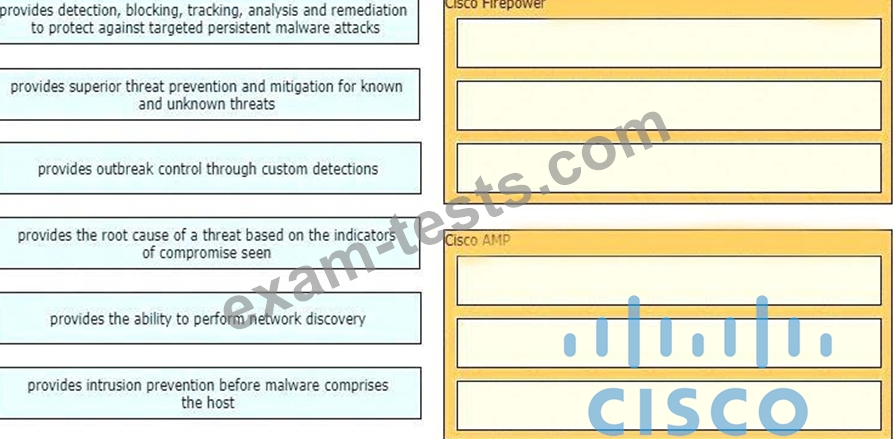
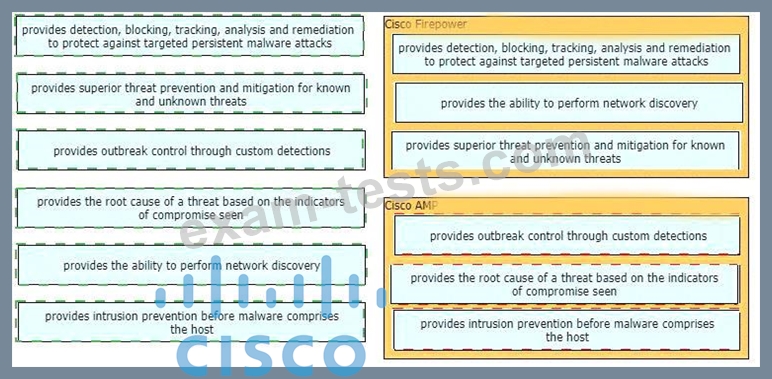
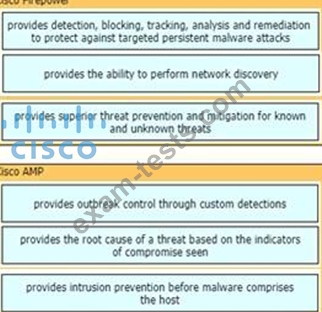
Drag and drop the capabilities of Cisco Firepower versus Cisco AMP from the left into the appropriate category on the right.
Correct Answer:
Explanation
https://www.cisco.com/c/en/us/products/collateral/security/ngips/datasheet-c78-742472.html
https://www.cisco.com/c/en/us/td/docs/security/firepower/60/configuration/guide/fpmc-config-guide-v60/Refere
https://www.cisco.com/c/en/us/solutions/collateral/enterprise-networks/advanced-malware-protection/solution-ov
- Other Version
- 1536Cisco.350-701.v2025-10-04.q562
- 1078Cisco.350-701.v2025-06-19.q238
- 1568Cisco.350-701.v2024-12-18.q472
- 2733Cisco.350-701.v2023-08-01.q405
- 3451Cisco.350-701.v2023-05-04.q372
- 2368Cisco.350-701.v2023-03-16.q218
- 7366Cisco.350-701.v2022-10-19.q571
- 4201Cisco.350-701.v2022-02-02.q204
- 116Cisco.Prepawaypdf.350-701.v2021-12-15.by.ellen.316q.pdf
- Latest Upload
- 105EC-COUNCIL.312-76.v2026-01-03.q103
- 107PaloAltoNetworks.PSE-Cortex-Pro-24.v2026-01-03.q62
- 105MedicalTests.AAPC-CPC.v2026-01-03.q50
- 106SAP.C_S4CPB_2502.v2026-01-03.q43
- 129USGBC.LEED-AP-Homes.v2026-01-02.q36
- 115SAP.C-THR94-2505.v2026-01-02.q29
- 137MedicalProfessional.CHFM.v2026-01-01.q37
- 116SAP.C-BCSPM-2502.v2026-01-01.q9
- 118Microsoft.MB-335.v2026-01-01.q142
- 124SAP.C_THR70_2505.v2026-01-01.q55
[×]
Download PDF File
Enter your email address to download Cisco.350-701.v2022-07-08.q453 Practice Test