

Question 16
A DMVPN network is being deployed for 10 branch sites to connect to the central headquarters over the Internet. Each branch site connects to the internet via a 1.5 Mb/s ADSL line, and the headquarters connects to the Internet over a 100Mb/s circuit limited to
20 Mb/s by the service provider. Which QoS mechanism if any, do you recommend at the headquarters location?
20 Mb/s by the service provider. Which QoS mechanism if any, do you recommend at the headquarters location?
Question 17
Refer to the exhibit.

You are designing a loop-free hierarchical VPLS service. Which two design considerations should be implemented for the pseudowires between the N-PE and U-PE routers? (Choose two.)
You are designing a loop-free hierarchical VPLS service. Which two design considerations should be implemented for the pseudowires between the N-PE and U-PE routers? (Choose two.)
Question 18
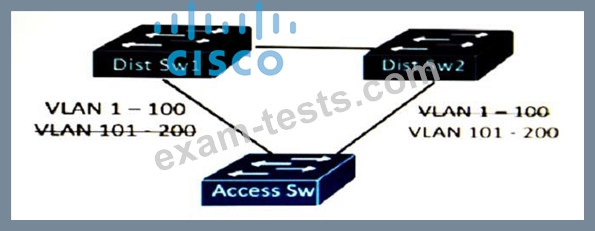
Refer to the exhibit.
This Layer 2 network is expected to add 150 VLANs over the next year, in addition to the existing 50 VLANs within the network. Which STP type will support this design requirement using the least amount of CPU resources and achieving load-balancing?
Question 19
Which three tasks are common network management practices? (Choose three.)
Question 20
Refer to the exhibit.
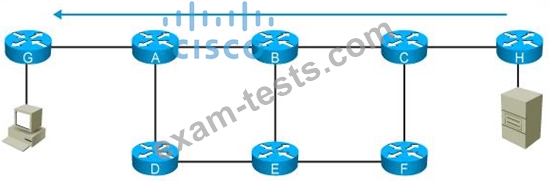
This network is running IS-IS as the single routing protocol and the LSP and SPF timers are aggressively configured so the network converges in subsecond. The customer reports that router B had a memory crash and reloaded, which resulted in some packets from the application being lost. The application servers are behind router G and the end users are behind router H.
Which design change should be made to prevent this packet-loss problem from reoccurring?
This network is running IS-IS as the single routing protocol and the LSP and SPF timers are aggressively configured so the network converges in subsecond. The customer reports that router B had a memory crash and reloaded, which resulted in some packets from the application being lost. The application servers are behind router G and the end users are behind router H.
Which design change should be made to prevent this packet-loss problem from reoccurring?