

Question 41
An organization has two branches connected over the Internet circuit using IPsec tunnels established on their edge routers belonging to different vendors Recently these branches were the victims of a DoS attack resulting in failure to establish the tunnels They are now looking for a better tunneling solution allowing full interoperability between vendors and allowing a standardized set of authentication methods Furthermore the solution must support detection of the peer's state as well as having support for next-gen encryption algorithms. Which protocol meets these requirements and is known to be resistant to DoS attacks?
Question 42
Company XYZ wants to deploy OSPF. The design plan requires that two OSPF networks be mutually redistributed at multiple locations and ensure end-to-end connectivity to all of the company's networks Which technology can be used to fulfill the requirements while avoiding the creation of routing loops?
Question 43
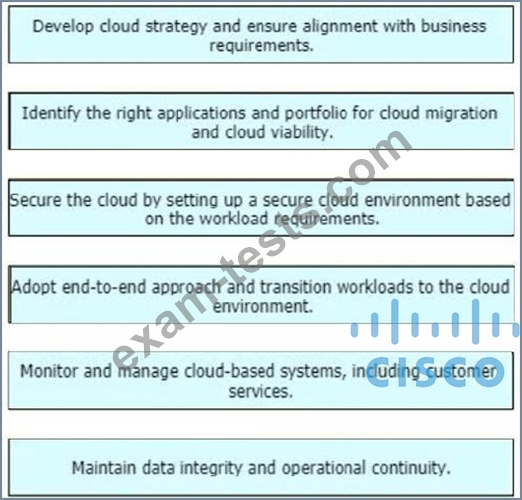
An enterprise wants to migrate an on-premises network to a cloud network, and the design team is finalizing the overall migration process. Drag and drop the options from the left into the correct order on the right.


Question 44
Your network operations team is deploying Access Control Lists (ACLs) across your Internet gateways.
They wish to place an ACL inbound on the Internet gateway interface facing the core network (the
"trusted" interface).
Which IP address would the ACL need for traffic sourced from the inside interface, to match the source address of the traffic?
They wish to place an ACL inbound on the Internet gateway interface facing the core network (the
"trusted" interface).
Which IP address would the ACL need for traffic sourced from the inside interface, to match the source address of the traffic?
Question 45
Refer to the exhibit.

Two data center siles X and Y are connected with a direct backdoor link with these conditions *Site-specific firewalls are deployed behind the Internet edge routers R1 and R2 *Both sites are advertising the address pool
100 75 10 0/23 toward the internet Site-X finds that Internet traffic returning from user PCs comes back on the Site-Y link Which design resolves the issue?