A retail company has over 3000 stores all using the same Point of Sale (POS) system. The company wants to deliver near real-time sales results to category managers. The stores operate in a variety of time zones and exhibit a dynamic range of transactions each minute, with some stores having higher sales volumes than others. Sales results are provided in a uniform fashion using data engineered fields that will be calculated in a complex data pipeline. Calculations include exceptions, aggregations, and scoring using external functions interfaced to scoring algorithms. The source data for aggregations has over 100M rows. Every minute, the POS sends all sales transactions files to a cloud storage location with a naming convention that includes store numbers and timestamps to identify the set of transactions contained in the files. The files are typically less than 10MB in size. How can the near real-time results be provided to the category managers? (Select TWO).
Correct Answer: B,C
To provide near real-time sales results to category managers, the Architect can use the following steps: Create an external stage that references the cloud storage location where the POS sends the sales transactions files. The external stage should use the file format and encryption settings that match the source files2 Create a Snowpipe that loads the files from the external stage into a target table in Snowflake. The Snowpipe should be configured with AUTO_INGEST = true, which means that it will automatically detect and ingest new files as they arrive in the external stage. The Snowpipe should also use a copy option to purge the files from the external stage after loading, to avoid duplicate ingestion3 Create a stream on the target table that captures the INSERTS made by the Snowpipe. The stream should include the metadata columns that provide information about the file name, path, size, and last modified time. The stream should also have a retention period that matches the real-time analytics needs4 Create a task that runs a query on the stream to process the near real-time data. The query should use the stream metadata to extract the store number and timestamps from the file name and path, and perform the calculations for exceptions, aggregations, and scoring using external functions. The query should also output the results to another table or view that can be accessed by the category managers. The task should be scheduled to run at a frequency that matches the real-time analytics needs, such as every minute or every 5 minutes. The other options are not optimal or feasible for providing near real-time results: All files should be concatenated before ingestion into Snowflake to avoid micro-ingestion. This option is not recommended because it would introduce additional latency and complexity in the data pipeline. Concatenating files would require an external process or service that monitors the cloud storage location and performs the file merging operation. This would delay the ingestion of new files into Snowflake and increase the risk of data loss or corruption. Moreover, concatenating files would not avoid micro-ingestion, as Snowpipe would still ingest each concatenated file as a separate load. An external scheduler should examine the contents of the cloud storage location and issue SnowSQL commands to process the data at a frequency that matches the real-time analytics needs. This option is not necessary because Snowpipe can automatically ingest new files from the external stage without requiring an external trigger or scheduler. Using an external scheduler would add more overhead and dependency to the data pipeline, and it would not guarantee near real-time ingestion, as it would depend on the polling interval and the availability of the external scheduler. The copy into command with a task scheduled to run every second should be used to achieve the near-real time requirement. This option is not feasible because tasks cannot be scheduled to run every second in Snowflake. The minimum interval for tasks is one minute, and even that is not guaranteed, as tasks are subject to scheduling delays and concurrency limits. Moreover, using the copy into command with a task would not leverage the benefits of Snowpipe, such as automatic file detection, load balancing, and micro-partition optimization. References: 1: SnowPro Advanced: Architect | Study Guide 2: Snowflake Documentation | Creating Stages 3: Snowflake Documentation | Loading Data Using Snowpipe 4: Snowflake Documentation | Using Streams and Tasks for ELT Snowflake Documentation | Creating Tasks Snowflake Documentation | Best Practices for Loading Data Snowflake Documentation | Using the Snowpipe REST API Snowflake Documentation | Scheduling Tasks SnowPro Advanced: Architect | Study Guide Creating Stages Loading Data Using Snowpipe Using Streams and Tasks for ELT [Creating Tasks] [Best Practices for Loading Data] [Using the Snowpipe REST API] [Scheduling Tasks]
Question 67
How do Snowflake databases that are created from shares differ from standard databases that are not created from shares? (Choose three.)
Correct Answer: A,C,D
According to the SnowPro Advanced: Architect documents and learning resources, the ways that Snowflake databases that are created from shares differ from standard databases that are not created from shares are: Shared databases are read-only. This means that the data consumers who access the shared databases cannot modify or delete the data or the objects in the databases. The data providers who share the databases have full control over the data and the objects, and can grant or revoke privileges on them1. Shared databases cannot be cloned. This means that the data consumers who access the shared databases cannot create a copy of the databases or the objects in the databases. The data providers who share the databases can clone the databases or the objects, but the clones are not automatically shared2. Shared databases are not supported by Time Travel. This means that the data consumers who access the shared databases cannot use the AS OF clause to query historical data or restore deleted data. The data providers who share the databases can use Time Travel on the databases or the objects, but the historical data is not visible to the data consumers3. The other options are incorrect because they are not ways that Snowflake databases that are created from shares differ from standard databases that are not created from shares. Option B is incorrect because shared databases do not need to be refreshed in order for new data to be visible. The data consumers who access the shared databases can see the latest data as soon as the data providers update the data1. Option E is incorrect because shared databases will not have the PUBLIC or INFORMATION_SCHEMA schemas without explicitly granting these schemas to the share. The data consumers who access the shared databases can only see the objects that the data providers grant to the share, and the PUBLIC and INFORMATION_SCHEMA schemas are not granted by default4. Option F is incorrect because shared databases cannot be created as transient databases. Transient databases are databases that do not support Time Travel or Fail-safe, and can be dropped without affecting the retention period of the data. Shared databases are always created as permanent databases, regardless of the type of the source database5. Reference: Introduction to Secure Data Sharing | Snowflake Documentation, Cloning Objects | Snowflake Documentation, Time Travel | Snowflake Documentation, Working with Shares | Snowflake Documentation, CREATE DATABASE | Snowflake Documentation
Question 68
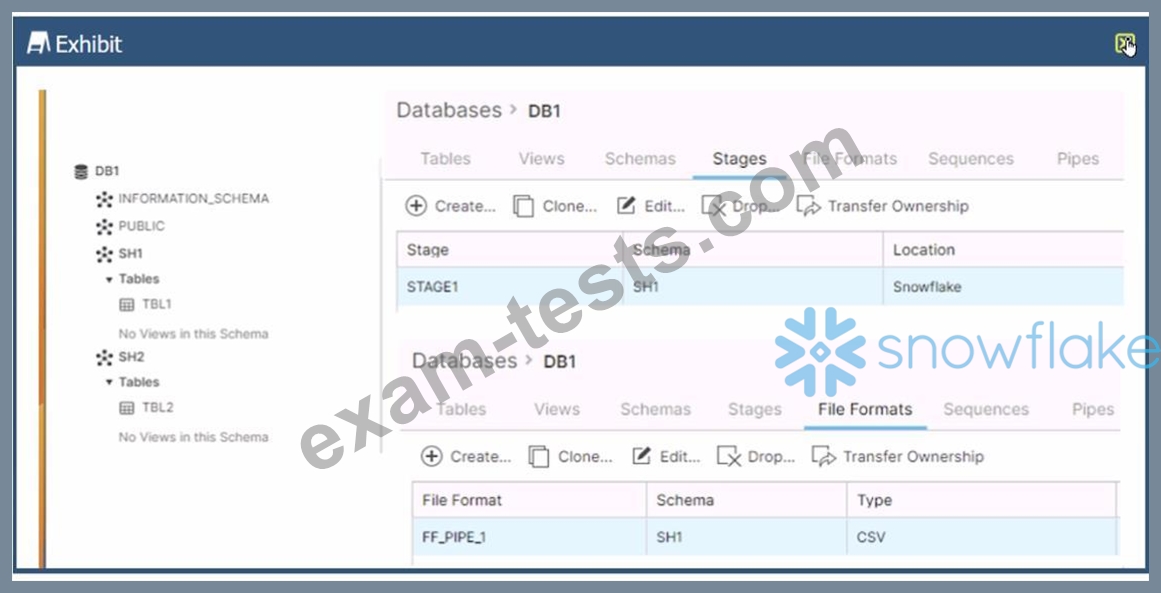
Based on the architecture in the image, how can the data from DB1 be copied into TBL2? (Select TWO).
Correct Answer: B,E
* The architecture in the image shows a Snowflake data platform with two databases, DB1 and DB2, and two schemas, SH1 and SH2. DB1 contains a table TBL1 and a stage STAGE1. DB2 contains a table TBL2. The image also shows a snippet of code written in SQL language that copies data from STAGE1 to TBL2 using a file format FF PIPE 1. * To copy data from DB1 to TBL2, there are two possible options among the choices given: * Option B: Use a named external stage that references STAGE1. This option requires creating an external stage object in DB2.SH2 that points to the same location as STAGE1 in DB1.SH1. The external stage can be created using the CREATE STAGE command with the URL parameter specifying the location of STAGE11. For example: SQLAI-generated code. Review and use carefully. More info on FAQ. use database DB2; use schema SH2; create stage EXT_STAGE1 url = @DB1.SH1.STAGE1; * Then, the data can be copied from the external stage to TBL2 using the COPY INTO command with the FROM parameter specifying the external stage name and the FILE FORMAT parameter specifying the file format name2. For example: SQLAI-generated code. Review and use carefully. More info on FAQ. copy into TBL2 from @EXT_STAGE1 file format = (format name = DB1.SH1.FF PIPE 1); * Option E: Use a cross-database query to select data from TBL1 and insert into TBL2. This option requires using the INSERT INTO command with the SELECT clause to query data from TBL1 in DB1.SH1 and insert it into TBL2 in DB2.SH2. The query must use the fully-qualified names of the tables, including the database and schema names3. For example: SQLAI-generated code. Review and use carefully. More info on FAQ. use database DB2; use schema SH2; insert into TBL2 select * from DB1.SH1.TBL1; * The other options are not valid because: * Option A: It uses an invalid syntax for the COPY INTO command. The FROM parameter cannot specify a table name, only a stage name or a file location2. * Option C: It uses an invalid syntax for the COPY INTO command. The FILE FORMAT parameter cannot specify a stage name, only a file format name or options2. * Option D: It uses an invalid syntax for the CREATE STAGE command. The URL parameter cannot specify a table name, only a file location1. References: * 1: CREATE STAGE | Snowflake Documentation * 2: COPY INTO table | Snowflake Documentation * 3: Cross-database Queries | Snowflake Documentation
Question 69
Company A would like to share data in Snowflake with Company B. Company B is not on the same cloud platform as Company A. What is required to allow data sharing between these two companies?
Correct Answer: C
According to the SnowPro Advanced: Architect documents and learning resources, the requirement to allow data sharing between two companies that are not on the same cloud platform is to set up data replication to the region and cloud platform where the consumer resides. Data replication is a feature of Snowflake that enables copying databases across accounts in different regions and cloud platforms. Data replication allows data providers to securely share data with data consumers across different regions and cloud platforms by creating a replica database in the consumer's account. The replica database is read-only and automatically synchronized with the primary database in the provider's account. Data replication is useful for scenarios where data sharing is not possible or desirable due to latency, compliance, or security reasons1. The other options are incorrect because they are not required or feasible to allow data sharing between two companies that are not on the same cloud platform. Option A is incorrect because creating a pipeline to write shared data to a cloud storage location in the target cloud provider is not a secure or efficient way of sharing data. It would require additional steps to load the data from the cloud storage to the consumer's account, and it would not leverage the benefits of Snowflake's data sharing features. Option B is incorrect because ensuring that all views are persisted is not relevant for data sharing across cloud platforms. Views can be shared across cloud platforms as long as they reference objects in the same database. Persisting views is an option to improve the performance of querying views, but it is not required for data sharing2. Option D is incorrect because Company A and Company B do not need to agree to use a single cloud platform. Data sharing is possible across different cloud platforms using data replication or other methods, such as listings or auto-fulfillment3. References: Replicating Databases Across Multiple Accounts | Snowflake Documentation, Persisting Views | Snowflake Documentation, Sharing Data Across Regions and Cloud Platforms | Snowflake Documentation
Question 70
A user can change object parameters using which of the following roles?
Correct Answer: C
According to the Snowflake documentation, object parameters are parameters that can be set on individual objects such as databases, schemas, tables, and stages. Object parameters can be set by users with the appropriate privileges on the objects. For example, to set the object parameter AUTO_REFRESH on a table, the user must have the MODIFY privilege on the table. The ACCOUNTADMIN role has the highest level of privileges on all objects in the account, so it can set any object parameter on any object. However, other roles, such as SECURITYADMIN or SYSADMIN, do not have the same level of privileges on all objects, so they cannot set object parameters on objects they do not own or have the required privileges on. Therefore, the correct answer is C. ACCOUNTADMIN, USER with PRIVILEGE. Reference: Parameters | Snowflake Documentation Object Parameters | Snowflake Documentation Object Privileges | Snowflake Documentation