

Question 11
Note: The question is included in a number of questions that depicts the identical set-up. However, every question has a distinctive result. Establish if the solution satisfies the requirements.
Your company makes use of Multi-Factor Authentication for when users are not in the office. The Per Authentication option has been configured as the usage model.
After the acquisition of a smaller business and the addition of the new staff to Azure Active Directory (Azure AD) obtains a different company and adding the new employees to Azure Active Directory (Azure AD), you are informed that these employees should also make use of Multi-Factor Authentication.
To achieve this, the Per Enabled User setting must be set for the usage model.
Solution: You reconfigure the existing usage model via the Azure portal.
Does the solution meet the goal?
Your company makes use of Multi-Factor Authentication for when users are not in the office. The Per Authentication option has been configured as the usage model.
After the acquisition of a smaller business and the addition of the new staff to Azure Active Directory (Azure AD) obtains a different company and adding the new employees to Azure Active Directory (Azure AD), you are informed that these employees should also make use of Multi-Factor Authentication.
To achieve this, the Per Enabled User setting must be set for the usage model.
Solution: You reconfigure the existing usage model via the Azure portal.
Does the solution meet the goal?
Question 12
You have an Azure virtual machine named VM1.
The network interface for VM1 is configured as shown in the exhibit. (Click the Exhibit tab.)

You need to ensure that users can connect to the website from the internet.
What should you do?
The network interface for VM1 is configured as shown in the exhibit. (Click the Exhibit tab.)
You need to ensure that users can connect to the website from the internet.
What should you do?
Question 13
You have an Azure subscription named Subscription1 that contains an Azure virtual network named VM1. VM1 is in a resource group named RG1.
VM1 runs services that will be used to deploy resources to RG1.
You need to ensure that a service running on VM1 can manage the resources in RG1 by using the identity of VM1.
What should you do first?
VM1 runs services that will be used to deploy resources to RG1.
You need to ensure that a service running on VM1 can manage the resources in RG1 by using the identity of VM1.
What should you do first?
Question 14
You have an Azure subscription that contains two virtual machines named VM1 and VM2 You create an Azure load balancer.
You plan to create a load balancing rule that will load balance HTTPS traffic between VM1 and VM2.
Which two additional load balance resources should you create before you can create the load balancing rule? Each correct answer presents part of the solution MOTL Each correct selection 5 worth one point.
You plan to create a load balancing rule that will load balance HTTPS traffic between VM1 and VM2.
Which two additional load balance resources should you create before you can create the load balancing rule? Each correct answer presents part of the solution MOTL Each correct selection 5 worth one point.
Question 15
You have an Azure Active Directory (Azure AD) tenant named contoso.com that contains the users shown in the following table:
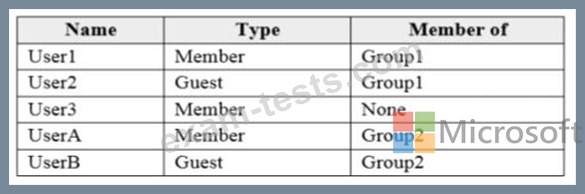
User3 is the owner of Group1.
Group2 is a member of Group1.
You configure an access review named Review1 as shown in the following exhibit:
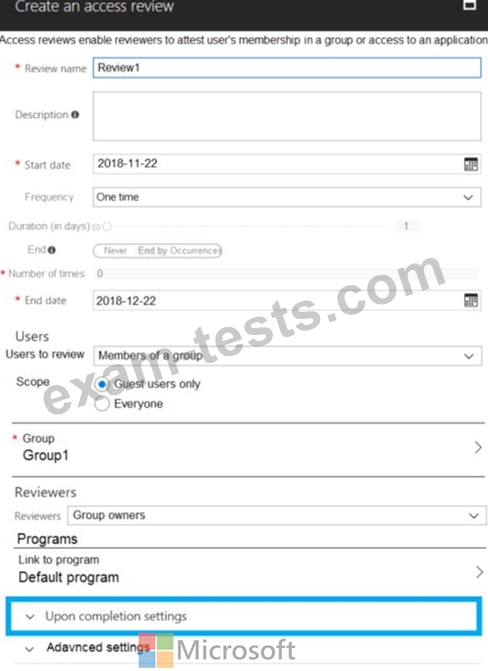
For each of the following statements, select Yes if the statement is true. Otherwise, select No.
NOTE: Each correct selection is worth one point.

User3 is the owner of Group1.
Group2 is a member of Group1.
You configure an access review named Review1 as shown in the following exhibit:
For each of the following statements, select Yes if the statement is true. Otherwise, select No.
NOTE: Each correct selection is worth one point.
