Question 136
You have an Azure subscription that contains the resources in the following table.

You install the Web Server server role (IIS) on VM1 and VM2, and then and VM1 and VM2 to LB1.
LB1 is configured as shown in the LB1 exhibit. (Click the LB1 tab.)

Rule1 is configure as shown in the Rule1 exhibit. (Click the Rule tab.)
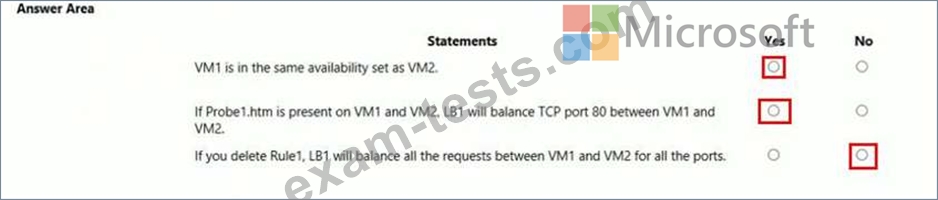
For each of the following statements, select Yes if the statements is true. Otherwise, select No.
NOTE: Each correct selection is worth one point.

You install the Web Server server role (IIS) on VM1 and VM2, and then and VM1 and VM2 to LB1.
LB1 is configured as shown in the LB1 exhibit. (Click the LB1 tab.)
Rule1 is configure as shown in the Rule1 exhibit. (Click the Rule tab.)
For each of the following statements, select Yes if the statements is true. Otherwise, select No.
NOTE: Each correct selection is worth one point.
Question 137
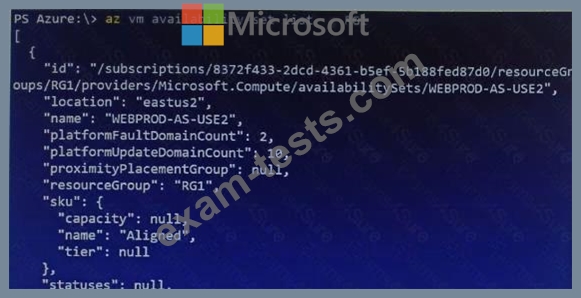
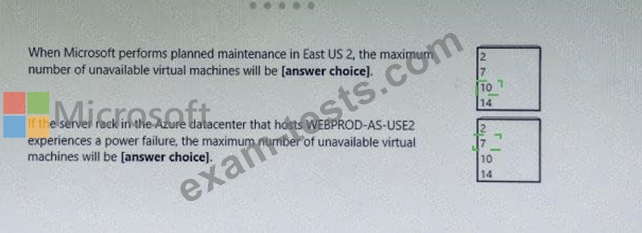
You have an Azure subscription that contains an Azure Availability Set named WEBPROD-AS-USE2 as shown in the following exhibit.

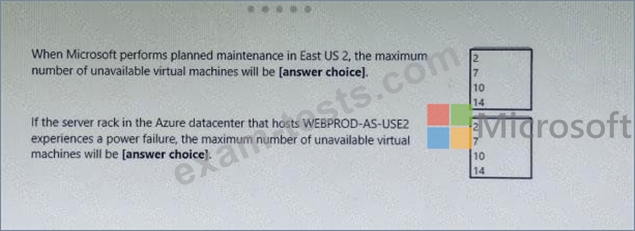
You add 14 virtual machines to WEBPROD-AS-USE2.
Use the drop-down menus to select the answer choice that completes each statement based on the information presented in the graphic.
NOTE: Each correct selection is worth one point.
You add 14 virtual machines to WEBPROD-AS-USE2.
Use the drop-down menus to select the answer choice that completes each statement based on the information presented in the graphic.
NOTE: Each correct selection is worth one point.
Question 138
You have an Azure Active Directory (Azure AD) tenant named Tenant1 and an Azure subscription named You enable Azure AD Privileged Identity Management.
You need to secure the members of the Lab Creator role. The solution must ensure that the lab creators request access when they create labs.
What should you do first?
You need to secure the members of the Lab Creator role. The solution must ensure that the lab creators request access when they create labs.
What should you do first?
Question 139
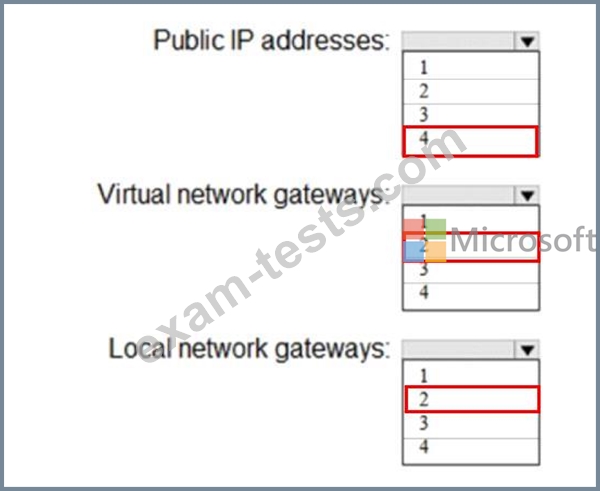
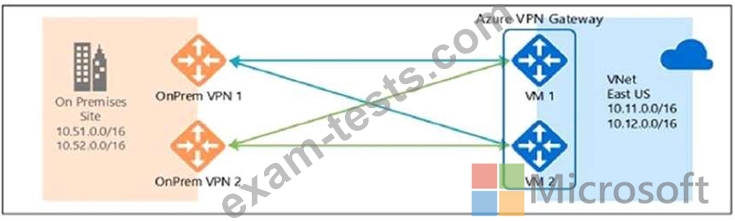
You have an on premises data center and an Azure subscription. The data center contains two VPN devices. The subscription contains an Azure virtual network named VNet1. VNet1 contains a gateway subnet.
You need to create a site-to-site VPN. The solution must ensure that if a single instance of an Azure VPN gateway fails, or a single on-premises VPN device fails, the failure will not cause an interruption that is longer than two minutes.
What is the minimum number of public IP addresses, virtual network gateways, and local network gateways required in Azure? To answer, select the appropriate options in the answer area.
NOTE: Each correct selection is worth one point.
Question 140
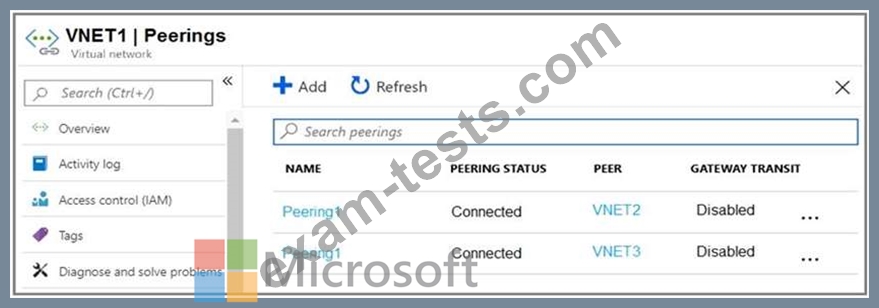
You have an Azure subscription that contains three virtual networks named VNET1, VNET2, and VNET3.
Peering for VNET1 is configured as shown in the following exhibit.
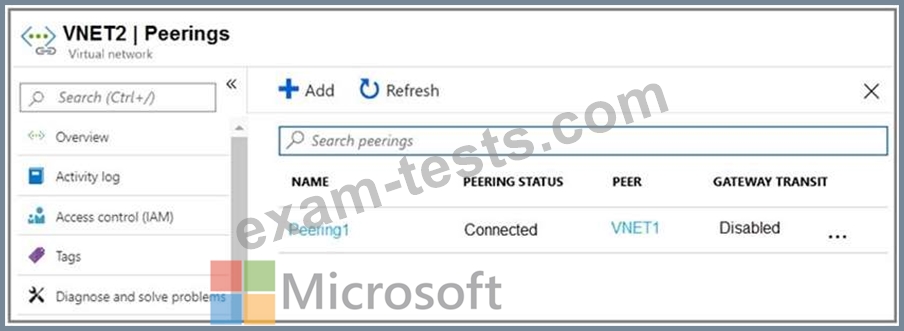
Peering for VNET2 is configured as shown in the following exhibit.
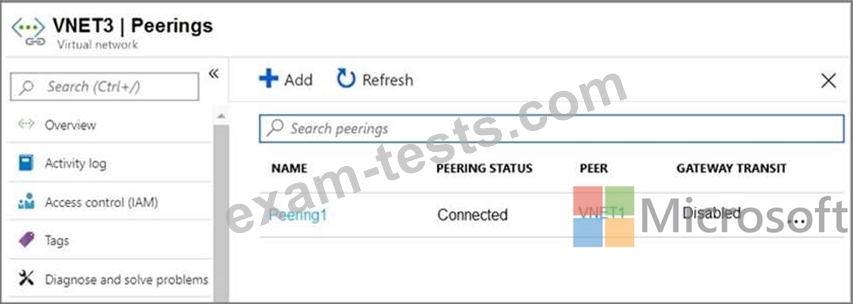
Peering for VNET3 is configured as shown in the following exhibit.
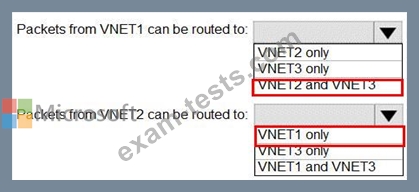
How can packets be routed between the virtual networks? To answer, select the appropriate options in the answer area.
NOTE: Each correct selection is worth one point.

Peering for VNET1 is configured as shown in the following exhibit.
Peering for VNET2 is configured as shown in the following exhibit.
Peering for VNET3 is configured as shown in the following exhibit.
How can packets be routed between the virtual networks? To answer, select the appropriate options in the answer area.
NOTE: Each correct selection is worth one point.