

Question 26
You have an Azure subscription that contains a virtual machine named VM1. VM1 hosts a line-of- business application that is available 24 hours a day.
VM1 has one network interface and one managed disk. VM1 uses the D4s v3 size.
You plan to make the following changes to VM1:
Change the size to D8s v3.
Add a 500-GB managed disk.
Add the Puppet Agent extension.
Attach an additional network interface.
Which change will cause downtime for VM1?
VM1 has one network interface and one managed disk. VM1 uses the D4s v3 size.
You plan to make the following changes to VM1:
Change the size to D8s v3.
Add a 500-GB managed disk.
Add the Puppet Agent extension.
Attach an additional network interface.
Which change will cause downtime for VM1?
Question 27
You have an Azure Storage account named storage1 that uses Azure Blob storage and Azure File storage.
You need to use AzCopy to copy data to the blob storage and file storage in storage1.
Which authentication method should you use for each type of storage? To answer, select the appropriate options in the answer area.
NOTE: Each correct selection is worth one point.
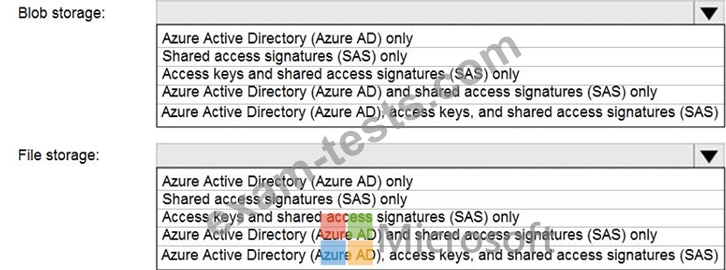
You need to use AzCopy to copy data to the blob storage and file storage in storage1.
Which authentication method should you use for each type of storage? To answer, select the appropriate options in the answer area.
NOTE: Each correct selection is worth one point.

Question 28
You have an Azure subscription named Subscription1. You have a virtualization environment that contains the virtualization server in the following table.

The virtual machines are configured as shown on the following table.

All the virtual machines use basic disks. VM1 is protected by using BitLocker Drive Encryption (BitLocker).
You plan to use Azure Site Recovery to migrate the virtual machines to Azure.
Which virtual machines can you migrate? To answer, select the appropriate options in the answer area.
NOTE: Each correct selection is worth one point.

The virtual machines are configured as shown on the following table.
All the virtual machines use basic disks. VM1 is protected by using BitLocker Drive Encryption (BitLocker).
You plan to use Azure Site Recovery to migrate the virtual machines to Azure.
Which virtual machines can you migrate? To answer, select the appropriate options in the answer area.
NOTE: Each correct selection is worth one point.


Question 29
Note: This question is part of a series of questions that present the same scenario. Each question in the series contains a unique solution that might meet the stated goals. Some question sets might have more than one correct solution, while others might not have a correct solution.
After you answer a question in this section, you will NOT be able to return to it. As a result, these questions will not appear in the review screen.
You have an Azure subscription that contains the following resources:
A virtual network that has a subnet named Subnet1
Two network security groups (NSGs) named NSG-VM1 and NSG-Subnet1
A virtual machine named VM1 that has the required Windows Server configurations to allow Remote Desktop connections
NSG-Subnet1 has the default inbound security rules only.
NSG-VM1 has the default inbound security rules and the following custom inbound security rule:
Priority: 100
Source: Any
Source port range: *
Destination: *
Destination port range: 3389
Protocol: UDP
Action: Allow
VM1 connects to Subnet1. NSG1-VM1 is associated to the network interface of VM1. NSG-Subnet1 is associated to Subnet1.
You need to be able to establish Remote Desktop connections from the internet to VM1.
Solution: You add an inbound security rule to NSG-Subnet1 that allows connections from the Any source to the VirtualNetwork destination for port range 3389 and uses the TCP protocol. You remove NSG-VM1 from the network interface of VM1.
Does this meet the goal?
After you answer a question in this section, you will NOT be able to return to it. As a result, these questions will not appear in the review screen.
You have an Azure subscription that contains the following resources:
A virtual network that has a subnet named Subnet1
Two network security groups (NSGs) named NSG-VM1 and NSG-Subnet1
A virtual machine named VM1 that has the required Windows Server configurations to allow Remote Desktop connections
NSG-Subnet1 has the default inbound security rules only.
NSG-VM1 has the default inbound security rules and the following custom inbound security rule:
Priority: 100
Source: Any
Source port range: *
Destination: *
Destination port range: 3389
Protocol: UDP
Action: Allow
VM1 connects to Subnet1. NSG1-VM1 is associated to the network interface of VM1. NSG-Subnet1 is associated to Subnet1.
You need to be able to establish Remote Desktop connections from the internet to VM1.
Solution: You add an inbound security rule to NSG-Subnet1 that allows connections from the Any source to the VirtualNetwork destination for port range 3389 and uses the TCP protocol. You remove NSG-VM1 from the network interface of VM1.
Does this meet the goal?
Question 30
You have an Azure subscription that contains the public load balancers shown in the following table.

You plan to create six virtual machines and to load balancer requests to the virtual machines. Each load balancer will load balance three virtual machines.
You need to create the virtual machines for the planned solution.
How should you create the virtual machines? To answer, select the appropriate options in the answer area.
NOTE: Each correct selection is worth one point.

You plan to create six virtual machines and to load balancer requests to the virtual machines. Each load balancer will load balance three virtual machines.
You need to create the virtual machines for the planned solution.
How should you create the virtual machines? To answer, select the appropriate options in the answer area.
NOTE: Each correct selection is worth one point.
