Question 101
Case Study 5 - Wide World Importers
Background
Wide World Importers is moving all their datacenters to Azure. The company has developed several applications and services to support supply chain operations and would like to leverage serverless computing where possible.
Current environment
Windows Server 2016 virtual machine
This virtual machine (VM) runs Biz Talk Server 2016. The VM runs the following workflows:
* Ocean Transport - This workflow gathers and validates container information including container contents and arrival notices at various shipping ports.
* Inland Transport - This workflow gathers and validates trucking information including fuel usage, number of stops, and routes.
The VM supports the following REST API calls:
* Container API - This API provides container information including weight, contents, and other attributes.
* Location API - This API provides location information regarding shipping ports of call and truck stops.
* Shipping REST API - This API provides shipping information for use and display on the shipping website.
Shipping Data
The application uses MongoDB JSON document storage database for all container and transport information.
Shipping Web Site
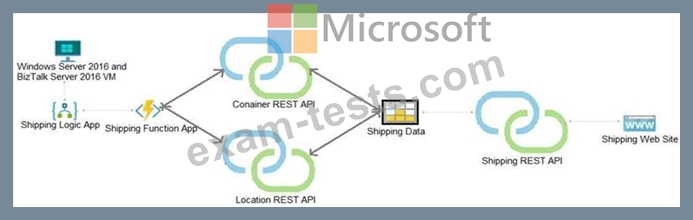
The site displays shipping container tracking information and container contents. The site is located at http://shipping.wideworldimporters.com Proposed solution The on-premises shipping application must be moved to Azure. The VM has been migrated to a new Standard_D16s_v3 Azure VM by using Azure Site Recovery and must remain running in Azure to complete the BizTalk component migrations. You create a Standard_D16s_v3 Azure VM to host BizTalk Server. The Azure architecture diagram for the proposed solution is shown below:
Shipping Logic App
The Shipping Logic app must meet the following requirements:
* Support the ocean transport and inland transport workflows by using a Logic App.
* Support industry-standard protocol X12 message format for various messages including vessel content details and arrival notices.
* Secure resources to the corporate VNet and use dedicated storage resources with a fixed costing model.
* Maintain on-premises connectivity to support legacy applications and final BizTalk migrations.
Shipping Function app
Implement secure function endpoints by using app-level security and include Azure Active Directory (Azure AD).
REST APIs
The REST API's that support the solution must meet the following requirements:
* Secure resources to the corporate VNet.
* Allow deployment to a testing location within Azure while not incurring additional costs.
* Automatically scale to double capacity during peak shipping times while not causing application downtime.
* Minimize costs when selecting an Azure payment model.
Shipping data
Data migration from on-premises to Azure must minimize costs and downtime.
Shipping website
Use Azure Content Delivery Network (CDN) and ensure maximum performance for dynamic content while minimizing latency and costs.
Issues
Windows Server 2016 VM
The VM shows high network latency, jitter, and high CPU utilization. The VM is critical and has not been backed up in the past. The VM must enable a quick restore from a 7-day snapshot to include in-place restore of disks in case of failure.
Shipping website and REST APIs
The following error message displays while you are testing the website:

You need to support the requirements for the Shipping Logic App.
What should you use?
Background
Wide World Importers is moving all their datacenters to Azure. The company has developed several applications and services to support supply chain operations and would like to leverage serverless computing where possible.
Current environment
Windows Server 2016 virtual machine
This virtual machine (VM) runs Biz Talk Server 2016. The VM runs the following workflows:
* Ocean Transport - This workflow gathers and validates container information including container contents and arrival notices at various shipping ports.
* Inland Transport - This workflow gathers and validates trucking information including fuel usage, number of stops, and routes.
The VM supports the following REST API calls:
* Container API - This API provides container information including weight, contents, and other attributes.
* Location API - This API provides location information regarding shipping ports of call and truck stops.
* Shipping REST API - This API provides shipping information for use and display on the shipping website.
Shipping Data
The application uses MongoDB JSON document storage database for all container and transport information.
Shipping Web Site
The site displays shipping container tracking information and container contents. The site is located at http://shipping.wideworldimporters.com Proposed solution The on-premises shipping application must be moved to Azure. The VM has been migrated to a new Standard_D16s_v3 Azure VM by using Azure Site Recovery and must remain running in Azure to complete the BizTalk component migrations. You create a Standard_D16s_v3 Azure VM to host BizTalk Server. The Azure architecture diagram for the proposed solution is shown below:
Shipping Logic App
The Shipping Logic app must meet the following requirements:
* Support the ocean transport and inland transport workflows by using a Logic App.
* Support industry-standard protocol X12 message format for various messages including vessel content details and arrival notices.
* Secure resources to the corporate VNet and use dedicated storage resources with a fixed costing model.
* Maintain on-premises connectivity to support legacy applications and final BizTalk migrations.
Shipping Function app
Implement secure function endpoints by using app-level security and include Azure Active Directory (Azure AD).
REST APIs
The REST API's that support the solution must meet the following requirements:
* Secure resources to the corporate VNet.
* Allow deployment to a testing location within Azure while not incurring additional costs.
* Automatically scale to double capacity during peak shipping times while not causing application downtime.
* Minimize costs when selecting an Azure payment model.
Shipping data
Data migration from on-premises to Azure must minimize costs and downtime.
Shipping website
Use Azure Content Delivery Network (CDN) and ensure maximum performance for dynamic content while minimizing latency and costs.
Issues
Windows Server 2016 VM
The VM shows high network latency, jitter, and high CPU utilization. The VM is critical and has not been backed up in the past. The VM must enable a quick restore from a 7-day snapshot to include in-place restore of disks in case of failure.
Shipping website and REST APIs
The following error message displays while you are testing the website:
You need to support the requirements for the Shipping Logic App.
What should you use?
Question 102
Case Study 4 - Best for You Organics
Background
Best for You Organics Company is a global restaurant franchise that has multiple locations. The company wants to enhance user experiences and vendor integrations. The company plans to implement automated mobile ordering and delivery services.
Best For You Organics hosts an Azure web app at the URL https://www.bestforyouorganics.com.
Users can use the web app to browse restaurant locations, menu items, nutritional, information, and company information. The company developed and deployed a cross-platform mobile app.
Requirements
You must develop a chartbot by using the Bot Builder SDK and Language Understanding Intelligence Service (LUIS). The chatbot must allow users to order food for pickup or delivery.
The chatbot must meet the following requirements:
* Ensure that chatbot endpoint can be accessed only by the Bot Framework connector.
* Use natural language processing and speech recognition so that users can interact with the chatbot by using text and voice. Processing must be server-based.
* Alert users about promotions at local restaurants.
* Enable users to place an order for delivery or pickup by using their voice.
* Greet the user upon sign-in by displaying a graphical interface that contains action buttons.
* The chatbot greeting interface must match the formatting of the following example:

Vendor API
Vendors receive and provide updates for the restaurant inventory and delivery services by using Azure API Management hosted APIs. Each vendor uses their own subscription to access each of the APIs.
APIs must meet the following conditions:
* API usage must not exceed 5,000 calls and 50,000 kilobytes of bandwidth per hour per vendor.
* If a vendor is nearing the number of calls or bandwidth limit, the API must trigger email notifications to the vendor.
* APIs must prevent API usage spikes on a per-subscription basis by limiting the call rate to 100 calls per minute.
* The Inventory API must be written by using ASP.NET Core and Node.js.
* The API must be updated to provide an interface to Azure SQL Database. Database objects must be managed by using code.
* The Delivery API must be protected by using the OAuth 2.0 protocol with Azure Active Directory (Azure AD) when called from the Azure web app. You register the Delivery API and web app in Azure AD. You enable OAuth 2.0 in the web app.
* The delivery API must update the Products table, the Vendor transactions table, and the Billing table in a single transaction.
The Best For You Organics Company architecture team has created the following diagram depicting the expected deployments into Azure:

Delivery API
The Delivery API intermittently throws the following exception:

Chatbot greeting
The chatbot's greeting does not show the user's name. You need to debug the chatbot locally.
Language processing
Users report that the bot fails to understand when a customer attempts to order dishes that use Italian names.
Relevant portions of the app files are shown below. Line numbers are included for reference only and include a two-character prefix that denotes the specific file to which they belong.
Startup.cs

Note: In this section you will see one or more sets of questions with the same scenario and problem. Each question presents a unique solution to the problem, and you must determine whether the solution meets the stated goals. More than one solution might solve the problem. It is also possible that none of the solutions solve the problem.
After you answer a question in this section, you will NOT be able to return to it. As a result, these questions will not appear in the review screen.
Note: This question is part of a series of questions that present the same scenario. Each question in the series contains a unique solution. Determine whether the solution meets the stated goals.
You need to meet the vendor notification requirement.
Solution: Configure notifications in the Azure API Management instance.
Does the solution meet the goal?
Background
Best for You Organics Company is a global restaurant franchise that has multiple locations. The company wants to enhance user experiences and vendor integrations. The company plans to implement automated mobile ordering and delivery services.
Best For You Organics hosts an Azure web app at the URL https://www.bestforyouorganics.com.
Users can use the web app to browse restaurant locations, menu items, nutritional, information, and company information. The company developed and deployed a cross-platform mobile app.
Requirements
You must develop a chartbot by using the Bot Builder SDK and Language Understanding Intelligence Service (LUIS). The chatbot must allow users to order food for pickup or delivery.
The chatbot must meet the following requirements:
* Ensure that chatbot endpoint can be accessed only by the Bot Framework connector.
* Use natural language processing and speech recognition so that users can interact with the chatbot by using text and voice. Processing must be server-based.
* Alert users about promotions at local restaurants.
* Enable users to place an order for delivery or pickup by using their voice.
* Greet the user upon sign-in by displaying a graphical interface that contains action buttons.
* The chatbot greeting interface must match the formatting of the following example:
Vendor API
Vendors receive and provide updates for the restaurant inventory and delivery services by using Azure API Management hosted APIs. Each vendor uses their own subscription to access each of the APIs.
APIs must meet the following conditions:
* API usage must not exceed 5,000 calls and 50,000 kilobytes of bandwidth per hour per vendor.
* If a vendor is nearing the number of calls or bandwidth limit, the API must trigger email notifications to the vendor.
* APIs must prevent API usage spikes on a per-subscription basis by limiting the call rate to 100 calls per minute.
* The Inventory API must be written by using ASP.NET Core and Node.js.
* The API must be updated to provide an interface to Azure SQL Database. Database objects must be managed by using code.
* The Delivery API must be protected by using the OAuth 2.0 protocol with Azure Active Directory (Azure AD) when called from the Azure web app. You register the Delivery API and web app in Azure AD. You enable OAuth 2.0 in the web app.
* The delivery API must update the Products table, the Vendor transactions table, and the Billing table in a single transaction.
The Best For You Organics Company architecture team has created the following diagram depicting the expected deployments into Azure:
Delivery API
The Delivery API intermittently throws the following exception:
Chatbot greeting
The chatbot's greeting does not show the user's name. You need to debug the chatbot locally.
Language processing
Users report that the bot fails to understand when a customer attempts to order dishes that use Italian names.
Relevant portions of the app files are shown below. Line numbers are included for reference only and include a two-character prefix that denotes the specific file to which they belong.
Startup.cs
Note: In this section you will see one or more sets of questions with the same scenario and problem. Each question presents a unique solution to the problem, and you must determine whether the solution meets the stated goals. More than one solution might solve the problem. It is also possible that none of the solutions solve the problem.
After you answer a question in this section, you will NOT be able to return to it. As a result, these questions will not appear in the review screen.
Note: This question is part of a series of questions that present the same scenario. Each question in the series contains a unique solution. Determine whether the solution meets the stated goals.
You need to meet the vendor notification requirement.
Solution: Configure notifications in the Azure API Management instance.
Does the solution meet the goal?
Question 103
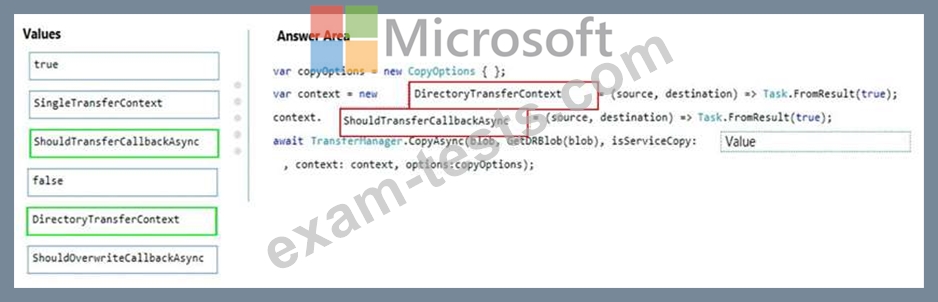
You need to ensure disaster recovery requirements are met.
What code should you add at line PC16?
To answer, drag the appropriate code fragments to the correct locations. Each code fragment may be used once, more than once, or not at all. You may need to drag the split bar between panes or scroll to view content.
NOTE: Each correct selection is worth one point.
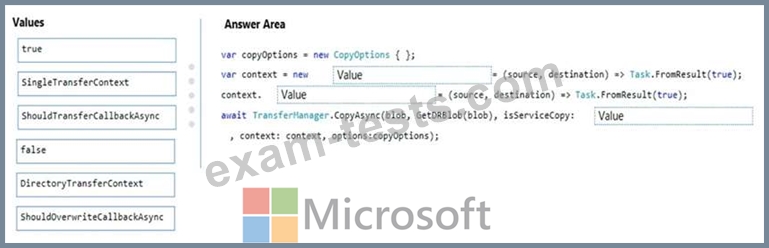
What code should you add at line PC16?
To answer, drag the appropriate code fragments to the correct locations. Each code fragment may be used once, more than once, or not at all. You may need to drag the split bar between panes or scroll to view content.
NOTE: Each correct selection is worth one point.
Question 104
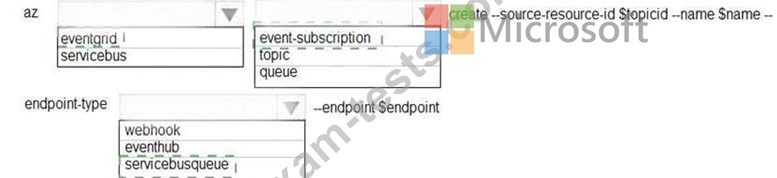
You need to configure Azure App Service to support the REST API requirements.
Which values should you use? To answer, select the appropriate options in the answer area.
NOTE: Each correct selection is worth one point.

Which values should you use? To answer, select the appropriate options in the answer area.
NOTE: Each correct selection is worth one point.

Question 105
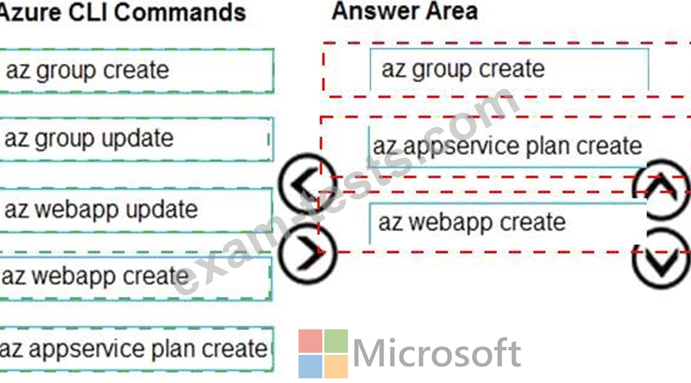
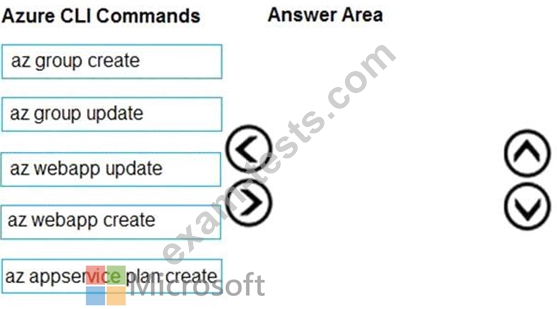
You are developing a Docker/Go using Azure App Service Web App for Containers. You plan to run the container in an App Service on Linux. You identify a Docker container image to use.
None of your current resource groups reside in a location that supports Linux. You must minimize the number of resource groups required.
You need to create the application and perform an initial deployment.
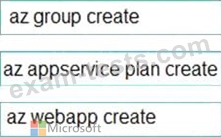
Which three Azure CLI commands should you use to develop the solution? To answer, move the appropriate commands from the list of commands to the answer area and arrange them in the correct order.
None of your current resource groups reside in a location that supports Linux. You must minimize the number of resource groups required.
You need to create the application and perform an initial deployment.
Which three Azure CLI commands should you use to develop the solution? To answer, move the appropriate commands from the list of commands to the answer area and arrange them in the correct order.