Question 226
You are developing a Java application that uses Cassandra to store key and value data. You plan to use a new Azure Cosmos DB resource and the Cassandra API in the application. You create an Azure Active Directory (Azure AD) group named Cosmos DB Creators to enable provisioning of Azure Cosmos accounts, databases, and containers.
The Azure AD group must not be able to access the keys that are required to access the data.
You need to restrict access to the Azure AD group.
Which role-based access control should you use?
The Azure AD group must not be able to access the keys that are required to access the data.
You need to restrict access to the Azure AD group.
Which role-based access control should you use?
Question 227
You develop an Azure web app. You monitor performance of the web app by using Application Insights.
You need to ensure the cost for Application Insights does not exceed a preset budget.
What should you do?
You need to ensure the cost for Application Insights does not exceed a preset budget.
What should you do?
Question 228
Note: This question is part of a series of questions that present the same scenario. Each question in the series contains a unique solution that might meet the stated goals. Some question sets might have more than one correct solution, while others might not have a correct solution.
After you answer a question in this section, you will NOT be able to return to it. As a result, these questions will not appear in the review screen.
You are developing an Azure Service application that processes queue data when it receives a message from a mobile application. Messages may not be sent to the service consistently.
You have the following requirements:
- Queue size must not grow larger than 80 gigabytes (GB).
- Use first-in-first-out (FIFO) ordering of messages.
- Minimize Azure costs.
You need to implement the messaging solution.
Solution: Use the .Net API to add a message to an Azure Service Bus Queue from the mobile application. Create an Azure Windows VM that is triggered from Azure Service Bus Queue.
Does the solution meet the goal?
Question 229
You are debugging an application that is running on Azure Kubernetes cluster named cluster1. The cluster uses Azure Monitor for containers to monitor the cluster.
The application has sticky sessions enabled on the ingress controller.
Some customers report a large number of errors in the application over the last 24 hours.
You need to determine on which virtual machines (VMs) the errors are occurring.
How should you complete the Azure Monitor query? To answer, select the appropriate options in the answer area.
NOTE: Each correct selection is worth one point.

Question 230
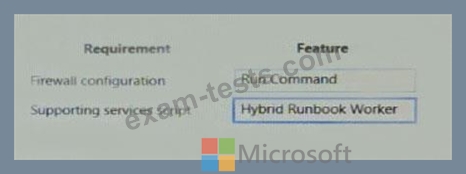
You are preparing to deploy an Azure virtual machine (VM) based application. The VMs that run the application have the following requirements:
* When a VM is provisioned the firewall must be automatically configured before it can access Azure resources.
* Supporting services must be installed by using an Azure PowerShell script that is stored in Azure Storage You need to ensure that the requirements are met.
Which features should you use? To answer, drag the appropriate features to the correct requirements.

* When a VM is provisioned the firewall must be automatically configured before it can access Azure resources.
* Supporting services must be installed by using an Azure PowerShell script that is stored in Azure Storage You need to ensure that the requirements are met.
Which features should you use? To answer, drag the appropriate features to the correct requirements.