

Question 11
Note: This question is part of a series of questions that present the same scenario. Each question in the series contains a unique solution that might meet the stated goals. Some question sets might have more than one correct solution, while others might not have a correct solution.
After you answer a question in this section, you will NOT be able to return to it. As a result, these questions will not appear in the review screen.
You have an Azure Stream Analytics job that receives input from an Azure IoT hub and sends the outputs to Azure Blob storage. The job has compatibility level 1.1 and six streaming units.
You have the following query for the job.

You plan to increase the streaming unit count to 12.
You need to optimize the job to take advantage of the additional streaming units and increase the throughput.
Solution: You change the compatibility level of the job to 1.2.
Does this meet the goal?
After you answer a question in this section, you will NOT be able to return to it. As a result, these questions will not appear in the review screen.
You have an Azure Stream Analytics job that receives input from an Azure IoT hub and sends the outputs to Azure Blob storage. The job has compatibility level 1.1 and six streaming units.
You have the following query for the job.
You plan to increase the streaming unit count to 12.
You need to optimize the job to take advantage of the additional streaming units and increase the throughput.
Solution: You change the compatibility level of the job to 1.2.
Does this meet the goal?
Question 12
You have an Azure loT solution that includes an loT device named Device1.
You are creating an loT Plug and Play model for Device1.
On Device1, you create a device model file in a folder named dtmi/com/source/.
How should you complete the model? To answer select the appropriate options in the answer area.
NOTE: Each correct selection is worth one point.

You are creating an loT Plug and Play model for Device1.
On Device1, you create a device model file in a folder named dtmi/com/source/.
How should you complete the model? To answer select the appropriate options in the answer area.
NOTE: Each correct selection is worth one point.

Question 13
You have an Azure IoT Edge automatic deployment named D1 that deploys a temperature module to five IoT Edge devices.
D1 has a deployment priority of 10 and the following module configuration.
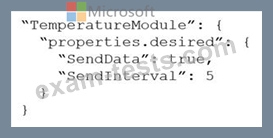
You need to create a new layered deployment that will add a new twin property named ReportingMode. The new deployment must not overwrite the existing module configurations set by D1.
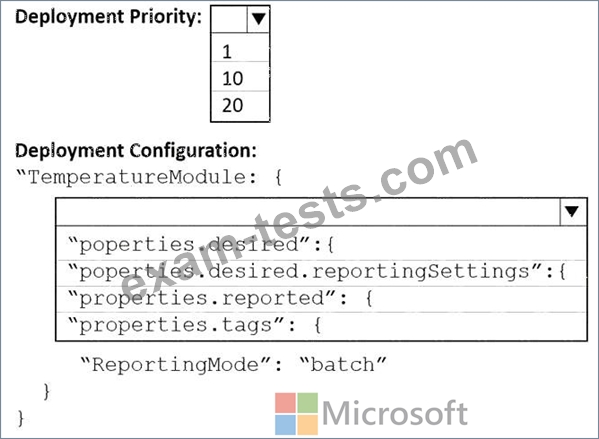
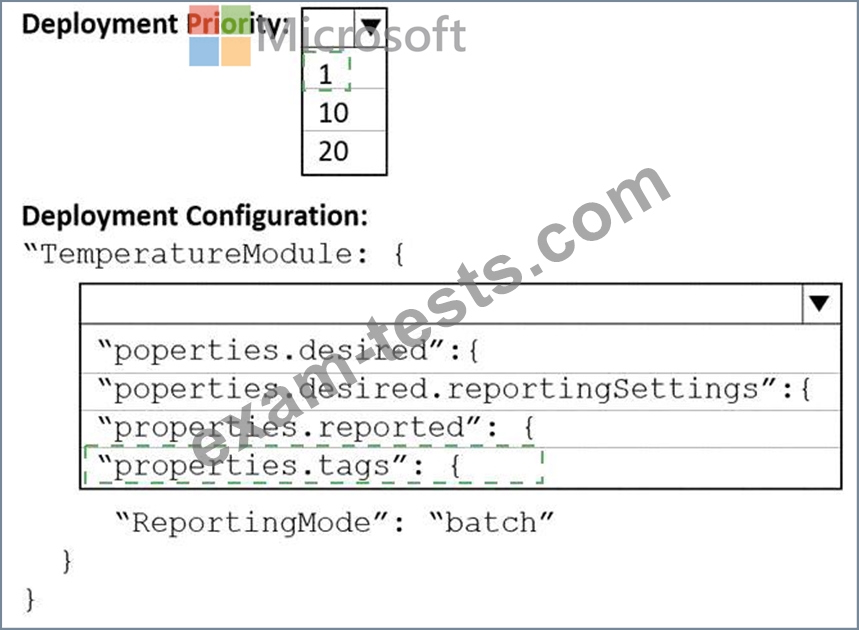
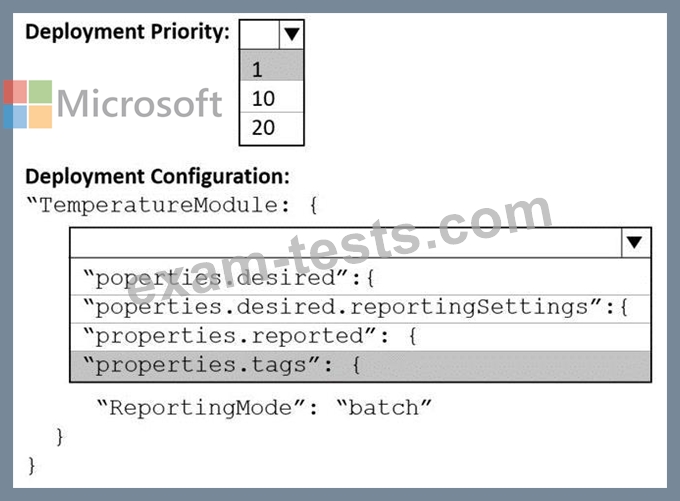
How should you configure the deployment? To answer, select the appropriate options in the answer area.
NOTE: Each correct selection is worth one point.
D1 has a deployment priority of 10 and the following module configuration.
You need to create a new layered deployment that will add a new twin property named ReportingMode. The new deployment must not overwrite the existing module configurations set by D1.
How should you configure the deployment? To answer, select the appropriate options in the answer area.
NOTE: Each correct selection is worth one point.
Question 14
Note: This question is part of a series of questions that present the same scenario. Each question in the series contains a unique solution that might meet the stated goals. Some question sets might have more than one correct solution, while others might not have a correct solution.
After you answer a question in this section, you will NOT be able to return to it. As a result, these questions will not appear in the review screen.
You have devices that connect to an Azure IoT hub. Each device has a fixed GPS location that includes latitude and longitude.
You discover that a device entry in the identity registry of the IoT hub is missing the GPS location.
You need to configure the GPS location for the device entry. The solution must prevent the changes from being propagated to the physical device.
Solution: You add the desired properties to the device twin.
Does the solution meet the goal?
After you answer a question in this section, you will NOT be able to return to it. As a result, these questions will not appear in the review screen.
You have devices that connect to an Azure IoT hub. Each device has a fixed GPS location that includes latitude and longitude.
You discover that a device entry in the identity registry of the IoT hub is missing the GPS location.
You need to configure the GPS location for the device entry. The solution must prevent the changes from being propagated to the physical device.
Solution: You add the desired properties to the device twin.
Does the solution meet the goal?
Question 15
You have an Azure IoT Central application that has a custom device template.
You need to configure the device template to support the following activities:
Return the reported power consumption.
Configure the desired fan speed.
Run the device reset routine.
Read the fan serial number.
Which option should you use for each activity? Each correct answer presents part of the solution.
NOTE: Each correct selection is worth one point.

You need to configure the device template to support the following activities:
Return the reported power consumption.
Configure the desired fan speed.
Run the device reset routine.
Read the fan serial number.
Which option should you use for each activity? Each correct answer presents part of the solution.
NOTE: Each correct selection is worth one point.
