

Question 31
You have a web application that uses a MongoDB database. You plan to migrate the web application to Azure.
You must migrate to Cosmos DB while minimizing code and configuration changes.
You need to design the Cosmos DB configuration.
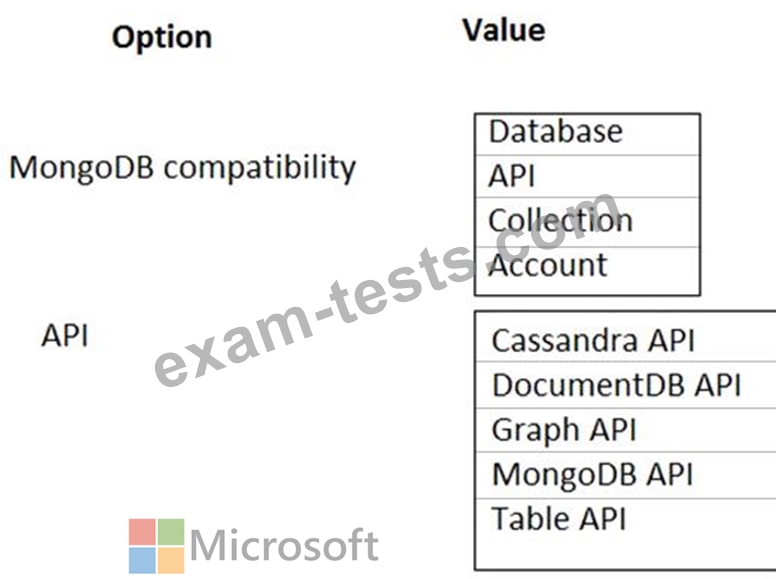
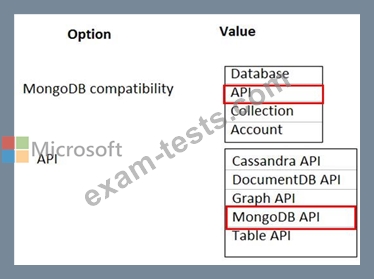
What should you recommend? To answer, select the appropriate values in the answer area.
NOTE: Each correct selection is worth one point.
You must migrate to Cosmos DB while minimizing code and configuration changes.
You need to design the Cosmos DB configuration.
What should you recommend? To answer, select the appropriate values in the answer area.
NOTE: Each correct selection is worth one point.
Question 32
Note: This question is part of a series of questions that present the same scenario. Each question in the series contains a unique solution that might meet the stated goals. Some question sets might have more than one correct solution, while others might not have a correct solution.
After you answer a question in this section, you will NOT be able to return to it. As a result, these questions will not appear in the review screen.
Your company has deployed several virtual machines (VMs) on-premises and to Azure. Azure ExpressRoute has been deployed and configured for on-premises to Azure connectivity.
Several VMs are exhibiting network connectivity issues.
You need to analyze the network traffic to determine whether packets are being allowed or denied to the VMs.
Solution: Install and configure the Microsoft Monitoring Agent and the Dependency Agent on all VMs. Use the Wire Data solution in Azure Monitor to analyze the network traffic.
Does the solution meet the goal?
After you answer a question in this section, you will NOT be able to return to it. As a result, these questions will not appear in the review screen.
Your company has deployed several virtual machines (VMs) on-premises and to Azure. Azure ExpressRoute has been deployed and configured for on-premises to Azure connectivity.
Several VMs are exhibiting network connectivity issues.
You need to analyze the network traffic to determine whether packets are being allowed or denied to the VMs.
Solution: Install and configure the Microsoft Monitoring Agent and the Dependency Agent on all VMs. Use the Wire Data solution in Azure Monitor to analyze the network traffic.
Does the solution meet the goal?
Question 33
Your company has an app named App1 that uses data from the on-premises Microsoft SQL Server databases shown in the following table.

App1 and the data are used on the first day of the month only. The data is not expected to grow more than 3% each year.
The company is rewriting App1 as an Azure web app and plans to migrate all the data to Azure.
You need to migrate the data to Azure SQL Database. The solution must minimize costs.
Which service tier should you use?
App1 and the data are used on the first day of the month only. The data is not expected to grow more than 3% each year.
The company is rewriting App1 as an Azure web app and plans to migrate all the data to Azure.
You need to migrate the data to Azure SQL Database. The solution must minimize costs.
Which service tier should you use?
Question 34
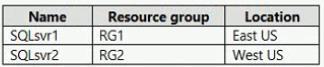
You have an Azure subscription that contains the SQL servers shown in the following table.

The subscription contains the storage accounts shown in the following table.

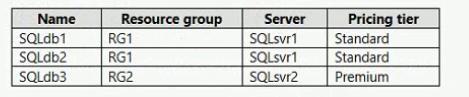
You create the Azure SQL databases shown in the following table.


The subscription contains the storage accounts shown in the following table.
You create the Azure SQL databases shown in the following table.

Question 35
You have an Azure subscription that contains the SQL servers shown in the following table.
The subscription contains the storage accounts shown in the following table.

You create the Azure SQL databases shown in the following table.

The subscription contains the storage accounts shown in the following table.
You create the Azure SQL databases shown in the following table.

