

Question 116
Your on-premises network contains a server named Server1 that runs an ASP.NET application named App1.
You have a hybrid deployment of Azure Active Directory (Azure AD).
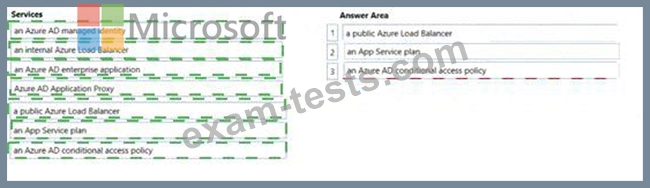
You need to recommend a solution to ensure that users sign in by using their Azure AD account and Azure Multi-Factor Authentication (MFA) when they connect to App1 from the internet.
Which three Azure services should you recommend be deployed and configured in sequence? To answer, move the appropriate services from the list of services to the answer area and arrange them in the correct order.
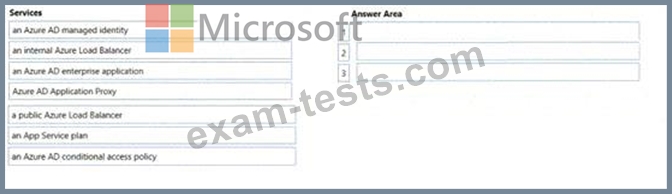
You have a hybrid deployment of Azure Active Directory (Azure AD).
You need to recommend a solution to ensure that users sign in by using their Azure AD account and Azure Multi-Factor Authentication (MFA) when they connect to App1 from the internet.
Which three Azure services should you recommend be deployed and configured in sequence? To answer, move the appropriate services from the list of services to the answer area and arrange them in the correct order.

Question 117
You are designing a software as a service (SaaS) application that will enable Azure Active Directory (Azure AD) users to create and publish surveys. The SaaS application will have a front-end web app and a back-end web API. The web app will rely on the web API to handle updates to customer surveys.
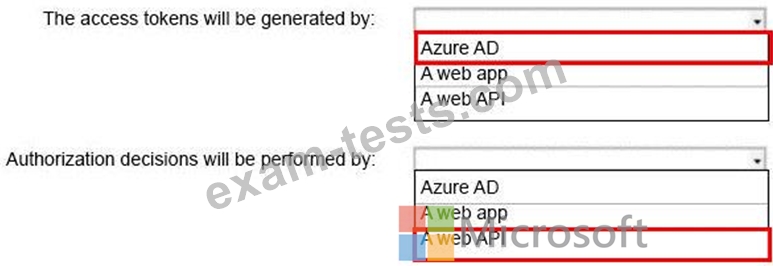
You need to design an authorization flow for the SaaS application. The solution must meet the following requirements:
To access the back-end web API, the web app must authenticate by using OAuth 2 bearer tokens.
The web app must authenticate by using the identities of individual users.
What should you include in the solution? To answer, select the appropriate options in the answer area.
NOTE: Each correct selection is worth one point.
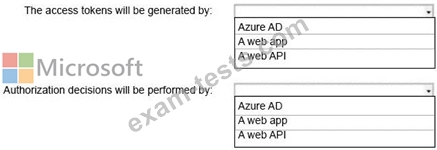
You need to design an authorization flow for the SaaS application. The solution must meet the following requirements:
To access the back-end web API, the web app must authenticate by using OAuth 2 bearer tokens.
The web app must authenticate by using the identities of individual users.
What should you include in the solution? To answer, select the appropriate options in the answer area.
NOTE: Each correct selection is worth one point.
Question 118
Note: This question is part of a series of questions that present the same scenario. Each question in the series contains a unique solution that might meet the stated goals. Some question sets might have more than one correct solution, while others might not have a correct solution.
After you answer a question in this section, you will NOT be able to return to it. As a result, these questions will not appear in the review screen.
You have an Azure Storage v2 account named storage1.
You plan to archive data to storage1.
You need to ensure that the archived data cannot be deleted for five years. The solution must prevent administrators from deleting the data.
Solution: You create an Azure Blob storage container, and you configure a legal hold access policy.
Does this meet the goal?
Question 119
DRAG DROP
A company named Contoso, Ltd. has an Azure Active Directory (Azure AD) tenant that uses the Basic license.
You plan to deploy two applications to Azure. The applications have the requirements shown in the following table.
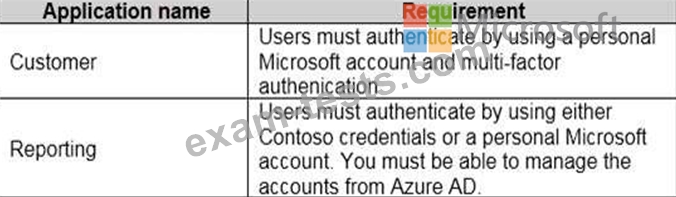
Which authentication strategy should you recommend for each application? To answer, drag the appropriate authentication strategies to the correct applications. Each authentication strategy may be used once, more than once, or not at all. You may need to drag the split bar between panes or scroll to view content.
NOTE: Each correct selection is worth one point.
Select and Place:
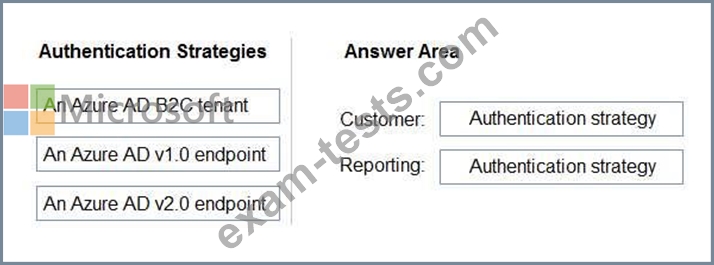
A company named Contoso, Ltd. has an Azure Active Directory (Azure AD) tenant that uses the Basic license.
You plan to deploy two applications to Azure. The applications have the requirements shown in the following table.
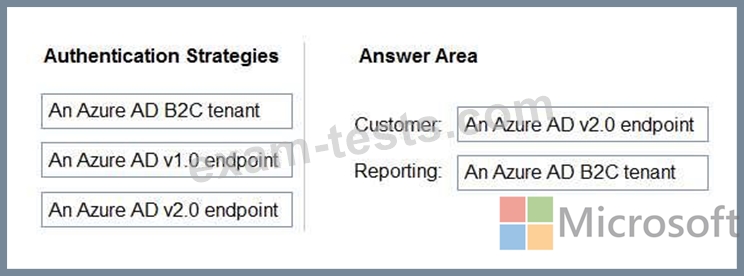
Which authentication strategy should you recommend for each application? To answer, drag the appropriate authentication strategies to the correct applications. Each authentication strategy may be used once, more than once, or not at all. You may need to drag the split bar between panes or scroll to view content.
NOTE: Each correct selection is worth one point.
Select and Place:
Question 120
Note: This question is part of a series of questions that present the same scenario. Each question in the series contains a unique solution that might meet the stated goals. Some question sets might have more than one correct solution, while others might not have a correct solution.
After you answer a question in this section, you will NOT be able to return to it. As a result, these questions will not appear in the review screen.
Your company has deployed several virtual machines (VMs) on-premises and to Azure. Azure ExpressRoute has been deployed and configured for on-premises to Azure connectivity.
Several VMs are exhibiting network connectivity issues.
You need to analyze the network traffic to determine whether packets are being allowed or denied to the VMs.
Solution: Install and configure the Microsoft Monitoring Agent and the Dependency Agent on all VMs. Use the Wire Data solution in Azure Monitor to analyze the network traffic.
Does the solution meet the goal?