

Question 26
You are designing a cost-optimized solution that uses Azure Batch to run two types of jobs on Linux nodes.
The first job type will consist of short-running tasks for a development environment. The second job type will consist of long-running Message Passing Interface (MP1) applications for a production environment that requires timely Job completion.
You need to recommend the pool type and node type for each job type. The solution must minimize compute charges and leverage Azure Hybrid Benefit whenever possible. What should you recommend? To answer, select the appropriate options in the answer area. NOTE: Each correct selection is worth one point.

The first job type will consist of short-running tasks for a development environment. The second job type will consist of long-running Message Passing Interface (MP1) applications for a production environment that requires timely Job completion.
You need to recommend the pool type and node type for each job type. The solution must minimize compute charges and leverage Azure Hybrid Benefit whenever possible. What should you recommend? To answer, select the appropriate options in the answer area. NOTE: Each correct selection is worth one point.


Question 27
You are designing an order processing system in Azure that will contain the Azure resources shown in the following table.

The order processing system will have the following transaction flow:
A customer will place an order by using App1.
When the order is received, App1 will generate a message to check for product availability at vendor 1 and vendor 2.
An integration component will process the message, and then trigger either Function1 or Function2 depending on the type of order.
Once a vendor confirms the product availability, a status message for App1 will be generated by Function1 or Function2.
All the steps of the transaction will be logged to storage1.
Which type of resource should you recommend for the integration component?
Which type of resource should you recommend for the integration component?
The order processing system will have the following transaction flow:
A customer will place an order by using App1.
When the order is received, App1 will generate a message to check for product availability at vendor 1 and vendor 2.
An integration component will process the message, and then trigger either Function1 or Function2 depending on the type of order.
Once a vendor confirms the product availability, a status message for App1 will be generated by Function1 or Function2.
All the steps of the transaction will be logged to storage1.
Which type of resource should you recommend for the integration component?
Which type of resource should you recommend for the integration component?
Question 28
You plan to deploy the backup policy shown in the following exhibit.
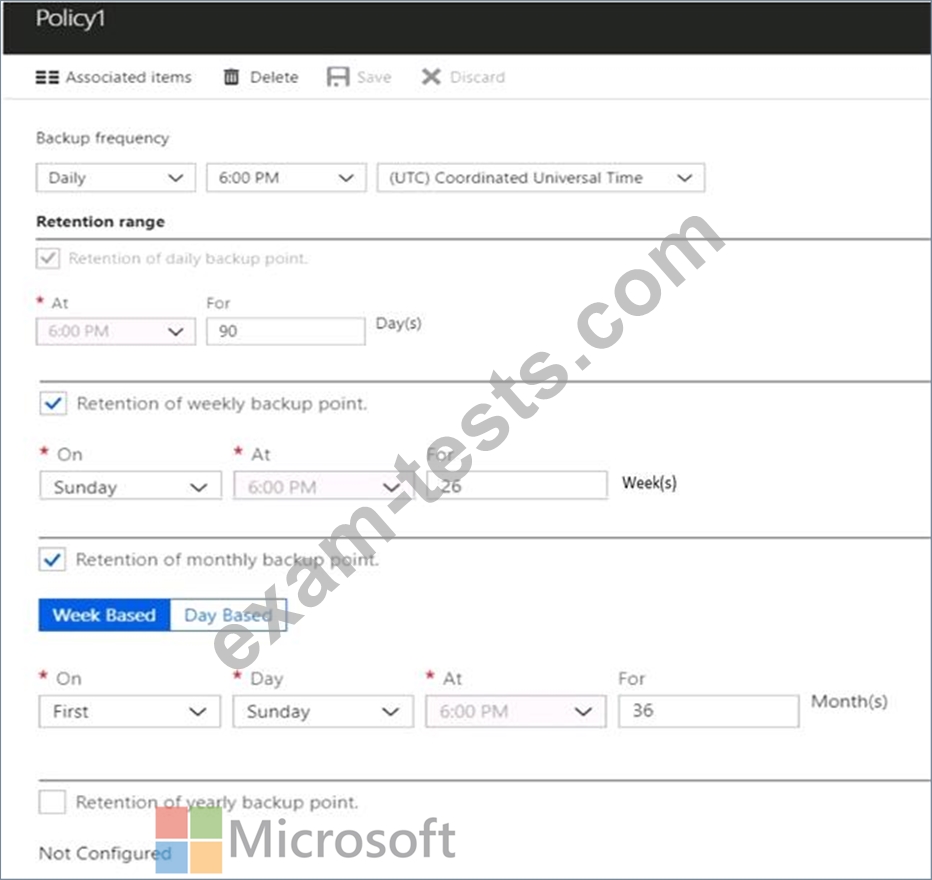
Use the drop-down menus to select the answer choice that completes each statement based on the information presented in the graphic.
NOTE: Each correct selection is worth one point.
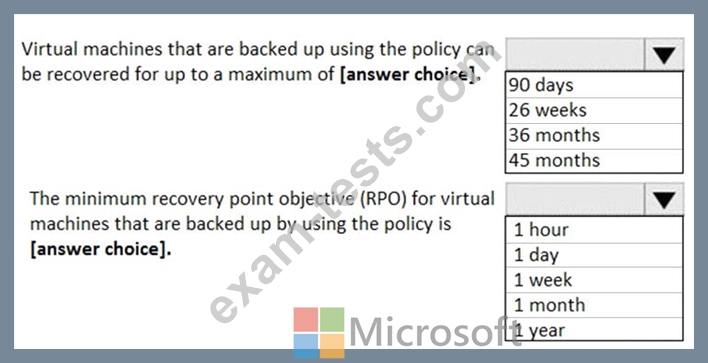
Use the drop-down menus to select the answer choice that completes each statement based on the information presented in the graphic.
NOTE: Each correct selection is worth one point.

Question 29
A company has a hybrid ASP.NET Web API application that is based on a software as a service (SaaS) offering.
Users report general issues with the data. You advise the company to implement live monitoring and use ad hoc queries on stored JSON data. You also advise the company to set up smart alerting to detect anomalies in the data.
You need to recommend a solution to set up smart alerting.
What should you recommend?
Users report general issues with the data. You advise the company to implement live monitoring and use ad hoc queries on stored JSON data. You also advise the company to set up smart alerting to detect anomalies in the data.
You need to recommend a solution to set up smart alerting.
What should you recommend?
Question 30
You plan to deploy an application named App1 that will run on five Azure virtual machines. Additional virtual machines will be deployed later to run App1.
You need to recommend a solution to meet the following requirements for the virtual machines that will run App1:
* Ensure that the virtual machines can authenticate to Azure Active Directory (Azure AD) to gain access to
* an Azure key vault, Azure Logic Apps instances, and an Azure SQL database.
* Avoid assigning new roles and permissions for Azure services when you deploy additional virtual machines.
* Avoid storing secrets and certificates on the virtual machines.
Which type of identity should you include in the recommendation?
You need to recommend a solution to meet the following requirements for the virtual machines that will run App1:
* Ensure that the virtual machines can authenticate to Azure Active Directory (Azure AD) to gain access to
* an Azure key vault, Azure Logic Apps instances, and an Azure SQL database.
* Avoid assigning new roles and permissions for Azure services when you deploy additional virtual machines.
* Avoid storing secrets and certificates on the virtual machines.
Which type of identity should you include in the recommendation?