

Question 1
You have an Azure subscription that contains the virtual machines shown in the following table.
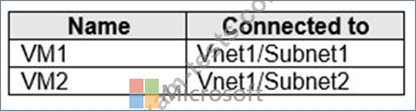
Subnet1 and Subnet2 are associated to a network security group (NSG) named NSG1 that has the following outbound rule:
* Priority: 100
* Port: Any
* Protocol: Any
* Source: Any
* Destination: Storage
* Action: Deny
You create a private endpoint that has the following settings:
* Name: Private1
* Resource type: Microsoft.Storage/storageAccounts
* Resource: storage1
* Target sub-resource: blob
* Virtual network: Vnet1
* Subnet: Subnet1
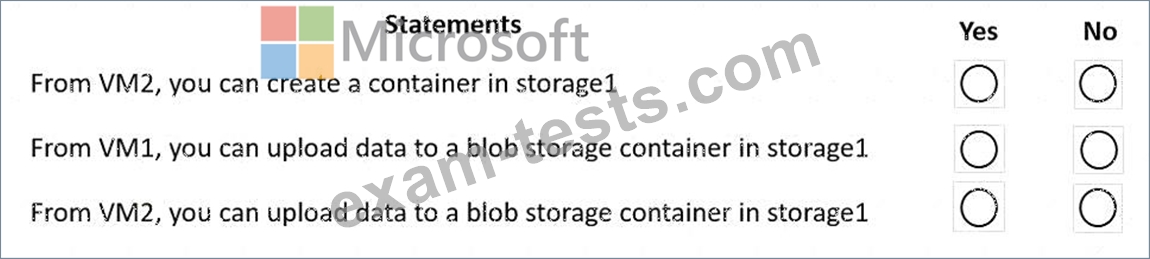
For each of the following statements, select Yes of the statement is true. Otherwise, select No.
NOTE: Each correct selection is worth one point.
Subnet1 and Subnet2 are associated to a network security group (NSG) named NSG1 that has the following outbound rule:
* Priority: 100
* Port: Any
* Protocol: Any
* Source: Any
* Destination: Storage
* Action: Deny
You create a private endpoint that has the following settings:
* Name: Private1
* Resource type: Microsoft.Storage/storageAccounts
* Resource: storage1
* Target sub-resource: blob
* Virtual network: Vnet1
* Subnet: Subnet1
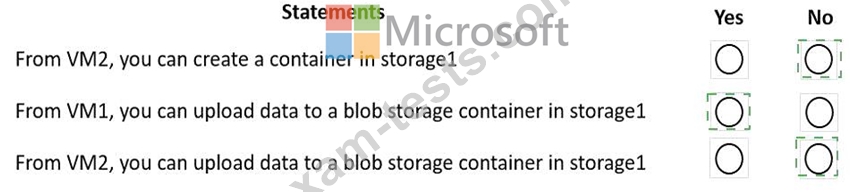
For each of the following statements, select Yes of the statement is true. Otherwise, select No.
NOTE: Each correct selection is worth one point.
Question 2
You have the Azure resources shown in the following table.
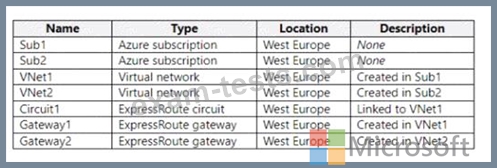
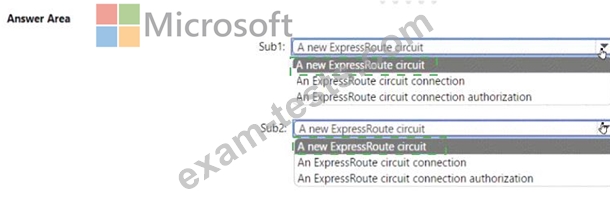
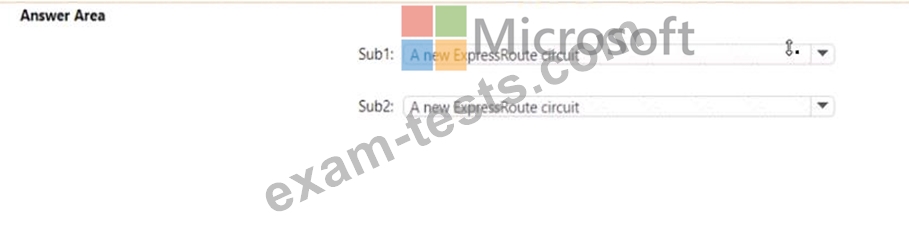
You need to link VNei2 to Circuit1
What should you create in each subscription? To answer, select the appropriate options in the answer area.
NOTE: Each correct selection is worth one point.
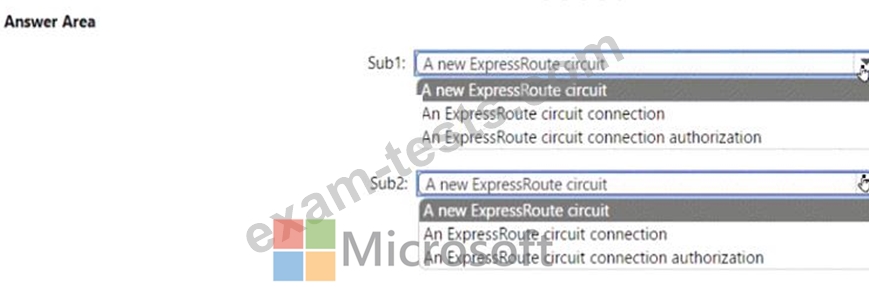
You need to link VNei2 to Circuit1
What should you create in each subscription? To answer, select the appropriate options in the answer area.
NOTE: Each correct selection is worth one point.
Question 3
You have an Azure subscription that is linked to an Azure Active Directory (Azure AD) tenant named contoso.onmicrosoft.com. The subscription contains the following resources:
* An Azure App Service app named App1
* An Azure DNS zone named contoso.com
* An Azure private DNS zone named private.contoso.com
* A virtual network named Vnet1
You create a private endpoint for App1. The record for the endpoint is registered automatically in Azure DNS.
You need to provide a developer with the name that is registered in Azure DNS for the private endpoint.
What should you provide?
* An Azure App Service app named App1
* An Azure DNS zone named contoso.com
* An Azure private DNS zone named private.contoso.com
* A virtual network named Vnet1
You create a private endpoint for App1. The record for the endpoint is registered automatically in Azure DNS.
You need to provide a developer with the name that is registered in Azure DNS for the private endpoint.
What should you provide?

Question 4
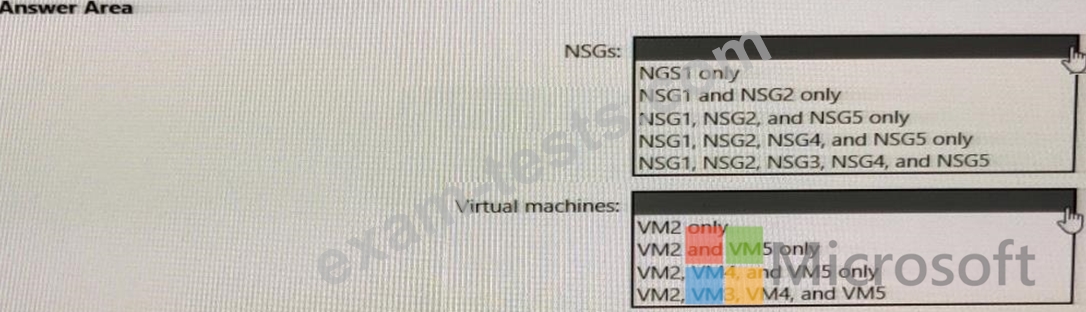
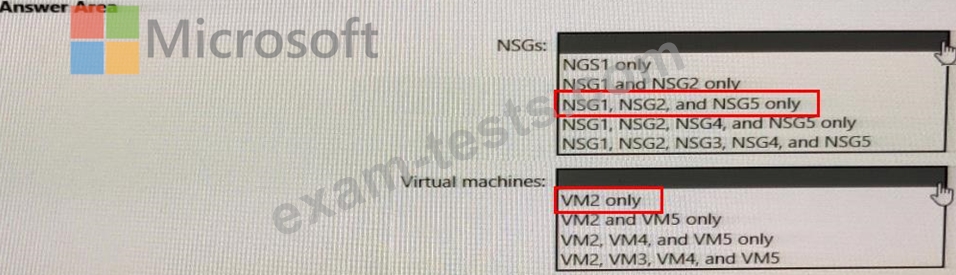
In which NSGs can you use ASG1 and to which virtual machine network interfaces can you associate ASG1? To answer, select the appropriate options in the answer area.
NOTE: Each correct selection is worth one point.
NOTE: Each correct selection is worth one point.
Question 5
Note: This question is part of a series of questions that present the same scenario. Each question in the series contains a unique solution that might meet the stated goals. Some question sets might have more than one correct solution, while others might not have a correct solution.
After you answer a question in this section, you will NOT be able to return to it. As a result, these questions will not appear in the review screen.
You have an Azure application gateway that has Azure Web Application Firewall (WAF) enabled.
You configure the application gateway to direct traffic to the URL of the application gateway.
You attempt to access the URL and receive an HTTP 403 error. You view the diagnostics log and discover the following error.
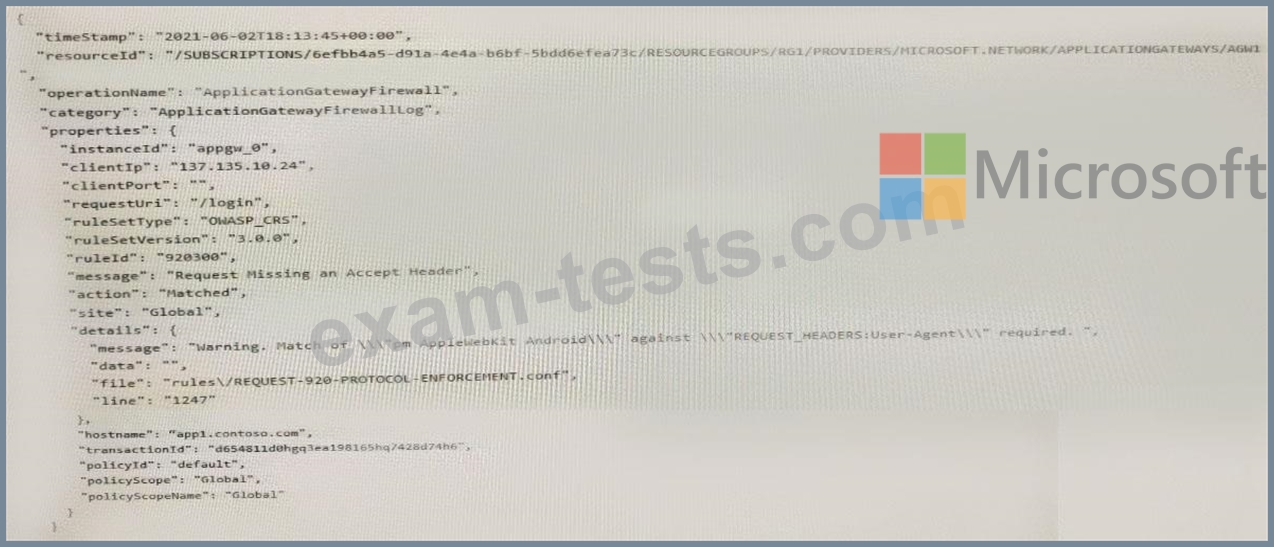
You need to ensure that the URL is accessible through the application gateway.
Solution: You create a WAF policy exclusion request headers that contain 137.135.10.24.
Does this meet the goat?
After you answer a question in this section, you will NOT be able to return to it. As a result, these questions will not appear in the review screen.
You have an Azure application gateway that has Azure Web Application Firewall (WAF) enabled.
You configure the application gateway to direct traffic to the URL of the application gateway.
You attempt to access the URL and receive an HTTP 403 error. You view the diagnostics log and discover the following error.
You need to ensure that the URL is accessible through the application gateway.
Solution: You create a WAF policy exclusion request headers that contain 137.135.10.24.
Does this meet the goat?