

Question 76
Your on-premises network uses an IP address space of 10.0.0.0/20.
You have an Azure subscription that contains the resources shown in the following table.

The on-premises network is connected to HubVnet by using a Site-to-Site (S2S) VPN.
You deploy an Azure firewall named AZFW1 to HubVNet.
You need to ensure that AZFW1 can inspect all the traffic between the on-premises network and SpokeVNet.
What should you do in RT1? To answer, drag the appropriate destination to the correct route. Each resource may be used once, more than once, or not at all. You may need to drag the split bar between panes or scroll to view content.
NOTE: Each correct selection is worth one point.

You have an Azure subscription that contains the resources shown in the following table.
The on-premises network is connected to HubVnet by using a Site-to-Site (S2S) VPN.
You deploy an Azure firewall named AZFW1 to HubVNet.
You need to ensure that AZFW1 can inspect all the traffic between the on-premises network and SpokeVNet.
What should you do in RT1? To answer, drag the appropriate destination to the correct route. Each resource may be used once, more than once, or not at all. You may need to drag the split bar between panes or scroll to view content.
NOTE: Each correct selection is worth one point.


Question 77
You have an Azure subscription that contains the resources shown in the following table.

You create a virtual network named Vnet2 in the West US region.
You plan to enable peering between Vnet1 and Vnet2.
You need to ensure that the virtual machines connected to Vnet2 can connect to VM1 and VM2 via LB1.
What should you do?
You create a virtual network named Vnet2 in the West US region.
You plan to enable peering between Vnet1 and Vnet2.
You need to ensure that the virtual machines connected to Vnet2 can connect to VM1 and VM2 via LB1.
What should you do?
Question 78
You have an Azure private DNS zone named contoso.com that is linked to the virtual networks shown in the following table.
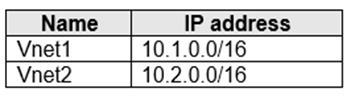
The links have auto registration enabled.
You create the virtual machines shown in the following table.
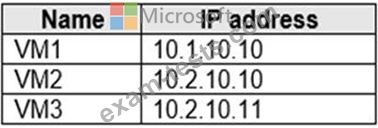
You manually add the following entry to the contoso.com zone:
Name: VM1
IP address: 10.1.10.9
For each of the following statements, select Yes of the statement is true. Otherwise, select No.
NOTE: Each correct selection is worth one point.

The links have auto registration enabled.
You create the virtual machines shown in the following table.
You manually add the following entry to the contoso.com zone:
Name: VM1
IP address: 10.1.10.9
For each of the following statements, select Yes of the statement is true. Otherwise, select No.
NOTE: Each correct selection is worth one point.


Question 79
You have an on-premises server named Server1 that runs Windows Server.
You have an Azure subscription that contains a virtual network named VNet1.
You plan to connect Server1 to VNet1 by using Azure Network Adapter.
You need to minimize how long it takes to deploy the adapter to Server1.
What should you create first?
You have an Azure subscription that contains a virtual network named VNet1.
You plan to connect Server1 to VNet1 by using Azure Network Adapter.
You need to minimize how long it takes to deploy the adapter to Server1.
What should you create first?
Question 80
You need to configure the default route on Vnet2 and Vnet3. The solution must meet the virtual networking requirements.
What should you use to configure the default route?
What should you use to configure the default route?


