

Question 6
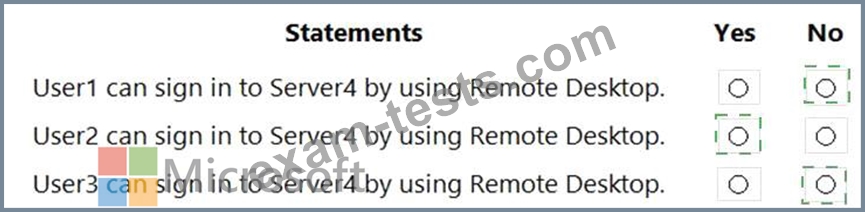
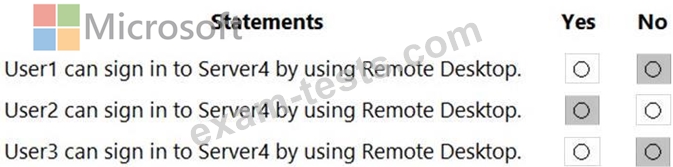
For each of the following statements, select Yes if the statement is true. Otherwise, select No.
NOTE: Each correct selection is worth one point.

NOTE: Each correct selection is worth one point.
Question 7
You have a server named Server1 that runs Windows Server and has the Web Server (IIS) server role installed. Server1 hosts an ASP.NET Core web app named WebApp1 and the app's source files.
You install Docker on Server1.
You need to ensure that you can deploy WebApp1 to an Azure App Service web app from the Azure Container Registry.
Which three actions should you perform in sequence? To answer, move the appropriate actions from the list of actions to the answer area and arrange them in the correct order.

You install Docker on Server1.
You need to ensure that you can deploy WebApp1 to an Azure App Service web app from the Azure Container Registry.
Which three actions should you perform in sequence? To answer, move the appropriate actions from the list of actions to the answer area and arrange them in the correct order.

Question 8
With which servers can Server1 and Server3 communicate? To answer, select the appropriate options in the answer area.
NOTE: Each correct selection is worth one point.

NOTE: Each correct selection is worth one point.

Question 9
You manage 200 physical servers that run Windows Server.
You plan to migrate the servers to Azure.
You need to prepare for discovery of the servers by using Azure Migrate.
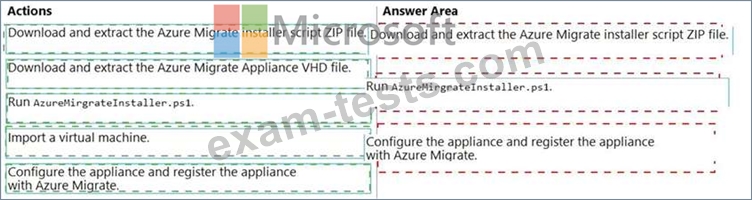
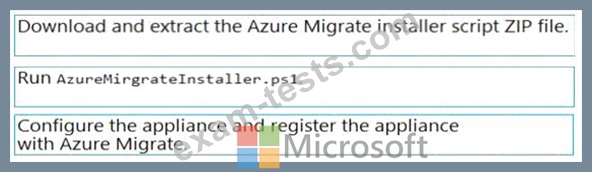
Which three actions should you perform in sequence on a physical server? To answer, move the appropriate actions from the list of actions to the answer area and arrange them in the correct order.

You plan to migrate the servers to Azure.
You need to prepare for discovery of the servers by using Azure Migrate.
Which three actions should you perform in sequence on a physical server? To answer, move the appropriate actions from the list of actions to the answer area and arrange them in the correct order.
Question 10
Your on-premises network contains two subnets. The subnets contain servers that run Windows Server as shown in the following table.
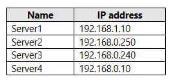
Server4 has the following IP configurations:
Ethernet adapter Ethernet:
Connection-specific DNS Suffix . . :
IPv4 Address . . . . . . . . . . . : 192.168.0.10
Subnet Mask . . . . . . . . . . . : 255.255.255.0
Default Gateway . . . . . . . . . : 192.168.0.1
From Server4, you can ping Server1 and Server2 successfully. When you ping Server3, you get a Request timed out response.
From Server2, you can ping Server1 and Server3 successfully.
The misconfiguration of which component on Server3 can cause the Request timed out response?
Server4 has the following IP configurations:
Ethernet adapter Ethernet:
Connection-specific DNS Suffix . . :
IPv4 Address . . . . . . . . . . . : 192.168.0.10
Subnet Mask . . . . . . . . . . . : 255.255.255.0
Default Gateway . . . . . . . . . : 192.168.0.1
From Server4, you can ping Server1 and Server2 successfully. When you ping Server3, you get a Request timed out response.
From Server2, you can ping Server1 and Server3 successfully.
The misconfiguration of which component on Server3 can cause the Request timed out response?