

Question 66
What is the effective minimum password length for User1 and Admin1? To answer, select the appropriate options in the answer area.
NOTE: Each correct selection is worth one point.

NOTE: Each correct selection is worth one point.

Question 67
You have a Hyper-V failover cluster named Cluster1 that uses a cloud witness. Cluster1 hosts a virtual machine named VM1 that runs Windows Server.
You need to fail over VM1 automatically to a different node when a service named Service1 on VM1 fails.
What should you do on Cluster1 and VM1? To answer, select the appropriate options in the answer area.
NOTE: Each correct selection is worth one point.

You need to fail over VM1 automatically to a different node when a service named Service1 on VM1 fails.
What should you do on Cluster1 and VM1? To answer, select the appropriate options in the answer area.
NOTE: Each correct selection is worth one point.


Question 68
You have two servers that have the Web Server (IIS) server role installed. The servers are configured as shown in the following table.

Both servers are configured to enable website deployment by using the Web Deployment Tool. Server1 hosts a website named Site1 that has Web Deploy Publishing configured.
You plan to migrate Site1 to Server2.
You need to perform a pull synchronization of Site1 by using the Web Deployment Agent Service.
How should you complete the command? To answer, select the appropriate options in the answer area.
NOTE: Each correct selection is worth one point.


Question 69
Your on-premises network contains two subnets. The subnets contain servers that run Windows Server as shown in the following table.
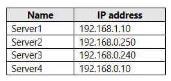
Server4 has the following IP configurations:
Ethernet adapter Ethernet:
Connection-specific DNS Suffix . . :
IPv4 Address . . . . . . . . . . . : 192.168.0.10
Subnet Mask . . . . . . . . . . . : 255.255.255.0
Default Gateway . . . . . . . . . : 192.168.0.1
From Server4, you can ping Server1 and Server2 successfully. When you ping Server3, you get a Request timed out response.
From Server2, you can ping Server1 and Server3 successfully.
The misconfiguration of which component on Server3 can cause the Request timed out response?
Question 70
Your network contains an Active Directory domain. The domain contains a domain controller named DC1 and a server named Server1 that runs Windows Server.
You need to enable event log subscriptions to forward events from DC1 to Server1.
Which command should you run to enable the Windows Event Collector service, and on which servers should you run the command? To answer, select the appropriate options in the answer area.
NOTE: Each correct selection is worth one point.
