

Question 31
Your company has a 3-tier solution running on Compute Engine. The configuration of the current infrastructure is shown below.
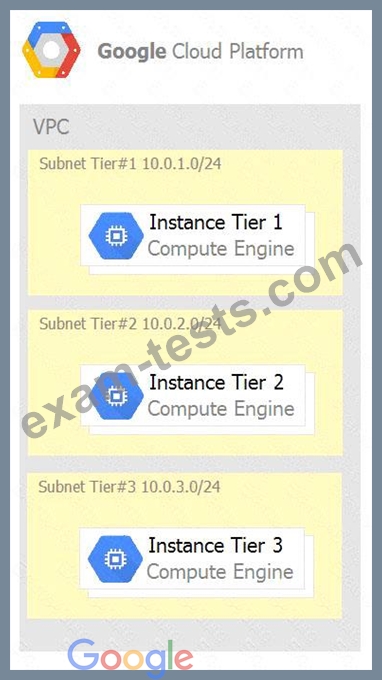
Each tier has a service account that is associated with all instances within it. You need to enable communication on TCP port 8080 between tiers as follows:
* Instances in tier #1 must communicate with tier #2.
* Instances in tier #2 must communicate with tier #3.
What should you do?
Each tier has a service account that is associated with all instances within it. You need to enable communication on TCP port 8080 between tiers as follows:
* Instances in tier #1 must communicate with tier #2.
* Instances in tier #2 must communicate with tier #3.
What should you do?
Question 32
You have a single binary application that you want to run on Google Cloud Platform. You decided to automatically scale the application based on underlying infrastructure CPU usage. Your organizational policies require you to use virtual machines directly. You need to ensure that the application scaling is operationally efficient and completed as quickly as possible. What should you do?
Question 33
You are hosting an application on bare-metal servers in your own data center. The application needs access to Cloud Storage. However, security policies prevent the servers hosting the application from having public IP addresses or access to the internet. You want to follow Google-recommended practices to provide the application with access to Cloud Storage. What should you do?
Question 34
Your customer has implemented a solution that uses Cloud Spanner and notices some read latency-related performance issues on one table. This table is accessed only by their users using a primary key. The table schema is shown below.
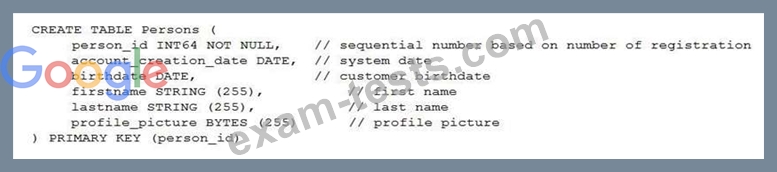
You want to resolve the issue. What should you do?

You want to resolve the issue. What should you do?
Question 35
You have successfully created a development environment in a project for an application. This application uses Compute Engine and Cloud SQL. Now, you need to create a production environment for this application.
The security team has forbidden the existence of network routes between these 2 environments, and asks you to follow Google-recommended practices. What should you do?
The security team has forbidden the existence of network routes between these 2 environments, and asks you to follow Google-recommended practices. What should you do?