

Question 6
(You are migrating your company's on-premises compute resources to Google Cloud. You need to deploy batch processing jobs that run every night. The jobs require significant CPU and memory for several hours but can tolerate interruptions. You must ensure that the deployment is cost-effective. What should you do?)
Question 7
Your company has a 3-tier solution running on Compute Engine. The configuration of the current infrastructure is shown below.
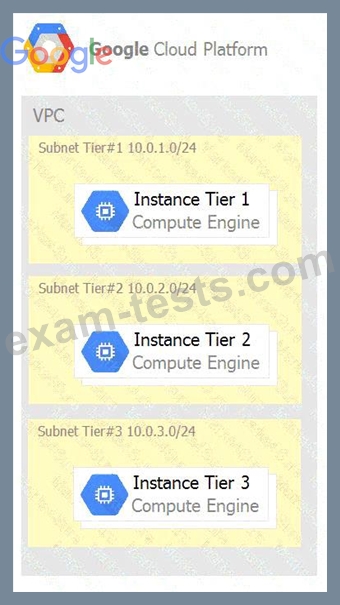
Each tier has a service account that is associated with all instances within it. You need to enable communication on TCP port 8080 between tiers as follows:
* Instances in tier #1 must communicate with tier #2.
* Instances in tier #2 must communicate with tier #3.
What should you do?
Each tier has a service account that is associated with all instances within it. You need to enable communication on TCP port 8080 between tiers as follows:
* Instances in tier #1 must communicate with tier #2.
* Instances in tier #2 must communicate with tier #3.
What should you do?
Question 8
You have 32 GB of data in a single file that you need to upload to a Nearline Storage bucket. The WAN connection you are using is rated at 1 Gbps, and you are the only one on the connection. You want to use as match of the rated 1 Gbps as possible to transfer the file rapidly. How should you upload the file?
Question 9
You have a Compute Engine instance hosting a production application. You want to receive an email if the instance consumes more than 90% of its CPU resources for more than 15 minutes. You want to use Google services. What should you do?
Question 10
You are using Deployment Manager to create a Google Kubernetes Engine cluster. Using the same Deployment Manager deployment, you also want to create a DaemonSet in the kube- system namespace of the cluster. You want a solution that uses the fewest possible services.
What should you do?
What should you do?