

Question 126
What requirements elicitation involves carefully selected stakeholders and subject matter experts for a short, intensive period (usually for one to a few days) to define and document the requirements for a solution?
Question 127
Which of the following is the best definition of the business rules analysis?
Question 128
Company A has been engaged to provide solution software to Company B as part of a combined service offering to Company C. This initiative requires a sub-project for Companies A and B to learn Company C's statutory requirements, a sub-project for Company A to write custom functionality for the solution, and a sub- project for Company B to develop infrastructure and support for the solution as well as the main project of implementation and cutover from Company C's current data processing solution to the service from Company
B. How does the business analyst (BA) assign requirements to the various solution components to ensure all objectives are met?
B. How does the business analyst (BA) assign requirements to the various solution components to ensure all objectives are met?
Question 129
A major manufacturer of popular beverages has appointed a local distributor to serve a specific territory. The demand for the beverages has a pronounced seasonal pattern. The distributor performs well overall, but is repeatedly unable to keep up with fulfilling many customer orders during peak demand periods. The distributor's current delivery capability is stretched to deliver 60 tons of merchandise per day whereas the season's peak demand periods need a daily delivery capability of up to 100 tons.
The distributor is under pressure to fully meet the year-round market demand in order to stay in business. The distributor's management wants to identify and consider more cost-effective options as resorting to adding more trucks and drivers would not be economically feasible.
A business analyst (BA) has spent several days observing and measuring the warehouse activities to understand the situation and to gain insights into possible solutions. The delivery workflow is a four-step process: (1) picking the orders and assembling them on trays, (2) bringing the trays to the loading bay, (3) loading the orders into trucks, and (4) delivering the orders to customers. As the following table illustrates, overall performance depends is dependent on five major resources: (1) the workers who pick the orders and load them into trucks, (2) the tallyers who check the orders, (3) the drivers, (4) the trucks, and (5) eight loading bays (LBs).
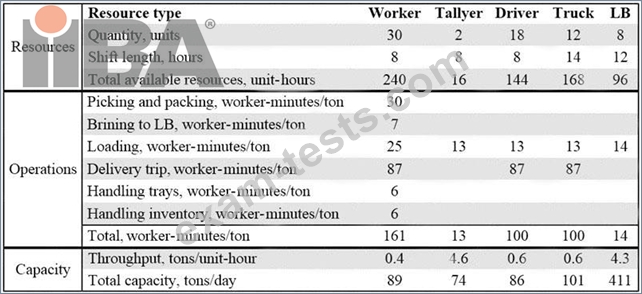
Preparing a customer order for loading takes about one hour. Upon the BA's observation, only 30% of trips have their orders available for loading when a truck arrives. This causes a waste of both the truck's and the driver's time.
What should the BA recommend to eliminate such waste?
The distributor is under pressure to fully meet the year-round market demand in order to stay in business. The distributor's management wants to identify and consider more cost-effective options as resorting to adding more trucks and drivers would not be economically feasible.
A business analyst (BA) has spent several days observing and measuring the warehouse activities to understand the situation and to gain insights into possible solutions. The delivery workflow is a four-step process: (1) picking the orders and assembling them on trays, (2) bringing the trays to the loading bay, (3) loading the orders into trucks, and (4) delivering the orders to customers. As the following table illustrates, overall performance depends is dependent on five major resources: (1) the workers who pick the orders and load them into trucks, (2) the tallyers who check the orders, (3) the drivers, (4) the trucks, and (5) eight loading bays (LBs).
Preparing a customer order for loading takes about one hour. Upon the BA's observation, only 30% of trips have their orders available for loading when a truck arrives. This causes a waste of both the truck's and the driver's time.
What should the BA recommend to eliminate such waste?
Question 130
A business analyst (BA) has recently completed a comprehensive stakeholder analysis. Next the BA would like to consider ways in which to ensure that the stakeholders remain engaged throughout the change strategy.
Some of the considerations include timing and frequency, location, available tools, delivery methods and the stakeholders' preferences. In which of the following plans would the BA document these considerations?
Some of the considerations include timing and frequency, location, available tools, delivery methods and the stakeholders' preferences. In which of the following plans would the BA document these considerations?