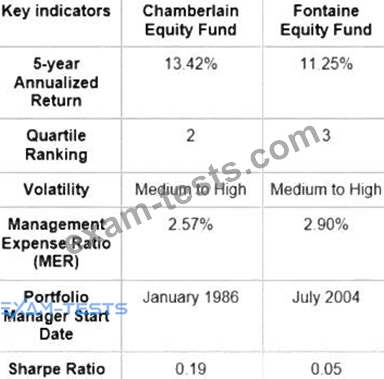
You have been researching Canadian equity mutual funds for a new client. You come across the following information. What can you conclude from this information?
Correct Answer: D
Explanation The management expense ratio (MER) is the percentage of a fund's assets that is paid to the fund manager for operating and managing the fund. A higher MER means that more of the fund's returns are eaten up by fees, leaving less for the investors. Therefore, Fontaine Equity Fund's higher MER of 2.99% contributes to its lower 5-year annualized return of 11.25%, compared to Chamberlain Equity Fund's MER of 2.57% and 5-year annualized return of 13.42%. Therefore, D is the correct answer. References: Canadian Investment Funds Course (CIFC) | IFSE Institute, Management Expense Ratio (MER): Definition and How It Works - Investopedia
Question 17
Which of the following statements regarding mutual fund fees is correct?
Correct Answer: C
Explanation Trailer fees are ongoing fees that are paid by mutual fund managers to mutual fund dealers for providing ongoing services to their clients who hold units of their funds. Trailer fees are calculated as a percentage of the value of assets under management (AUM) of the clients who hold units of the fund. Trailer fees are paid out of the management fee that is charged by the mutual fund manager to cover the costs of operating and administering the fund. Therefore, option C is correct regarding mutual fund fees. The other options are incorrect. Option A is false because redemptions are not made from units held by investors to pay trailer fees; rather, trailer fees are paid out of the management fee that is deducted from the net asset value (NAV) of the fund. Option B is false because trailer fees are not only paid to mutual fund dealers when a purchase is made; rather, trailer fees are paid on an ongoing basis as long as the clients hold units of the fund. Option D is false because trading commissions are not paid from the management fee; rather, trading commissions are paid from the trading expense ratio (TER) that reflects the costs of buying and selling securities within the fund. References: [Mutual Fund Fees Explained | Wealthsimple], [Mutual Fund Fees | GetSmarterAboutMoney.ca], [Understanding Mutual Fund Fees | Investopedia]
Question 18
Leira has a marginal tax rate of 45% and may deduct $5,000 in registered retirement savings plan (RRSP) contributions on her income tax return. If she decides to use her available deduction and assuming this does not reduce her taxable income to a lower tax bracket, by how much will it reduce her tax payable?
Correct Answer: C
Explanation A registered retirement savings plan (RRSP) is a type of tax-deferred account that allows individuals to save for retirement. Contributions to an RRSP are deductible from taxable income, which means that they reduce the amount of income tax payable for the year. The amount of tax savings from an RRSP contribution depends on the individual's marginal tax rate, which is the tax rate applied to the next dollar earned. Leira has a marginal tax rate of 45% and may deduct $5,000 in RRSP contributions on her income tax return. If she decides to use her available deduction and assuming this does not reduce her taxable income to a lower tax bracket, by how much will it reduce her tax payable? To answer this question, we can use the following formula: $$(Tax savings = RRSP contribution \times Marginal tax rate)
Question 19
Lior is considering an investment that gains exposure to companies that trade on the Toronto Stock Exchange (TSX). He is not sure what the differences are between a Canadian equity fund and a Canadian dividend fund. What would you tell him?
Correct Answer: C
Explanation The answer that you should tell Lior is that dividend funds tend to be less volatile and lower risk than equity funds. A dividend fund is a type of equity fund that invests primarily in dividend-paying stocks, which are shares of companies that distribute a portion of their earnings to shareholders on a regular basis. A dividend fund provides income and capital appreciation to investors, as well as tax advantages for eligible dividends paid by Canadian corporations. A dividend fund tends to be less volatile and lower risk than an equity fund that invests in non-dividend-paying stocks or growth stocks, which are shares of companies that reinvest their earnings into expanding their business rather than paying dividends. This is because dividend-paying stocks are usually issued by well-established and profitable companies that have stable cash flows and earnings, which make them more resilient to market fluctuations and economic downturns. Therefore, option C is correct regarding what you should tell Lior. The other options are not correct or relevant to what you should tell Lior. Option A is false because equity funds are not more appropriate than dividend funds if Lior requires a steady flow of income; rather, dividend funds are more suitable for income-oriented investors who want to receive regular dividends from their investments. Option B is false because dividend funds do not generate tax-preferred income while income from equity funds is fully taxable; rather, both types of funds generate taxable income for investors, but eligible dividends from Canadian corporations may qualify for a lower tax rate than other types of income due to the dividend tax credit. Option D is false because equity funds do not hold common shares while dividend funds hold only preferred shares; rather, both types of funds hold common shares, but dividend funds focus on common shares that pay dividends, while equity funds may also hold common shares that do not pay dividends or pay low dividends. References: [Dividend Funds | GetSmarterAboutMoney.ca], [Equity Funds | GetSmarterAboutMoney.ca], [Dividend Tax Credit | GetSmarterAboutMoney.ca]
Question 20
Which of the following characteristics about mortgage mutual funds is CORRECT?