

Question 61
Country X's short-term interest rates are slightly higher than its long-term rates. Which THREE of the following statements are correct?
Question 62
A company enters into a floating rate borrowing with interest due every 12 months over the five year life of the borrowing.
At the same time, the company arranges an interest rate swap to swap the interest profile on the borrowing from floating to fixed rate.
These transactions are designated as a hedge for hedge accounting purposes under IAS 39 Financial Instruments: Recognition and Measurement.
Assuming the hedge is considered to be effective, how would the swap be accounted for 12 months later?
At the same time, the company arranges an interest rate swap to swap the interest profile on the borrowing from floating to fixed rate.
These transactions are designated as a hedge for hedge accounting purposes under IAS 39 Financial Instruments: Recognition and Measurement.
Assuming the hedge is considered to be effective, how would the swap be accounted for 12 months later?
Question 63
Delta and Kappa both wish to borrow $50m.
Delta can borrow at a fixed rate of 12% or at a floating rate of the risk-free rate +3% Kappa can borrow at 15% fixed or the risk-free rate +4%.
Delta wishes a variable rate loan and Kappa a fixed rate loan The bank for the two companies suggests a swap arrangement The two companies agree to a swap arrangement, sharing savings equally What is the effective swap rate for each company?
Delta can borrow at a fixed rate of 12% or at a floating rate of the risk-free rate +3% Kappa can borrow at 15% fixed or the risk-free rate +4%.
Delta wishes a variable rate loan and Kappa a fixed rate loan The bank for the two companies suggests a swap arrangement The two companies agree to a swap arrangement, sharing savings equally What is the effective swap rate for each company?
Question 64
Listed company R is in the process of making a cash offer for the equity of unlisted company S.
Company R has a market capitalisation of $200 million and a price/earnings ratio of 10.
Company S has a market capitalisation of $50 million and earnings of $7 million.
Company R intends to offer $60 million and expects to be able to realise synergistic benefits of $20 million by combining the two businesses. This estimate excludes the estimated $8 million cost of integrating the two businesses.
Which of the following figures need to be used when calculating the value of the combined entity in $ millions?
Company R has a market capitalisation of $200 million and a price/earnings ratio of 10.
Company S has a market capitalisation of $50 million and earnings of $7 million.
Company R intends to offer $60 million and expects to be able to realise synergistic benefits of $20 million by combining the two businesses. This estimate excludes the estimated $8 million cost of integrating the two businesses.
Which of the following figures need to be used when calculating the value of the combined entity in $ millions?
Question 65
Two companies that operate in the same industry have different Price/Earnings (P/E) ratios as follows:
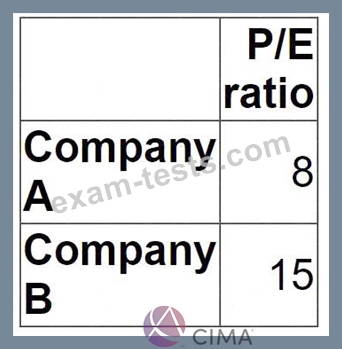
Which of the following is the most likely explanation of the different P/E ratios?
Which of the following is the most likely explanation of the different P/E ratios?
Premium Bundle
Newest CIMAPRA19-F03-1 Exam PDF Dumps shared by BraindumpsPass.com for Helping Passing CIMAPRA19-F03-1 Exam! BraindumpsPass.com now offer the updated CIMAPRA19-F03-1 exam dumps, the BraindumpsPass.com CIMAPRA19-F03-1 exam questions have been updated and answers have been corrected get the latest BraindumpsPass.com CIMAPRA19-F03-1 pdf dumps with Exam Engine here: