
- Home
- ISACA Certification
- CISA Exam
- ISACA.CISA.v2026-01-26.q999 Practice Test

Question 506
Which of the following is MOST important for an IS auditor to do during an exit meeting with an auditee?
Correct Answer: D
Question 507
Which of the following should an IS auditor review when verifying the integrity of a relational database management system (RDBMS)?
Correct Answer: C
Question 508
Which of the following key performance indicators (KPIs) provides stakeholders with the MOST useful information about whether information security risk is being managed?
Correct Answer: B
Question 509
Which of the following dynamic interaction of a Business Model for Information Security (BMIS) is a place
to introduce possible solutions such as feedback loops; alignment with process improvement; and
consideration of emergent issues in system design life cycle, change control, and risk management?
to introduce possible solutions such as feedback loops; alignment with process improvement; and
consideration of emergent issues in system design life cycle, change control, and risk management?
Correct Answer: D
Section: Governance and Management of IT
Explanation:
Emergence-which connotes surfacing, developing, growing and evolving-refers to patterns that arise in
the life of the enterprise that appear to have no obvious cause and whose outcomes seem impossible to
predict and control. The emergence dynamic interconnection (between people and processes) is a place to
introduce possible solutions such as feedback loops; alignment with process improvement; and
consideration of emergent issues in system design life cycle, change control, and risk management.
For your exam you should know the information below.
Business Model for Information Security
The Business Model for Information Security (BMIS) originated at the Institute for Critical Information
Infrastructure Protection at the Marshall School of Business at the University of Southern California in the
USA. ISACA has undertaken the development of the Systemic Security Management Model. The BMIS
takes a business-oriented approach to managing information security, building on the foundational
concepts developed by the Institute. The model utilizes systems thinking to clarify complex relationships
within the enterprise, and thus to more effectively manage security. The elements and dynamic
interconnections that form the basis of the model establish the boundaries of an information security
program and model how the program functions and reacts to internal and external change. The BMIS
provides the context for frameworks such as Cubit.
The essence of systems theory is that a system needs to be viewed holistically-not merely as a sum of its
parts-to be accurately understood. A holistic approach examines the system as a complete functioning
unit. Another tenet of systems theory is that one part of the system enables understanding of other parts of
the system. "Systems thinking" is a widely recognized term that refers to the examination of how systems
interact, how complex systems work and why "the whole is more than the sum of its parts." Systems theory
is most accurately described as a complex network of events, relationships, reactions, consequences,
technologies, processes and people that interact in often unseen and unexpected ways. Studying the
behaviors and results of the interactions can assist the manager to better understand the organizational
system and the way it functions. While management of any discipline within the enterprise can be
enhanced by approaching it from a systems thinking perspective, its implementation will certainly help with
managing risk.
The success that the systems approach has achieved in other fields bodes well for the benefits it can bring
to security. The often dramatic failures of enterprises to adequately address security issues in recent years
are due, to a significant extent, to their inability to define security and present it in a way that is
comprehensible and relevant to all stakeholders. Utilizing a systems approach to information security
management will help information security managers address complex and dynamic environments, and will
generate a beneficial effect on collaboration within the enterprise, adaptation to operational change,
navigation of strategic uncertainty and tolerance of the impact of external factors. The model is represented
below.
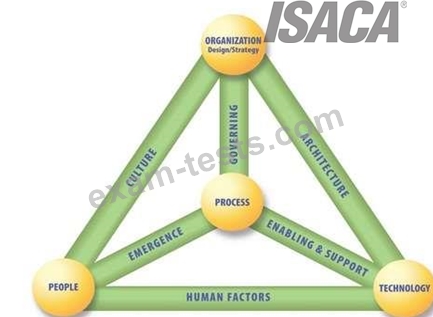
As illustrated in above, the model is best viewed as a flexible, three-dimensional, pyramid-shaped structure
made up of four elements linked together by six dynamic interconnections.
All aspects of the model interact with each other. If any one part of the model is changed, not addressed or
managed inappropriately, the equilibrium of the model is potentially at risk. The dynamic interconnections
act as tensions, exerting a push/pull force in reaction to changes in the enterprise, allowing the model to
adapt as needed.
The four elements of the model are:
1. Organization Design and Strategy-An organization is a network of people, assets and processes
interacting with each other in defined roles and working toward a common goal.
An enterprise's strategy specifies its business goals and the objectives to be achieved as well as the values
and missions to be pursued. It is the enterprise's formula for success and sets its basic direction. The
strategy should adapt to external and internal factors. Resources are the primary material to design the
strategy and can be of different types (people, equipment, know-how). Design defines how the organization
implements its strategy. Processes, culture and architecture are important in determining the design.
2. People-The human resources and the security issues that surround them. It defines who implements
(through design) each part of the strategy. It represents a human collective and must take into account
values, behaviors and biases. Internally, it is critical for the information security manager to work with the
human resources and legal departments to address issues such as:
Recruitment strategies (access, background checks, interviews, roles and responsibilities)
Employment issues (location of office, access to tools and data, training and awareness, movement within
the enterprise)
Termination (reasons for leaving, timing of exit, roles and responsibilities, access to systems, access to
other employees). Externally, customers, suppliers, media, stakeholders and others can have a strong
influence on the enterprise and need to be considered within the security posture.
3. Process-Includes formal and informal mechanisms (large and small, simple and complex) to get things
done and provides a vital link to all of the dynamic interconnections.
Processes identify, measure, manage and control risk, availability, integrity and confidentiality, and they
also ensure accountability. They derive from the strategy and implement the operational part of the
organization element.
To be advantageous to the enterprise, processes must:
Meet business requirements and align with policy
Consider emergence and be adaptable to changing requirements
Be well documented and communicated to appropriate human resources
Be reviewed periodically, once they are in place, to ensure efficiency and effectiveness
4. Technology-Composed of all of the tools, applications and infrastructure that make processes more
efficient. As an evolving element that experiences frequent changes, it has its own dynamic risk. Given the
typical enterprise's dependence on technology, technology constitutes a core part of the enterprise's
infrastructure and a critical component in accomplishing its mission.
Technology is often seen by the enterprise's management team as a way to resolve security threats and
risk. While technical controls are helpful in mitigating some types of risk, technology should not be viewed
as an information security solution.
Technology is greatly impacted by users and by organizational culture. Some individuals still mistrust
technology; some have not learned to use it; and others feel it slows them down. Regardless of the reason,
information security managers must be aware that many people will try to sidestep technical controls.
Dynamic Interconnections
The dynamic interconnections are what link the elements together and exert a multidirectional force that
pushes and pulls as things change. Actions and behaviors that occur in the dynamic interconnections can
force the model out of balance or bring it back to equilibrium.
The six dynamic interconnections are:
1. Governing-Governing is the steering of the enterprise and demands strategic leadership. Governing
sets limits within which an enterprise operates and is implemented within processes to monitor
performance, describe activities and achieve compliance while also providing adaptability to emergent
conditions. Governing incorporates ensuring that objectives are determined and defined, ascertaining that
risks are managed appropriately, and verifying that the enterprise's resources are used responsibly.
2. Culture-Culture is a pattern of behaviors, beliefs, assumptions, attitudes and ways of doing things. It is
emergent and learned, and it creates a sense of comfort. Culture evolves as a type of shared history as a
group goes through a set of common experiences. Those similar experiences cause certain responses,
which become a set of expected and shared behaviors. These behaviors become unwritten rules, which
become norms that are shared by all people who have that common history. It is important to understand
the culture of the enterprise because it profoundly influences what information is considered, how it is
interpreted and what will be done with it. Culture may exist on many levels, such as national (legislation/
regulation, political and traditional), organizational (policies, hierarchical style and expectations) and social
(family, etiquette). It is created from both external and internal factors, and is influenced by and influences
organizational patterns.
3. Enabling and support-The enabling and support dynamic interconnection connects the technology
element to the process element. One way to help ensure that people comply with technical security
measures, policies and procedures is to make processes usable and easy. Transparency can help
generate acceptance for security controls by assuring users that security will not inhibit their ability to work
effectively. Many of the actions that affect both technology and processes occur in the enabling and support
dynamic interconnection. Policies, standards and guidelines must be designed to support the needs of the
business by reducing or eliminating conflicts of interest, remaining flexible to support changing business
objectives, and being acceptable and easy for people to follow.
4. Emergence-Emergence-which connotes surfacing, developing, growing and evolving-refers to
patterns that arise in the life of the enterprise that appear to have no obvious cause and whose outcomes
seem impossible to predict and control. The emergence dynamic interconnection (between people and
processes) is a place to introduce possible solutions such as feedback loops; alignment with process
improvement; and consideration of emergent issues in system design life cycle, change control, and risk
management.
5. Human factors-The human factors dynamic interconnection represents the interaction and gap
between technology and people and, as such, is critical to an information security program. If people do not
understand how to use the technology, do not embrace the technology or will not follow pertinent policies,
serious security problems can evolve. Internal threats such as data leakage, data theft and misuse of data
can occur within this dynamic interconnection. Human factors may arise because of age, experience level
and/or cultural experiences. Because human factors are critical components in maintaining balance within
the model, it is important to train all of the enterprise's human resources on pertinent skills.
6. Architecture-A security architecture is a comprehensive and formal encapsulation of the people,
processes, policies and technology that comprise an enterprise's security practices. A robust business
information architecture is essential to understanding the need for security and designing the security
architecture. It is within the architecture dynamic interconnection that the enterprise can ensure defense in
depth. The design describes how the security controls are positioned and how they relate to the overall IT
architecture. An enterprise security architecture facilitates security capabilities across lines of businesses in
a consistent and a cost-effective manner and enables enterprises to be proactive with their security
investment decisions.
The following answers are incorrect:
Governing - Governing is the steering of the enterprise and demands strategic leadership. Governing sets
limits within which an enterprise operates and is implemented within processes to monitor performance,
describe activities and achieve compliance while also providing adaptability to emergent conditions.
Governing incorporates ensuring that objectives are determined and defined, ascertaining that risks are
managed appropriately, and verifying that the enterprise's resources are used responsibly.
Enabling and support - The enabling and support dynamic interconnection connects the technology
element to the process element. One way to help ensure that people comply with technical security
measures, policies and procedures is to make processes usable and easy. Transparency can help
generate acceptance for security controls by assuring users that security will not inhibit their ability to work
effectively. Many of the actions that affect both technology and processes occur in the enabling and support
dynamic interconnection. Policies, standards and guidelines must be designed to support the needs of the
business by reducing or eliminating conflicts of interest, remaining flexible to support changing business
objectives, and being acceptable and easy for people to follow.
Culture - Culture is a pattern of behaviors, beliefs, assumptions, attitudes and ways of doing things. It is
emergent and learned, and it creates a sense of comfort. Culture evolves as a type of shared history as a
group goes through a set of common experiences. Those similar experiences cause certain responses,
which become a set of expected and shared behaviors. These behaviors become unwritten rules, which
become norms that are shared by all people who have that common history. It is important to understand
the culture of the enterprise because it profoundly influences what information is considered, how it is
interpreted and what will be done with it. Culture may exist on many levels, such as national (legislation/
regulation, political and traditional), organizational (policies, hierarchical style and expectations) and social
(family, etiquette). It is created from both external and internal factors, and is influenced by and influences
organizational patterns.
The following reference(s) were/was used to create this question:
CISA review manual 2014 page number 37 and 38
http://www.isaca.org/Knowledge-Center/BMIS/Documents/IntrotoBMIS.pdf
Explanation:
Emergence-which connotes surfacing, developing, growing and evolving-refers to patterns that arise in
the life of the enterprise that appear to have no obvious cause and whose outcomes seem impossible to
predict and control. The emergence dynamic interconnection (between people and processes) is a place to
introduce possible solutions such as feedback loops; alignment with process improvement; and
consideration of emergent issues in system design life cycle, change control, and risk management.
For your exam you should know the information below.
Business Model for Information Security
The Business Model for Information Security (BMIS) originated at the Institute for Critical Information
Infrastructure Protection at the Marshall School of Business at the University of Southern California in the
USA. ISACA has undertaken the development of the Systemic Security Management Model. The BMIS
takes a business-oriented approach to managing information security, building on the foundational
concepts developed by the Institute. The model utilizes systems thinking to clarify complex relationships
within the enterprise, and thus to more effectively manage security. The elements and dynamic
interconnections that form the basis of the model establish the boundaries of an information security
program and model how the program functions and reacts to internal and external change. The BMIS
provides the context for frameworks such as Cubit.
The essence of systems theory is that a system needs to be viewed holistically-not merely as a sum of its
parts-to be accurately understood. A holistic approach examines the system as a complete functioning
unit. Another tenet of systems theory is that one part of the system enables understanding of other parts of
the system. "Systems thinking" is a widely recognized term that refers to the examination of how systems
interact, how complex systems work and why "the whole is more than the sum of its parts." Systems theory
is most accurately described as a complex network of events, relationships, reactions, consequences,
technologies, processes and people that interact in often unseen and unexpected ways. Studying the
behaviors and results of the interactions can assist the manager to better understand the organizational
system and the way it functions. While management of any discipline within the enterprise can be
enhanced by approaching it from a systems thinking perspective, its implementation will certainly help with
managing risk.
The success that the systems approach has achieved in other fields bodes well for the benefits it can bring
to security. The often dramatic failures of enterprises to adequately address security issues in recent years
are due, to a significant extent, to their inability to define security and present it in a way that is
comprehensible and relevant to all stakeholders. Utilizing a systems approach to information security
management will help information security managers address complex and dynamic environments, and will
generate a beneficial effect on collaboration within the enterprise, adaptation to operational change,
navigation of strategic uncertainty and tolerance of the impact of external factors. The model is represented
below.
As illustrated in above, the model is best viewed as a flexible, three-dimensional, pyramid-shaped structure
made up of four elements linked together by six dynamic interconnections.
All aspects of the model interact with each other. If any one part of the model is changed, not addressed or
managed inappropriately, the equilibrium of the model is potentially at risk. The dynamic interconnections
act as tensions, exerting a push/pull force in reaction to changes in the enterprise, allowing the model to
adapt as needed.
The four elements of the model are:
1. Organization Design and Strategy-An organization is a network of people, assets and processes
interacting with each other in defined roles and working toward a common goal.
An enterprise's strategy specifies its business goals and the objectives to be achieved as well as the values
and missions to be pursued. It is the enterprise's formula for success and sets its basic direction. The
strategy should adapt to external and internal factors. Resources are the primary material to design the
strategy and can be of different types (people, equipment, know-how). Design defines how the organization
implements its strategy. Processes, culture and architecture are important in determining the design.
2. People-The human resources and the security issues that surround them. It defines who implements
(through design) each part of the strategy. It represents a human collective and must take into account
values, behaviors and biases. Internally, it is critical for the information security manager to work with the
human resources and legal departments to address issues such as:
Recruitment strategies (access, background checks, interviews, roles and responsibilities)
Employment issues (location of office, access to tools and data, training and awareness, movement within
the enterprise)
Termination (reasons for leaving, timing of exit, roles and responsibilities, access to systems, access to
other employees). Externally, customers, suppliers, media, stakeholders and others can have a strong
influence on the enterprise and need to be considered within the security posture.
3. Process-Includes formal and informal mechanisms (large and small, simple and complex) to get things
done and provides a vital link to all of the dynamic interconnections.
Processes identify, measure, manage and control risk, availability, integrity and confidentiality, and they
also ensure accountability. They derive from the strategy and implement the operational part of the
organization element.
To be advantageous to the enterprise, processes must:
Meet business requirements and align with policy
Consider emergence and be adaptable to changing requirements
Be well documented and communicated to appropriate human resources
Be reviewed periodically, once they are in place, to ensure efficiency and effectiveness
4. Technology-Composed of all of the tools, applications and infrastructure that make processes more
efficient. As an evolving element that experiences frequent changes, it has its own dynamic risk. Given the
typical enterprise's dependence on technology, technology constitutes a core part of the enterprise's
infrastructure and a critical component in accomplishing its mission.
Technology is often seen by the enterprise's management team as a way to resolve security threats and
risk. While technical controls are helpful in mitigating some types of risk, technology should not be viewed
as an information security solution.
Technology is greatly impacted by users and by organizational culture. Some individuals still mistrust
technology; some have not learned to use it; and others feel it slows them down. Regardless of the reason,
information security managers must be aware that many people will try to sidestep technical controls.
Dynamic Interconnections
The dynamic interconnections are what link the elements together and exert a multidirectional force that
pushes and pulls as things change. Actions and behaviors that occur in the dynamic interconnections can
force the model out of balance or bring it back to equilibrium.
The six dynamic interconnections are:
1. Governing-Governing is the steering of the enterprise and demands strategic leadership. Governing
sets limits within which an enterprise operates and is implemented within processes to monitor
performance, describe activities and achieve compliance while also providing adaptability to emergent
conditions. Governing incorporates ensuring that objectives are determined and defined, ascertaining that
risks are managed appropriately, and verifying that the enterprise's resources are used responsibly.
2. Culture-Culture is a pattern of behaviors, beliefs, assumptions, attitudes and ways of doing things. It is
emergent and learned, and it creates a sense of comfort. Culture evolves as a type of shared history as a
group goes through a set of common experiences. Those similar experiences cause certain responses,
which become a set of expected and shared behaviors. These behaviors become unwritten rules, which
become norms that are shared by all people who have that common history. It is important to understand
the culture of the enterprise because it profoundly influences what information is considered, how it is
interpreted and what will be done with it. Culture may exist on many levels, such as national (legislation/
regulation, political and traditional), organizational (policies, hierarchical style and expectations) and social
(family, etiquette). It is created from both external and internal factors, and is influenced by and influences
organizational patterns.
3. Enabling and support-The enabling and support dynamic interconnection connects the technology
element to the process element. One way to help ensure that people comply with technical security
measures, policies and procedures is to make processes usable and easy. Transparency can help
generate acceptance for security controls by assuring users that security will not inhibit their ability to work
effectively. Many of the actions that affect both technology and processes occur in the enabling and support
dynamic interconnection. Policies, standards and guidelines must be designed to support the needs of the
business by reducing or eliminating conflicts of interest, remaining flexible to support changing business
objectives, and being acceptable and easy for people to follow.
4. Emergence-Emergence-which connotes surfacing, developing, growing and evolving-refers to
patterns that arise in the life of the enterprise that appear to have no obvious cause and whose outcomes
seem impossible to predict and control. The emergence dynamic interconnection (between people and
processes) is a place to introduce possible solutions such as feedback loops; alignment with process
improvement; and consideration of emergent issues in system design life cycle, change control, and risk
management.
5. Human factors-The human factors dynamic interconnection represents the interaction and gap
between technology and people and, as such, is critical to an information security program. If people do not
understand how to use the technology, do not embrace the technology or will not follow pertinent policies,
serious security problems can evolve. Internal threats such as data leakage, data theft and misuse of data
can occur within this dynamic interconnection. Human factors may arise because of age, experience level
and/or cultural experiences. Because human factors are critical components in maintaining balance within
the model, it is important to train all of the enterprise's human resources on pertinent skills.
6. Architecture-A security architecture is a comprehensive and formal encapsulation of the people,
processes, policies and technology that comprise an enterprise's security practices. A robust business
information architecture is essential to understanding the need for security and designing the security
architecture. It is within the architecture dynamic interconnection that the enterprise can ensure defense in
depth. The design describes how the security controls are positioned and how they relate to the overall IT
architecture. An enterprise security architecture facilitates security capabilities across lines of businesses in
a consistent and a cost-effective manner and enables enterprises to be proactive with their security
investment decisions.
The following answers are incorrect:
Governing - Governing is the steering of the enterprise and demands strategic leadership. Governing sets
limits within which an enterprise operates and is implemented within processes to monitor performance,
describe activities and achieve compliance while also providing adaptability to emergent conditions.
Governing incorporates ensuring that objectives are determined and defined, ascertaining that risks are
managed appropriately, and verifying that the enterprise's resources are used responsibly.
Enabling and support - The enabling and support dynamic interconnection connects the technology
element to the process element. One way to help ensure that people comply with technical security
measures, policies and procedures is to make processes usable and easy. Transparency can help
generate acceptance for security controls by assuring users that security will not inhibit their ability to work
effectively. Many of the actions that affect both technology and processes occur in the enabling and support
dynamic interconnection. Policies, standards and guidelines must be designed to support the needs of the
business by reducing or eliminating conflicts of interest, remaining flexible to support changing business
objectives, and being acceptable and easy for people to follow.
Culture - Culture is a pattern of behaviors, beliefs, assumptions, attitudes and ways of doing things. It is
emergent and learned, and it creates a sense of comfort. Culture evolves as a type of shared history as a
group goes through a set of common experiences. Those similar experiences cause certain responses,
which become a set of expected and shared behaviors. These behaviors become unwritten rules, which
become norms that are shared by all people who have that common history. It is important to understand
the culture of the enterprise because it profoundly influences what information is considered, how it is
interpreted and what will be done with it. Culture may exist on many levels, such as national (legislation/
regulation, political and traditional), organizational (policies, hierarchical style and expectations) and social
(family, etiquette). It is created from both external and internal factors, and is influenced by and influences
organizational patterns.
The following reference(s) were/was used to create this question:
CISA review manual 2014 page number 37 and 38
http://www.isaca.org/Knowledge-Center/BMIS/Documents/IntrotoBMIS.pdf
Question 510
Who is responsible for authorizing access level of a data user?
Correct Answer: A
Explanation/Reference:
Data owners are responsible for authorizing access level of a data user. These peoples are generally managers and directors responsible for using information for running and controlling the business. Their security responsibilities include authorizing access, ensuring that access rules are updated when personnel changes occur, and regularly review access rule for the data for which they are responsible.
For your exam you should know below roles in an organization
Data Owners - Data Owners are generally managers and directors responsible for using information for running and controlling the business. Their security responsibilities include authorizing access, ensuring that access rules are updated when personnel changes occur, and regularly review access rule for the data for which they are responsible.
Data Custodian or Data Steward -are responsible for storing and safeguarding the data, and include IS personnel such as system analysis and computer operators.
Security Administrator -Security administrator is responsible for providing adequate physical and logical security for IS programs, data and equipment.
Data Users - Data users, including internal and external user community, are the actual user of computerized data. Their level of access into the computer should be authorized by data owners, and restricted and monitor by security administrator.
The following were incorrect answers:
Security Administrator -Security administrator is responsible for providing adequate and logical security for IS programs, data and equipment.
Data Users - Data users, including internal and external user community, are the actual user of computerized data.
Data custodian is responsible for storing and safeguarding the data, and include IS personnel such as system analyst and computer operators.
The following reference(s) were/was used to create this question:
CISA review manual 2014 Page number361
Data owners are responsible for authorizing access level of a data user. These peoples are generally managers and directors responsible for using information for running and controlling the business. Their security responsibilities include authorizing access, ensuring that access rules are updated when personnel changes occur, and regularly review access rule for the data for which they are responsible.
For your exam you should know below roles in an organization
Data Owners - Data Owners are generally managers and directors responsible for using information for running and controlling the business. Their security responsibilities include authorizing access, ensuring that access rules are updated when personnel changes occur, and regularly review access rule for the data for which they are responsible.
Data Custodian or Data Steward -are responsible for storing and safeguarding the data, and include IS personnel such as system analysis and computer operators.
Security Administrator -Security administrator is responsible for providing adequate physical and logical security for IS programs, data and equipment.
Data Users - Data users, including internal and external user community, are the actual user of computerized data. Their level of access into the computer should be authorized by data owners, and restricted and monitor by security administrator.
The following were incorrect answers:
Security Administrator -Security administrator is responsible for providing adequate and logical security for IS programs, data and equipment.
Data Users - Data users, including internal and external user community, are the actual user of computerized data.
Data custodian is responsible for storing and safeguarding the data, and include IS personnel such as system analyst and computer operators.
The following reference(s) were/was used to create this question:
CISA review manual 2014 Page number361
- Other Version
- 6717ISACA.CISA.v2026-02-11.q999
- 12034ISACA.CISA.v2025-05-24.q773
- 4973ISACA.CISA.v2024-10-22.q310
- 11257ISACA.CISA.v2023-10-02.q715
- 5626ISACA.CISA.v2023-03-29.q119
- 4644ISACA.CISA.v2023-02-09.q181
- 2852ISACA.CISA.v2023-02-06.q107
- 4442ISACA.CISA.v2022-08-28.q129
- 6126ISACA.CISA.v2022-02-25.q148
- 130ISACA.Actualtestpdf.CISA.v2021-11-13.by.sarah.721q.pdf
- 7778ISACA.CISA.v2021-11-11.q194
- 11191ISACA.CISA.v2021-10-08.q198
- 12292ISACA.CISA.v2021-09-28.q199
- 14915ISACA.CISA.v2021-09-11.q201
- Latest Upload
- 191Google.Professional-Cloud-DevOps-Engineer.v2026-09-16.q209
- 181AAPC.CPC.v2026-09-16.q132
- 125HP.HPE0-J82.v2026-09-16.q26
- 188F5.303.v2026-09-16.q147
- 181PaloAltoNetworks.NGFW-Engineer.v2026-09-16.q105
- 133Workday.Workday-Pro-Recruiting.v2026-09-15.q19
- 145ACAMS.CAMS-FCI.v2026-09-15.q36
- 161VMware.250-614.v2026-09-15.q42
- 205IAPP.CIPM.v2026-09-15.q217
- 177VMware.2V0-13.25.v2026-09-14.q122
[×]
Download PDF File
Enter your email address to download ISACA.CISA.v2026-01-26.q999 Practice Test