
- Home
- ISACA Certification
- CISA Exam
- ISACA.CISA.v2026-01-26.q999 Practice Test

Question 666
Which of the following testing methods is MOST appropriate for assessing whether system integrity has been maintained after changes have been made?
Correct Answer: A
Regression testing is the most appropriate testing method for assessing whether system integrity has been maintained after changes have been made. Regression testing is a type of software testing that ensures that previously developed and tested software still performs as expected after a change1 Regression testing helps to detectany defects or errors that may have been introduced or uncovered due to the change2 Regression testing can be performed at different levels of testing, such as unit, integration, system, and acceptance3 Unit testing is a type of software testing that verifies the functionality of individual components or units of code. Unit testing is usually performed by developers before integrating the code with other components. Unit testing helps to identify and fix errors at an early stage of development, but it does not ensure that the system as a whole works as expected after a change.
Integration testing is a type of software testing that verifies the functionality, performance, and reliability of the interactions between different components or units of code. Integration testing is usually performed after unit testing and before system testing. Integration testing helps to identify and fix errors that may occur when different components are integrated, but it does not ensure that the system as a whole works as expected after a change.
Acceptance testing is a type of software testing that verifies whether the system meets the user requirements and expectations. Acceptance testing is usually performed by end-users or customersafter system testing and before deploying the system to production. Acceptance testing helps to ensure that the system delivers the desired value and quality to the users, but it does not ensure that the system as a whole works as expected after a change.
References: 1: What is Regression Testing? Test Cases (Example) - Guru99 2: What is Regression Testing? Definition, Tools, Examples - Katalon 3: Regression testing - Wikipedia : What is Unit Testing?
Definition, Types, Tools & Examples - Guru99 : What is Integration Testing? Definition, Types, Tools & Examples - Guru99 : What is Acceptance Testing? Definition, Types, Tools & Examples - Guru99
Integration testing is a type of software testing that verifies the functionality, performance, and reliability of the interactions between different components or units of code. Integration testing is usually performed after unit testing and before system testing. Integration testing helps to identify and fix errors that may occur when different components are integrated, but it does not ensure that the system as a whole works as expected after a change.
Acceptance testing is a type of software testing that verifies whether the system meets the user requirements and expectations. Acceptance testing is usually performed by end-users or customersafter system testing and before deploying the system to production. Acceptance testing helps to ensure that the system delivers the desired value and quality to the users, but it does not ensure that the system as a whole works as expected after a change.
References: 1: What is Regression Testing? Test Cases (Example) - Guru99 2: What is Regression Testing? Definition, Tools, Examples - Katalon 3: Regression testing - Wikipedia : What is Unit Testing?
Definition, Types, Tools & Examples - Guru99 : What is Integration Testing? Definition, Types, Tools & Examples - Guru99 : What is Acceptance Testing? Definition, Types, Tools & Examples - Guru99
Question 667
Which of the following is the MOST effective control when granting temporary access to vendors?
Correct Answer: B
Section: Protection of Information Assets
Explanation:
The most effective control is to ensure that the granting of temporary access is based on services to be provided and that there is an expiration date (hopefully automated) associated with each ID. The SLA may have a provision for providing access, but this is not a control; it would merely define the need for access.
Vendors require access for a limited period during the time of service. However, it is important to ensure that the access during this period is monitored. Deleting these user, I Dafter the work is completed is necessary, but if not automated, the deletion could be overlooked.
Explanation:
The most effective control is to ensure that the granting of temporary access is based on services to be provided and that there is an expiration date (hopefully automated) associated with each ID. The SLA may have a provision for providing access, but this is not a control; it would merely define the need for access.
Vendors require access for a limited period during the time of service. However, it is important to ensure that the access during this period is monitored. Deleting these user, I Dafter the work is completed is necessary, but if not automated, the deletion could be overlooked.
Question 668
Which of the following should an IS auditor consider FIRST when evaluating firewall rules?
Correct Answer: A
Explanation
This should be the first thing that an IS auditor considers when evaluating firewall rules, because it defines the objectives, standards, and guidelines for securing the organization's network and information assets. The firewall rules should be aligned with the organization's security policy, and reflect the level of risk and protection required for each type of network traffic, system, or data. The IS auditor should compare the firewall rules with the security policy, and identify any discrepancies, gaps, or conflicts that could compromise the security or performance of the network.
The other options are not as important as the organization's security policy when evaluating firewall rules:
The number of remote nodes. This is a factor that may affect the complexity and scalability of the firewall rules, but it is not a primary consideration for the IS auditor. Remote nodes are devices or systems that connect to the network from outside locations, such as teleworkers, mobile users, or branch offices. The IS auditor should ensure that the firewall rules provide adequate security and access control for remote nodes, but this depends on the organization's security policy and business needs.
The firewalls' default settings. These are the predefined configurations that come with the firewall devices or software, and that determine how they handle network traffic by default. The IS auditor should review the firewalls' default settings, and verify that they are appropriate and secure for the organization's network environment. However, the firewalls' default settings may not match the organization's security policy or specific requirements, and may need to be customized or overridden by firewall rules.
The physical location of the firewalls. This is a factor that may affect the placement and design of the firewall rules, but it is not a critical consideration for the IS auditor. The physical location of the firewalls refers to where they are installed or deployed in relation to the network topology, such as at the network perimeter, between network segments, or on individual hosts. The IS auditor should ensure that the firewall rules are consistent and coordinated across different locations, but this depends on the organization's security policy and network architecture.
This should be the first thing that an IS auditor considers when evaluating firewall rules, because it defines the objectives, standards, and guidelines for securing the organization's network and information assets. The firewall rules should be aligned with the organization's security policy, and reflect the level of risk and protection required for each type of network traffic, system, or data. The IS auditor should compare the firewall rules with the security policy, and identify any discrepancies, gaps, or conflicts that could compromise the security or performance of the network.
The other options are not as important as the organization's security policy when evaluating firewall rules:
The number of remote nodes. This is a factor that may affect the complexity and scalability of the firewall rules, but it is not a primary consideration for the IS auditor. Remote nodes are devices or systems that connect to the network from outside locations, such as teleworkers, mobile users, or branch offices. The IS auditor should ensure that the firewall rules provide adequate security and access control for remote nodes, but this depends on the organization's security policy and business needs.
The firewalls' default settings. These are the predefined configurations that come with the firewall devices or software, and that determine how they handle network traffic by default. The IS auditor should review the firewalls' default settings, and verify that they are appropriate and secure for the organization's network environment. However, the firewalls' default settings may not match the organization's security policy or specific requirements, and may need to be customized or overridden by firewall rules.
The physical location of the firewalls. This is a factor that may affect the placement and design of the firewall rules, but it is not a critical consideration for the IS auditor. The physical location of the firewalls refers to where they are installed or deployed in relation to the network topology, such as at the network perimeter, between network segments, or on individual hosts. The IS auditor should ensure that the firewall rules are consistent and coordinated across different locations, but this depends on the organization's security policy and network architecture.
Question 669
Which of the following is the MOST effective method for dealing with the spreading of a network worm that exploits vulnerability in a protocol?
Correct Answer: D
Stopping the service and installing the security fix is the safest way to prevent the worm from spreading, if the service is not stopped, installing the fix is not the most effective method because the worm continues spreading until the fix becomes effective. Blocking the protocol on the perimeter does not stop the worm from spreading to the internal network(s). Blocking the protocol helps to slow down the spreading but also prohibits any software that utilizes it from working between segments.
Question 670
Which of the following statement INCORRECTLY describes device and where they sit within the TCP/IP model?
Correct Answer: A
Explanation/Reference:
The keyword within the question is INCORRECTLY. You need to find out incorrect statement.
For your exam you should know below information about TCP/IP model:
Network models
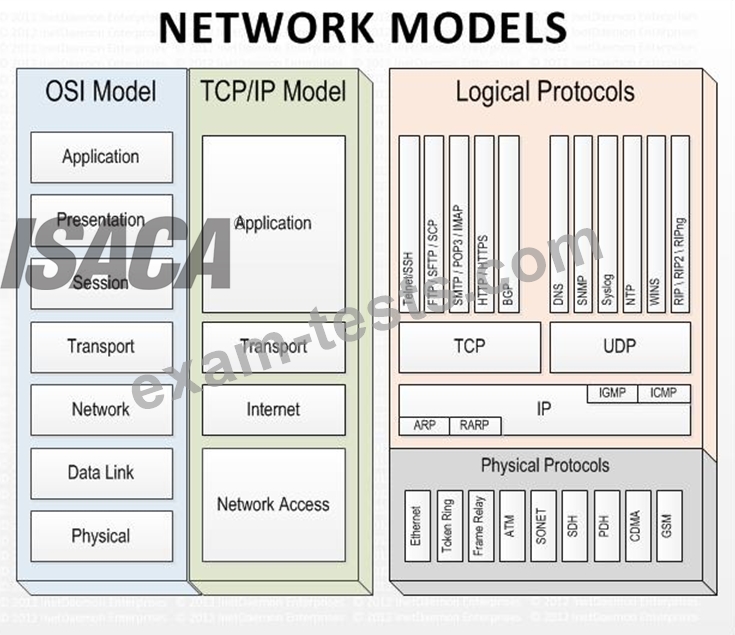
Layer 4. Application Layer
Application layer is the top most layer of four layer TCP/IP model. Application layer is present on the top of the Transport layer. Application layer defines TCP/IP application protocols and how host programs interface with Transport layer services to use the network.
Application layer includes all the higher-level protocols like DNS (Domain Naming System), HTTP (Hypertext Transfer Protocol), Telnet, SSH, FTP (File Transfer Protocol), TFTP (Trivial File Transfer Protocol), SNMP (Simple Network Management Protocol), SMTP (Simple Mail Transfer Protocol) , DHCP (Dynamic Host Configuration Protocol), X Windows, RDP (Remote Desktop Protocol) etc.
Layer 3. Transport Layer
Transport Layer is the third layer of the four layer TCP/IP model. The position of the Transport layer is between Application layer and Internet layer. The purpose of Transport layer is to permit devices on the source and destination hosts to carry on a conversation. Transport layer defines the level of service and status of the connection used when transporting data.
The main protocols included at Transport layer are TCP (Transmission Control Protocol) and UDP (User Datagram Protocol).
Layer 2. Internet Layer
Internet Layer is the second layer of the four layer TCP/IP model. The position of Internet layer is between Network Access Layer and Transport layer. Internet layer pack data into data packets known as IP datagram's, which contain source and destination address (logical address or IP address) information that is used to forward the datagram's between hosts and across networks. The Internet layer is also responsible for routing of IP datagram's.
Packet switching network depends upon a connectionless internetwork layer. This layer is known as Internet layer. Its job is to allow hosts to insert packets into any network and have them to deliver independently to the destination. At the destination side data packets may appear in a different order than they were sent. It is the job of the higher layers to rearrange them in order to deliver them to proper network applications operating at the Application layer.
The main protocols included at Internet layer are IP (Internet Protocol), ICMP (Internet Control Message Protocol), ARP (Address Resolution Protocol), RARP (Reverse Address Resolution Protocol) and IGMP (Internet Group Management Protocol).
Layer 1. Network Access Layer
Network Access Layer is the first layer of the four layer TCP/IP model. Network Access Layer defines details of how data is physically sent through the network, including how bits are electrically or optically signaled by hardware devices that interface directly with a network medium, such as coaxial cable, optical fiber, or twisted pair copper wire.
The protocols included in Network Access Layer are Ethernet, Token Ring, FDDI, X.25, Frame Relay etc.
The most popular LAN architecture among those listed above is Ethernet. Ethernet uses an Access Method called CSMA/CD (Carrier Sense Multiple Access/Collision Detection) to access the media, when Ethernet operates in a shared media. An Access Method determines how a host will place data on the medium.
IN CSMA/CD Access Method, every host has equal access to the medium and can place data on the wire when the wire is free from network traffic. When a host wants to place data on the wire, it will check the wire to find whether another host is already using the medium. If there is traffic already in the medium, the host will wait and if there is no traffic, it will place the data in the medium. But, if two systems place data on the medium at the same instance, they will collide with each other, destroying the data. If the data is destroyed during transmission, the data will need to be retransmitted. After collision, each host will wait for a small interval of time and again the data will be retransmitted.
Protocol Data Unit (PDU) :
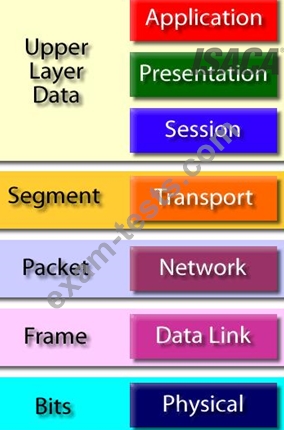
Protocol Data Unit - PDU
The following answers are incorrect:
The other options correctly describes about network device functioning based on TCP/IP model The following reference(s) were/was used to create this question:
CISA review manual 2014 page number 272
The keyword within the question is INCORRECTLY. You need to find out incorrect statement.
For your exam you should know below information about TCP/IP model:
Network models
Layer 4. Application Layer
Application layer is the top most layer of four layer TCP/IP model. Application layer is present on the top of the Transport layer. Application layer defines TCP/IP application protocols and how host programs interface with Transport layer services to use the network.
Application layer includes all the higher-level protocols like DNS (Domain Naming System), HTTP (Hypertext Transfer Protocol), Telnet, SSH, FTP (File Transfer Protocol), TFTP (Trivial File Transfer Protocol), SNMP (Simple Network Management Protocol), SMTP (Simple Mail Transfer Protocol) , DHCP (Dynamic Host Configuration Protocol), X Windows, RDP (Remote Desktop Protocol) etc.
Layer 3. Transport Layer
Transport Layer is the third layer of the four layer TCP/IP model. The position of the Transport layer is between Application layer and Internet layer. The purpose of Transport layer is to permit devices on the source and destination hosts to carry on a conversation. Transport layer defines the level of service and status of the connection used when transporting data.
The main protocols included at Transport layer are TCP (Transmission Control Protocol) and UDP (User Datagram Protocol).
Layer 2. Internet Layer
Internet Layer is the second layer of the four layer TCP/IP model. The position of Internet layer is between Network Access Layer and Transport layer. Internet layer pack data into data packets known as IP datagram's, which contain source and destination address (logical address or IP address) information that is used to forward the datagram's between hosts and across networks. The Internet layer is also responsible for routing of IP datagram's.
Packet switching network depends upon a connectionless internetwork layer. This layer is known as Internet layer. Its job is to allow hosts to insert packets into any network and have them to deliver independently to the destination. At the destination side data packets may appear in a different order than they were sent. It is the job of the higher layers to rearrange them in order to deliver them to proper network applications operating at the Application layer.
The main protocols included at Internet layer are IP (Internet Protocol), ICMP (Internet Control Message Protocol), ARP (Address Resolution Protocol), RARP (Reverse Address Resolution Protocol) and IGMP (Internet Group Management Protocol).
Layer 1. Network Access Layer
Network Access Layer is the first layer of the four layer TCP/IP model. Network Access Layer defines details of how data is physically sent through the network, including how bits are electrically or optically signaled by hardware devices that interface directly with a network medium, such as coaxial cable, optical fiber, or twisted pair copper wire.
The protocols included in Network Access Layer are Ethernet, Token Ring, FDDI, X.25, Frame Relay etc.
The most popular LAN architecture among those listed above is Ethernet. Ethernet uses an Access Method called CSMA/CD (Carrier Sense Multiple Access/Collision Detection) to access the media, when Ethernet operates in a shared media. An Access Method determines how a host will place data on the medium.
IN CSMA/CD Access Method, every host has equal access to the medium and can place data on the wire when the wire is free from network traffic. When a host wants to place data on the wire, it will check the wire to find whether another host is already using the medium. If there is traffic already in the medium, the host will wait and if there is no traffic, it will place the data in the medium. But, if two systems place data on the medium at the same instance, they will collide with each other, destroying the data. If the data is destroyed during transmission, the data will need to be retransmitted. After collision, each host will wait for a small interval of time and again the data will be retransmitted.
Protocol Data Unit (PDU) :
Protocol Data Unit - PDU
The following answers are incorrect:
The other options correctly describes about network device functioning based on TCP/IP model The following reference(s) were/was used to create this question:
CISA review manual 2014 page number 272
- Other Version
- 6710ISACA.CISA.v2026-02-11.q999
- 12023ISACA.CISA.v2025-05-24.q773
- 4973ISACA.CISA.v2024-10-22.q310
- 11254ISACA.CISA.v2023-10-02.q715
- 5626ISACA.CISA.v2023-03-29.q119
- 4642ISACA.CISA.v2023-02-09.q181
- 2849ISACA.CISA.v2023-02-06.q107
- 4440ISACA.CISA.v2022-08-28.q129
- 6123ISACA.CISA.v2022-02-25.q148
- 130ISACA.Actualtestpdf.CISA.v2021-11-13.by.sarah.721q.pdf
- 7778ISACA.CISA.v2021-11-11.q194
- 11190ISACA.CISA.v2021-10-08.q198
- 12291ISACA.CISA.v2021-09-28.q199
- 14913ISACA.CISA.v2021-09-11.q201
- Latest Upload
- 190Google.Professional-Cloud-DevOps-Engineer.v2026-09-16.q209
- 155AAPC.CPC.v2026-09-16.q132
- 117HP.HPE0-J82.v2026-09-16.q26
- 186F5.303.v2026-09-16.q147
- 170PaloAltoNetworks.NGFW-Engineer.v2026-09-16.q105
- 131Workday.Workday-Pro-Recruiting.v2026-09-15.q19
- 141ACAMS.CAMS-FCI.v2026-09-15.q36
- 157VMware.250-614.v2026-09-15.q42
- 187IAPP.CIPM.v2026-09-15.q217
- 171VMware.2V0-13.25.v2026-09-14.q122
[×]
Download PDF File
Enter your email address to download ISACA.CISA.v2026-01-26.q999 Practice Test