
- Home
- ISACA Certification
- CISA Exam
- ISACA.CISA.v2026-01-26.q999 Practice Test

Question 306
Identify the network topology from below diagram presented below:

Network Topology
Network Topology
Correct Answer: D
Explanation/Reference:
For your exam you should know the information below related to LAN topologies:
LAN Topologies
Network topology is the physical arrangement of the various elements (links, nodes, etc.) of a computer network.
Essentially, it is the topological structure of a network, and may be depicted physically or logically. Physical topology refers to the placement of the network's various components, including device location and cable installation, while logical topology shows how data flows within a network, regardless of its physical design.
Distances between nodes, physical interconnections, transmission rates, and/or signal types may differ between two networks, yet their topologies may be identical.
Bus
In local area networks where bus topology is used, each node is connected to a single cable. Each computer or server is connected to the single bus cable. A signal from the source travels in both directions to all machines connected on the bus cable until it finds the intended recipient. If the machine address does not match the intended address for the data, the machine ignores the data. Alternatively, if the data matches the machine address, the data is accepted. Since the bus topology consists of only one wire, it is rather inexpensive to implement when compared to other topologies. However, the low cost of implementing the technology is offset by the high cost of managing the network. Additionally, since only one cable is utilized, it can be the single point of failure. If the network cable is terminated on both ends and when without termination data transfer stop and when cable breaks, the entire network will be down.
Bus topology

Graphic from: http://www.technologyuk.net/telecommunications/networks/images/bus_topology.gif Linear bus
The type of network topology in which all of the nodes of the network are connected to a common transmission medium which has exactly two endpoints (this is the 'bus', which is also commonly referred to as the backbone, or trunk) - all data that is transmitted between nodes in the network is transmitted over this common transmission medium and is able to be received by all nodes in the network simultaneously.
Distributed bus
The type of network topology in which all of the nodes of the network are connected to a common transmission medium which has more than two endpoints that are created by adding branches to the main section of the transmission medium - the physical distributed bus topology functions in exactly the same fashion as the physical linear bus topology (i.e., all nodes share a common transmission medium).
Star
In local area networks with a star topology, each network host is connected to a central point with a point- to-point connection. In Star topology every node (computer workstation or any other peripheral) is connected to central node called hub or switch.
The switch is the server and the peripherals are the clients. The network does not necessarily have to resemble a star to be classified as a star network, but all of the nodes on the network must be connected to one central device.
All traffic that traverses the network passes through the central point. The central point acts as a signal repeater.
The star topology is considered the easiest topology to design and implement. An advantage of the star topology is the simplicity of adding additional nodes. The primary disadvantage of the star topology is that the central point represents a single point of failure.
Star Topology

Image from: http://fcit.usf.edu/network/chap5/pics/star.gif
Ring
A network topology that is set up in a circular fashion in which data travels around the ring in one direction and each device on the ring acts as a repeater to keep the signal strong as it travels. Each device incorporates a receiver for the incoming signal and a transmitter to send the data on to the next device in the ring.
The network is dependent on the ability of the signal to travel around the ring. When a device sends data, it must travel through each device on the ring until it reaches its destination. Every node is a critical link. If one node goes down the whole link would be affected.
Ring Topology
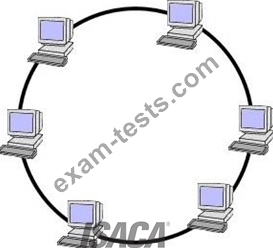
Image from: https://forrester-infosystems.wikispaces.com/
Mesh
The value of a fully meshed networks is proportional to the exponent of the number of subscribers, assuming that communicating groups of any two endpoints, up to and including all the endpoints, is approximated by Reed's Law.
A mesh network provides for high availability and redundancy. However, the cost of such network could be very expensive if dozens of devices are in the mesh.
Mesh Topology
Image from: http://www.technologyuk.net/telecommunications/networks/images/mesh_topology.gif Fully connected mesh topology
A fully connected network is a communication network in which each of the nodes is connected to each other. In graph theory it known as a complete graph. A fully connected network doesn't need to use switching nor broadcasting. However, its major disadvantage is that the number of connections grows quadratic ally with the number of nodes, so it is extremely impractical for large networks. A two-node network is technically a fully connected network.
Partially connected mesh topology
The type of network topology in which some of the nodes of the network are connected to more than one other node in the network with a point-to-point link - this makes it possible to take advantage of some of the redundancy that is provided by a physical fully connected mesh topology without the expense and complexity required for a connection between every node in the network.
The following answers are incorrect:
The other options presented are not valid.
The following reference(s) were/was used to create this question:
CISA review manual 2014, Page number 262
For your exam you should know the information below related to LAN topologies:
LAN Topologies
Network topology is the physical arrangement of the various elements (links, nodes, etc.) of a computer network.
Essentially, it is the topological structure of a network, and may be depicted physically or logically. Physical topology refers to the placement of the network's various components, including device location and cable installation, while logical topology shows how data flows within a network, regardless of its physical design.
Distances between nodes, physical interconnections, transmission rates, and/or signal types may differ between two networks, yet their topologies may be identical.
Bus
In local area networks where bus topology is used, each node is connected to a single cable. Each computer or server is connected to the single bus cable. A signal from the source travels in both directions to all machines connected on the bus cable until it finds the intended recipient. If the machine address does not match the intended address for the data, the machine ignores the data. Alternatively, if the data matches the machine address, the data is accepted. Since the bus topology consists of only one wire, it is rather inexpensive to implement when compared to other topologies. However, the low cost of implementing the technology is offset by the high cost of managing the network. Additionally, since only one cable is utilized, it can be the single point of failure. If the network cable is terminated on both ends and when without termination data transfer stop and when cable breaks, the entire network will be down.
Bus topology
Graphic from: http://www.technologyuk.net/telecommunications/networks/images/bus_topology.gif Linear bus
The type of network topology in which all of the nodes of the network are connected to a common transmission medium which has exactly two endpoints (this is the 'bus', which is also commonly referred to as the backbone, or trunk) - all data that is transmitted between nodes in the network is transmitted over this common transmission medium and is able to be received by all nodes in the network simultaneously.
Distributed bus
The type of network topology in which all of the nodes of the network are connected to a common transmission medium which has more than two endpoints that are created by adding branches to the main section of the transmission medium - the physical distributed bus topology functions in exactly the same fashion as the physical linear bus topology (i.e., all nodes share a common transmission medium).
Star
In local area networks with a star topology, each network host is connected to a central point with a point- to-point connection. In Star topology every node (computer workstation or any other peripheral) is connected to central node called hub or switch.
The switch is the server and the peripherals are the clients. The network does not necessarily have to resemble a star to be classified as a star network, but all of the nodes on the network must be connected to one central device.
All traffic that traverses the network passes through the central point. The central point acts as a signal repeater.
The star topology is considered the easiest topology to design and implement. An advantage of the star topology is the simplicity of adding additional nodes. The primary disadvantage of the star topology is that the central point represents a single point of failure.
Star Topology
Image from: http://fcit.usf.edu/network/chap5/pics/star.gif
Ring
A network topology that is set up in a circular fashion in which data travels around the ring in one direction and each device on the ring acts as a repeater to keep the signal strong as it travels. Each device incorporates a receiver for the incoming signal and a transmitter to send the data on to the next device in the ring.
The network is dependent on the ability of the signal to travel around the ring. When a device sends data, it must travel through each device on the ring until it reaches its destination. Every node is a critical link. If one node goes down the whole link would be affected.
Ring Topology
Image from: https://forrester-infosystems.wikispaces.com/
Mesh
The value of a fully meshed networks is proportional to the exponent of the number of subscribers, assuming that communicating groups of any two endpoints, up to and including all the endpoints, is approximated by Reed's Law.
A mesh network provides for high availability and redundancy. However, the cost of such network could be very expensive if dozens of devices are in the mesh.
Mesh Topology
Image from: http://www.technologyuk.net/telecommunications/networks/images/mesh_topology.gif Fully connected mesh topology
A fully connected network is a communication network in which each of the nodes is connected to each other. In graph theory it known as a complete graph. A fully connected network doesn't need to use switching nor broadcasting. However, its major disadvantage is that the number of connections grows quadratic ally with the number of nodes, so it is extremely impractical for large networks. A two-node network is technically a fully connected network.
Partially connected mesh topology
The type of network topology in which some of the nodes of the network are connected to more than one other node in the network with a point-to-point link - this makes it possible to take advantage of some of the redundancy that is provided by a physical fully connected mesh topology without the expense and complexity required for a connection between every node in the network.
The following answers are incorrect:
The other options presented are not valid.
The following reference(s) were/was used to create this question:
CISA review manual 2014, Page number 262
Question 307
The MOST effective biometric control system is the one:
Correct Answer: B
Section: Protection of Information Assets
Explanation:
The equal-error rate (EER) of a biometric system denotes the percent at which the false- acceptance rate
(FAR) is equal to the false-rejection rate (FRR). The biometric that has the lowest EER is the most
effective. The biometric that has the highest EER is the most ineffective. For any biometric, there will be a
measure at which the FRR will be equal to the FAR. This is the EER. FER is an aggregate measure of
FRR.
Explanation:
The equal-error rate (EER) of a biometric system denotes the percent at which the false- acceptance rate
(FAR) is equal to the false-rejection rate (FRR). The biometric that has the lowest EER is the most
effective. The biometric that has the highest EER is the most ineffective. For any biometric, there will be a
measure at which the FRR will be equal to the FAR. This is the EER. FER is an aggregate measure of
FRR.
Question 308
The PRIMARY purpose of running a new system in parallel s to:
Correct Answer: D
Question 309
Which of the following attack techniques will succeed because of an inherent security weakness in an Internet firewall?
Correct Answer: D
Explanation
Flooding the site with an excessive number of packets is an attack technique that will succeed because of an inherent security weakness in an Internet firewall. This type of attack is also known as a denial-of-service (DoS) attack or a distributed denial-of-service (DDoS) attack if it involves multiple sources. The aim of this attack is to overwhelm the network bandwidth or the processing capacity of the firewall or the target system, rendering it unable to respond to legitimate requests or perform its normal functions. An Internet firewall is a device or software that monitors and controls incoming and outgoing network traffic based on predefined rules. A firewall can block or allow traffic based on various criteria, such as source address, destination address, port number, protocol type, application type, etc. However, a firewall cannot prevent traffic from reaching its interface or distinguish between legitimate and malicious traffic based on its content or behavior.
Therefore, a firewall is vulnerable to flooding attacks that exploit its limited resources. Phishing is an attack technique that involves sending fraudulent emails or messages that appear to come from legitimate sources, such as banks, government agencies, online services, etc., in order to trick recipients into revealing their personal or financial information, such as passwords, credit card numbers, bank account details, etc., or into clicking on malicious links or attachments that can infect their systems with malware or ransomware.
Phishing does not exploit an inherent security weakness in an Internet firewall, but rather exploits human psychology and social engineering techniques. A firewall cannot prevent phishing emails or messages from reaching their intended targets, unless they contain some identifiable features that can be filtered out by the firewall rules. However, a firewall cannot detect or prevent users from responding to phishing emails or messages or from opening malicious links or attachments. Using a dictionary attack of encrypted passwords is an attack technique that involves trying to guess or crack passwords by using a list of common or likely passwords or by using a brute-force method that tries all possible combinations of characters. This type of attack does not exploit an inherent security weakness in an Internet firewall, but rather exploits weak or poorly chosen passwords or weak encryption algorithms. A firewall cannot prevent a dictionary attack of encrypted passwords, unless it has some mechanisms to detect and block repeated or suspicious login attempts or to enforce strong password policies. However, a firewall cannot protect passwords from being stolen or intercepted by other means, such as phishing, malware, keylogging, etc. Intercepting packets and viewing passwords is an attack technique that involves capturing and analyzing network traffic that contains sensitive information, such as passwords, credit card numbers, bank account details, etc., in order to use them for malicious purposes. This type of attack does not exploit an inherent security weakness in an Internet firewall, but rather exploits insecure or unencrypted network communication protocols or channels. A firewall cannot prevent packets from being intercepted and viewed by unauthorized parties, unless it has some mechanisms to encrypt or obfuscate the network traffic or to authenticate the source and destination of the traffic. However, a firewall cannot protect packets from being modified or tampered with by other means, such as man-in-the-middle attacks, replay attacks, etc. References: ISACA CISA Review Manual 27th Edition, page
300
Flooding the site with an excessive number of packets is an attack technique that will succeed because of an inherent security weakness in an Internet firewall. This type of attack is also known as a denial-of-service (DoS) attack or a distributed denial-of-service (DDoS) attack if it involves multiple sources. The aim of this attack is to overwhelm the network bandwidth or the processing capacity of the firewall or the target system, rendering it unable to respond to legitimate requests or perform its normal functions. An Internet firewall is a device or software that monitors and controls incoming and outgoing network traffic based on predefined rules. A firewall can block or allow traffic based on various criteria, such as source address, destination address, port number, protocol type, application type, etc. However, a firewall cannot prevent traffic from reaching its interface or distinguish between legitimate and malicious traffic based on its content or behavior.
Therefore, a firewall is vulnerable to flooding attacks that exploit its limited resources. Phishing is an attack technique that involves sending fraudulent emails or messages that appear to come from legitimate sources, such as banks, government agencies, online services, etc., in order to trick recipients into revealing their personal or financial information, such as passwords, credit card numbers, bank account details, etc., or into clicking on malicious links or attachments that can infect their systems with malware or ransomware.
Phishing does not exploit an inherent security weakness in an Internet firewall, but rather exploits human psychology and social engineering techniques. A firewall cannot prevent phishing emails or messages from reaching their intended targets, unless they contain some identifiable features that can be filtered out by the firewall rules. However, a firewall cannot detect or prevent users from responding to phishing emails or messages or from opening malicious links or attachments. Using a dictionary attack of encrypted passwords is an attack technique that involves trying to guess or crack passwords by using a list of common or likely passwords or by using a brute-force method that tries all possible combinations of characters. This type of attack does not exploit an inherent security weakness in an Internet firewall, but rather exploits weak or poorly chosen passwords or weak encryption algorithms. A firewall cannot prevent a dictionary attack of encrypted passwords, unless it has some mechanisms to detect and block repeated or suspicious login attempts or to enforce strong password policies. However, a firewall cannot protect passwords from being stolen or intercepted by other means, such as phishing, malware, keylogging, etc. Intercepting packets and viewing passwords is an attack technique that involves capturing and analyzing network traffic that contains sensitive information, such as passwords, credit card numbers, bank account details, etc., in order to use them for malicious purposes. This type of attack does not exploit an inherent security weakness in an Internet firewall, but rather exploits insecure or unencrypted network communication protocols or channels. A firewall cannot prevent packets from being intercepted and viewed by unauthorized parties, unless it has some mechanisms to encrypt or obfuscate the network traffic or to authenticate the source and destination of the traffic. However, a firewall cannot protect packets from being modified or tampered with by other means, such as man-in-the-middle attacks, replay attacks, etc. References: ISACA CISA Review Manual 27th Edition, page
300
Question 310
Which of the following application input controls would MOST likely detect data input errors in the customer account number field during the processing of an accounts receivable transaction?
Correct Answer: A
Section: Information System Operations, Maintenance and Support
- Other Version
- 6724ISACA.CISA.v2026-02-11.q999
- 12045ISACA.CISA.v2025-05-24.q773
- 4975ISACA.CISA.v2024-10-22.q310
- 11264ISACA.CISA.v2023-10-02.q715
- 5631ISACA.CISA.v2023-03-29.q119
- 4645ISACA.CISA.v2023-02-09.q181
- 2856ISACA.CISA.v2023-02-06.q107
- 4443ISACA.CISA.v2022-08-28.q129
- 6126ISACA.CISA.v2022-02-25.q148
- 130ISACA.Actualtestpdf.CISA.v2021-11-13.by.sarah.721q.pdf
- 7778ISACA.CISA.v2021-11-11.q194
- 11192ISACA.CISA.v2021-10-08.q198
- 12297ISACA.CISA.v2021-09-28.q199
- 14917ISACA.CISA.v2021-09-11.q201
- Latest Upload
- 124VMware.3V0-23.25.v2026-09-17.q73
- 117Workday.Workday-Adaptive-Planning.v2026-09-17.q20
- 122SAP.C_ACDET.v2026-09-17.q20
- 119Appian.ACD-301.v2026-09-17.q16
- 204Google.Professional-Cloud-DevOps-Engineer.v2026-09-16.q209
- 183AAPC.CPC.v2026-09-16.q132
- 125HP.HPE0-J82.v2026-09-16.q26
- 199F5.303.v2026-09-16.q147
- 193PaloAltoNetworks.NGFW-Engineer.v2026-09-16.q105
- 138Workday.Workday-Pro-Recruiting.v2026-09-15.q19
[×]
Download PDF File
Enter your email address to download ISACA.CISA.v2026-01-26.q999 Practice Test