
- Home
- ISACA Certification
- CISA Exam
- ISACA.CISA.v2026-02-11.q999 Practice Test

Question 521
Which of the following device in Frame Relay WAN technique is generally customer owned device that provides a connectivity between company's own network and the frame relays network?
Correct Answer: A
Explanation/Reference:
Data Terminal Equipment (DTE) - Usually a customer owned device that provides connectivity between company's own network and the frame relay's network.
For your exam you should know below information about WAN Technologies:
Point-to-point protocol
PPP (Point-to-Point Protocol) is a protocol for communication between two computers using a serial interface, typically a personal computer connected by phone line to a server. For example, your Internet server provider may provide you with a PPP connection so that the provider's server can respond to your requests, pass them on to the Internet, and forward your requested Internet responses back to you.
PPP uses the Internet protocol (IP) (and is designed to handle other protocol as well). It is sometimes considered a member of the TCP/IP suite of protocols. Relative to the Open Systems Interconnection (OSI) reference model, PPP provides layer 2 (data-link layer) service. Essentially, it packages your computer's TCP/IP packets and forwards them to the server where they can actually be put on the Internet.
PPP is a full-duplex protocol that can be used on various physical media, including twisted pair or fiber optic lines or satellite transmission. It uses a variation of High Speed Data Link Control (HDLC) for packet encapsulation.
PPP is usually preferred over the earlier de facto standard Serial Line Internet Protocol (SLIP) because it can handle synchronous as well as asynchronous communication. PPP can share a line with other users and it has error detection that SLIP lacks. Where a choice is possible, PPP is preferred.
Point-to-point protocol
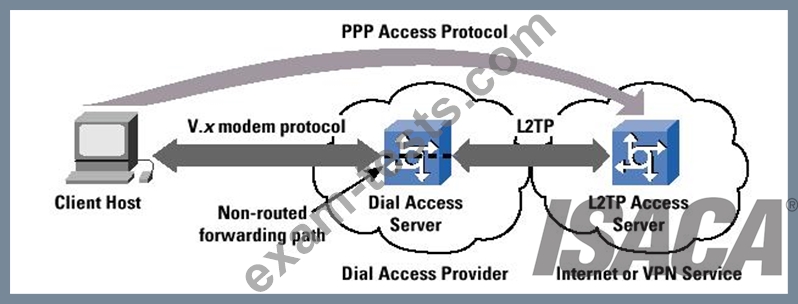
Image from:http://withfriendship.com/images/g/31728/a-pointtopoint-protocol.png
X.25
X.25 is an ITU-T standard protocol suite for packet switched wide area network (WAN) communication.
X.25 is a packet switching technology which uses carrier switch to provide connectivity for many different networks.
Subscribers are charged based on amount of bandwidth they use. Data are divided into 128 bytes and encapsulated in High Level Data Link Control (HDLC).
X.25 works at network and data link layer of an OSI model.
X.25
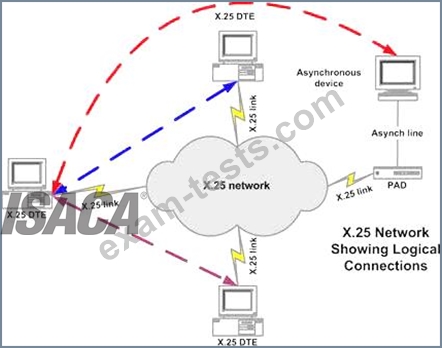
Image from:http://www.sangoma.com/assets/images/content/tutorials_x25_1.gif Frame Relay Works as packet switching Operates at data link layer of an OSI model Companies that pay more to ensure that a higher level of bandwidth will always be available, pay a committed information rate or CIR Two main types of equipment's are used in Frame Relay
1. Data Terminal Equipment (DTE) - Usually a customer owned device that provides connectivity between company's own network and the frame relay's network.
2. Data Circuit Terminal Equipment (DCE) - Service provider device that does the actual data transmission and switching in the frame relay cloud.
The Frame relay cloud is the collection of DCE that provides that provides switching and data communication functionality. Frame relay is any to any service.
Frame Relay
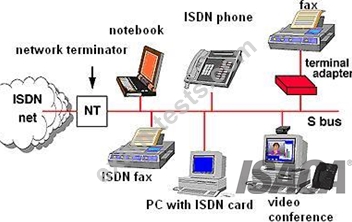
Image from: http://www.cpcstech.com/images/frame-2.jpg
Integrated Service Digital Network (ISDN)
Enables data, voice and other types of traffic to travel over a medium in a digital manner previously used only for analog voice transmission.
Runs on top of the Plain Old Telephone System (POTS). The same copper telephone wire is used.
Provide digital point-to-point circuit switching medium.
ISDN
Image from: http://www.hw-server.com/obrazek/network_topology
Asynchronous Transfer Mode (ATM)
Uses Cell switching method
High speed network technology used for LAN, MAN and WAN
Like frame relay it is connection oriented technology which creates and uses fixed channel Data are segmented into fixed size cell of 53 bytes Some companies have replaces FDDI back-end with ATM Asynchronous Transfer Mode
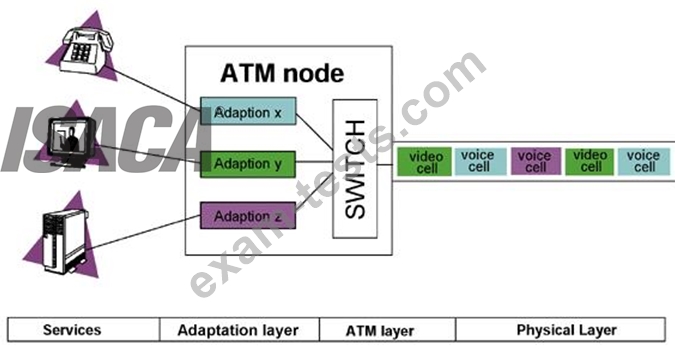
Image from: http://html.rincondelvago.com/000050700.png
Multiprotocol Label Switching (MPLS)
Multiprotocol Label Switching (MPLS) is a standard-approved technology for speeding up network traffic flow and making things easier to manage.MPLS involves setting up a specific path for a given sequence of packets, identified by a label put in each packet, thus saving the time needed for a router to look up the address to the next node to forward the packet to.
MPLS is called multiprotocol because it works with the Internet Protocol (IP), Asynchronous Transport Mode (ATM), and frame relay network protocols.
In reference to the Open Systems Interconnection, or OSI model, MPLS allows most packets to be forwarded at Layer 2 (switching) level rather than at the Layer 3 (routing) level.
In addition to moving traffic faster overall, MPLS makes it easy to manage a network for quality of service (QoS). For these reasons, the technique is expected to be readily adopted as networks begin to carry more and different mixtures of traffic.
MPLS
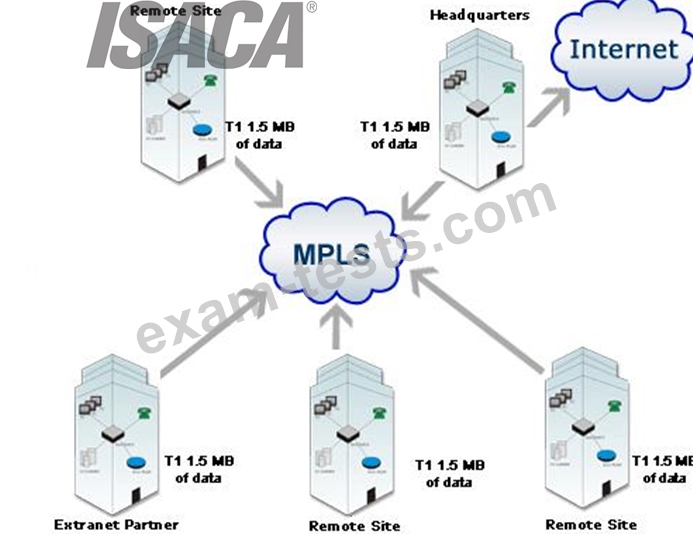
Image from: http://www.carrierbid.com/wp-content/uploads/2011/01/mpls1.gif The following answers are incorrect:
DCE - Data Circuit Terminal Equipment (DCE) is a service provider device that does the actual data transmission and switching in the frame relay cloud.
DME - Not a valid frame relay technique
DLE - Not a valid frame relay technique
The following reference(s) were/was used to create this question:
CISA review manual 2014 page number 266
Data Terminal Equipment (DTE) - Usually a customer owned device that provides connectivity between company's own network and the frame relay's network.
For your exam you should know below information about WAN Technologies:
Point-to-point protocol
PPP (Point-to-Point Protocol) is a protocol for communication between two computers using a serial interface, typically a personal computer connected by phone line to a server. For example, your Internet server provider may provide you with a PPP connection so that the provider's server can respond to your requests, pass them on to the Internet, and forward your requested Internet responses back to you.
PPP uses the Internet protocol (IP) (and is designed to handle other protocol as well). It is sometimes considered a member of the TCP/IP suite of protocols. Relative to the Open Systems Interconnection (OSI) reference model, PPP provides layer 2 (data-link layer) service. Essentially, it packages your computer's TCP/IP packets and forwards them to the server where they can actually be put on the Internet.
PPP is a full-duplex protocol that can be used on various physical media, including twisted pair or fiber optic lines or satellite transmission. It uses a variation of High Speed Data Link Control (HDLC) for packet encapsulation.
PPP is usually preferred over the earlier de facto standard Serial Line Internet Protocol (SLIP) because it can handle synchronous as well as asynchronous communication. PPP can share a line with other users and it has error detection that SLIP lacks. Where a choice is possible, PPP is preferred.
Point-to-point protocol
Image from:http://withfriendship.com/images/g/31728/a-pointtopoint-protocol.png
X.25
X.25 is an ITU-T standard protocol suite for packet switched wide area network (WAN) communication.
X.25 is a packet switching technology which uses carrier switch to provide connectivity for many different networks.
Subscribers are charged based on amount of bandwidth they use. Data are divided into 128 bytes and encapsulated in High Level Data Link Control (HDLC).
X.25 works at network and data link layer of an OSI model.
X.25
Image from:http://www.sangoma.com/assets/images/content/tutorials_x25_1.gif Frame Relay Works as packet switching Operates at data link layer of an OSI model Companies that pay more to ensure that a higher level of bandwidth will always be available, pay a committed information rate or CIR Two main types of equipment's are used in Frame Relay
1. Data Terminal Equipment (DTE) - Usually a customer owned device that provides connectivity between company's own network and the frame relay's network.
2. Data Circuit Terminal Equipment (DCE) - Service provider device that does the actual data transmission and switching in the frame relay cloud.
The Frame relay cloud is the collection of DCE that provides that provides switching and data communication functionality. Frame relay is any to any service.
Frame Relay
Image from: http://www.cpcstech.com/images/frame-2.jpg
Integrated Service Digital Network (ISDN)
Enables data, voice and other types of traffic to travel over a medium in a digital manner previously used only for analog voice transmission.
Runs on top of the Plain Old Telephone System (POTS). The same copper telephone wire is used.
Provide digital point-to-point circuit switching medium.
ISDN
Image from: http://www.hw-server.com/obrazek/network_topology
Asynchronous Transfer Mode (ATM)
Uses Cell switching method
High speed network technology used for LAN, MAN and WAN
Like frame relay it is connection oriented technology which creates and uses fixed channel Data are segmented into fixed size cell of 53 bytes Some companies have replaces FDDI back-end with ATM Asynchronous Transfer Mode
Image from: http://html.rincondelvago.com/000050700.png
Multiprotocol Label Switching (MPLS)
Multiprotocol Label Switching (MPLS) is a standard-approved technology for speeding up network traffic flow and making things easier to manage.MPLS involves setting up a specific path for a given sequence of packets, identified by a label put in each packet, thus saving the time needed for a router to look up the address to the next node to forward the packet to.
MPLS is called multiprotocol because it works with the Internet Protocol (IP), Asynchronous Transport Mode (ATM), and frame relay network protocols.
In reference to the Open Systems Interconnection, or OSI model, MPLS allows most packets to be forwarded at Layer 2 (switching) level rather than at the Layer 3 (routing) level.
In addition to moving traffic faster overall, MPLS makes it easy to manage a network for quality of service (QoS). For these reasons, the technique is expected to be readily adopted as networks begin to carry more and different mixtures of traffic.
MPLS
Image from: http://www.carrierbid.com/wp-content/uploads/2011/01/mpls1.gif The following answers are incorrect:
DCE - Data Circuit Terminal Equipment (DCE) is a service provider device that does the actual data transmission and switching in the frame relay cloud.
DME - Not a valid frame relay technique
DLE - Not a valid frame relay technique
The following reference(s) were/was used to create this question:
CISA review manual 2014 page number 266
Question 522
Which of the following is the BEST method for converting a file into a format suitable for data analysis in a forensic investigation?
Correct Answer: C
Question 523
.Which of the following is BEST characterized by unauthorized modification of data before or during systems data entry?
Correct Answer: A
Data diddling involves modifying data before or during systems data entry.
Question 524
Which of the following control make sure that input data comply with predefined criteria maintained in
computerized table of possible values?
computerized table of possible values?
Correct Answer: B
Section: Information System Acquisition, Development and Implementation
Explanation
Explanation/Reference:
In table lookups input data comply with predefined criteria maintained in computerized table of possible
values. For example, an input check enters a city code of 1 to 10. This number corresponds with a
computerize table that matches a code to a city name.
For CISA exam you should know below mentioned data validation edits and controls
Sequence Check - The control number follows sequentially and any sequence or duplicated control
numbers are rejected or noted on an exception report for follow-up purposes. For example, invoices are
numbered sequentially. The day's invoice begins with 12001 and ends with 15045. If any invoice larger than
15045 is encountered during processing, that invoice would be rejected as an invalid invoice number.
Limit Check - Data should not exceed a predefined amount. For example, payroll checks should not
exceed US $ 4000. If a check exceeds US $ 4000, data would be rejected for further verification/
authorization.
Validity Check - Programmed checking of data validity in accordance with predefined criteria. For example,
a payroll record contains a field for marital status and the acceptable status codes are M or
S. If any other
code is entered, record should be rejected.
Range Check -Data should not exceed a predefined range of values. For example, product type code
range from 100 to 250. Any code outside this range should be rejected as an invalid product type.
Reasonableness check - Input data are matched to predefined reasonable limits or occurrence rates. For
example, a widget manufacturer usually receives an order for no more than 20 widgets. If an order for more
than 20 widgets is received, the computer program should be designed to print the record with a warning
indicating that the order appears unreasonable.
Table Lookups - Input data comply with predefined criteria maintained in computerized table of possible
values. For example, an input check enters a city code of 1 to 10. This number corresponds with a
computerize table that matches a code to a city name.
Existence Check - Data are entered correctly and agree with valid predefined criteria. For example, a valid
transaction code must be entered in transaction code field.
Key verification -The keying process is repeated by a separate individual using a machine that compares
the original key stroke to the repeated keyed input. For ex. the worker number is keyed twice and
compared to verify the keying process.
Check digit - a numeric value that has been calculated mathematically is added to a data to ensure that
original data have not been p[ altered or incorrect, but Valid, value substituted. This control is effective in
detecting transposition and transcription error. For ex. A check digit is added to an account number so it
can be checked for accuracy when it is used.
Completeness check - a filed should always contain data rather than zero or blanks. A check of each byte
of that field should be performed to determine that some form of data, or not blanks or zeros, is present.
For ex. A worker number on a new employee record is left blank. His is identified as a key in filed and the
record would be rejected, with a request that the field be completed before the record is accepted for
processing.
Duplicate check- new transaction is matched to those previously input to ensure that they have not already
been entered. For ex. A vendor invoice number agrees with previously recorded invoice to ensure that the
current order is not a duplicate and, therefore, the vendor will not be paid twice.
Logical relationship check - if a particular condition is true, then one or more additional conditions or data
input relationship may be required to be true and consider the input valid. For ex. The hire data of an
employee may be required to be true and consider the input valid. For ex. The hire date of an employee
may be required to be more than 16 years past his her date of birth.
The following were incorrect answers:
Range Check -Data should not exceed a predefined range of values. For example, product type code
range from 100 to 250. Any code outside this range should be rejected as an invalid product type.
Existence Check - Data are entered correctly and agree with valid predefined criteria. For example, a valid
transaction code must be entered in transaction code field.
Reasonableness check - Input data are matched to predefined reasonable limits or occurrence rates. For
example, a widget manufacturer usually receives an order for no more than 20 widgets. If an order for more
than 20 widgets is received, the computer program should be designed to print the record with a warning
indicating that the order appears unreasonable.
The following reference(s) were/was used to create this question:
CISA review manual 2014 Page number 215
Explanation
Explanation/Reference:
In table lookups input data comply with predefined criteria maintained in computerized table of possible
values. For example, an input check enters a city code of 1 to 10. This number corresponds with a
computerize table that matches a code to a city name.
For CISA exam you should know below mentioned data validation edits and controls
Sequence Check - The control number follows sequentially and any sequence or duplicated control
numbers are rejected or noted on an exception report for follow-up purposes. For example, invoices are
numbered sequentially. The day's invoice begins with 12001 and ends with 15045. If any invoice larger than
15045 is encountered during processing, that invoice would be rejected as an invalid invoice number.
Limit Check - Data should not exceed a predefined amount. For example, payroll checks should not
exceed US $ 4000. If a check exceeds US $ 4000, data would be rejected for further verification/
authorization.
Validity Check - Programmed checking of data validity in accordance with predefined criteria. For example,
a payroll record contains a field for marital status and the acceptable status codes are M or
S. If any other
code is entered, record should be rejected.
Range Check -Data should not exceed a predefined range of values. For example, product type code
range from 100 to 250. Any code outside this range should be rejected as an invalid product type.
Reasonableness check - Input data are matched to predefined reasonable limits or occurrence rates. For
example, a widget manufacturer usually receives an order for no more than 20 widgets. If an order for more
than 20 widgets is received, the computer program should be designed to print the record with a warning
indicating that the order appears unreasonable.
Table Lookups - Input data comply with predefined criteria maintained in computerized table of possible
values. For example, an input check enters a city code of 1 to 10. This number corresponds with a
computerize table that matches a code to a city name.
Existence Check - Data are entered correctly and agree with valid predefined criteria. For example, a valid
transaction code must be entered in transaction code field.
Key verification -The keying process is repeated by a separate individual using a machine that compares
the original key stroke to the repeated keyed input. For ex. the worker number is keyed twice and
compared to verify the keying process.
Check digit - a numeric value that has been calculated mathematically is added to a data to ensure that
original data have not been p[ altered or incorrect, but Valid, value substituted. This control is effective in
detecting transposition and transcription error. For ex. A check digit is added to an account number so it
can be checked for accuracy when it is used.
Completeness check - a filed should always contain data rather than zero or blanks. A check of each byte
of that field should be performed to determine that some form of data, or not blanks or zeros, is present.
For ex. A worker number on a new employee record is left blank. His is identified as a key in filed and the
record would be rejected, with a request that the field be completed before the record is accepted for
processing.
Duplicate check- new transaction is matched to those previously input to ensure that they have not already
been entered. For ex. A vendor invoice number agrees with previously recorded invoice to ensure that the
current order is not a duplicate and, therefore, the vendor will not be paid twice.
Logical relationship check - if a particular condition is true, then one or more additional conditions or data
input relationship may be required to be true and consider the input valid. For ex. The hire data of an
employee may be required to be true and consider the input valid. For ex. The hire date of an employee
may be required to be more than 16 years past his her date of birth.
The following were incorrect answers:
Range Check -Data should not exceed a predefined range of values. For example, product type code
range from 100 to 250. Any code outside this range should be rejected as an invalid product type.
Existence Check - Data are entered correctly and agree with valid predefined criteria. For example, a valid
transaction code must be entered in transaction code field.
Reasonableness check - Input data are matched to predefined reasonable limits or occurrence rates. For
example, a widget manufacturer usually receives an order for no more than 20 widgets. If an order for more
than 20 widgets is received, the computer program should be designed to print the record with a warning
indicating that the order appears unreasonable.
The following reference(s) were/was used to create this question:
CISA review manual 2014 Page number 215
Question 525
An IS auditor is reviewing the release management process for an in-house software development solution. In which environment Is the software version MOST likely to be the same as production?
Correct Answer: A
- Other Version
- 6297ISACA.CISA.v2026-01-26.q999
- 9863ISACA.CISA.v2025-05-24.q773
- 3488ISACA.CISA.v2024-10-22.q310
- 7954ISACA.CISA.v2023-10-02.q715
- 4905ISACA.CISA.v2023-03-29.q119
- 3756ISACA.CISA.v2023-02-09.q181
- 2314ISACA.CISA.v2023-02-06.q107
- 3847ISACA.CISA.v2022-08-28.q129
- 5308ISACA.CISA.v2022-02-25.q148
- 130ISACA.Actualtestpdf.CISA.v2021-11-13.by.sarah.721q.pdf
- 6989ISACA.CISA.v2021-11-11.q194
- 10495ISACA.CISA.v2021-10-08.q198
- 11562ISACA.CISA.v2021-09-28.q199
- 13811ISACA.CISA.v2021-09-11.q201
- Latest Upload
- 288PaloAltoNetworks.NGFW-Engineer.v2026-05-01.q43
- 419Nokia.4A0-113.v2026-05-01.q69
- 451EC-COUNCIL.312-49v11.v2026-04-30.q214
- 421Microsoft.MB-820.v2026-04-30.q101
- 287Salesforce.MC-202.v2026-04-30.q57
- 333BICSI.INSTC_V8.v2026-04-29.q53
- 468NMLS.MLO.v2026-04-28.q82
- 304NCARB.Project-Management.v2026-04-28.q27
- 562EMC.D-AV-DY-23.v2026-04-27.q184
- 1417ServiceNow.CSA.v2026-04-27.q483
[×]
Download PDF File
Enter your email address to download ISACA.CISA.v2026-02-11.q999 Practice Test