

Question 46
You have a Deployment running a database application with a stateful application using a StatefulSet. How can you scale the database to handle increased read traffic without impacting the write performance for the stateful application?
Question 47
You are managing a Kubernetes cluster with a team of developers. You need to ensure that each developer only has access to the resources they need. For example, Developer A can only access the 'frontend' namespace and deploy applications there.
Developer B can access the 'backend' namespace and manage deployments and services.
Developer C can access the 'monitoring' namespace and access only read-only access to pods and services.
Define the RBAC rules and create the necessary Role, RoleBinding, and ServiceAccount resources to achieve this access control policy.
Developer B can access the 'backend' namespace and manage deployments and services.
Developer C can access the 'monitoring' namespace and access only read-only access to pods and services.
Define the RBAC rules and create the necessary Role, RoleBinding, and ServiceAccount resources to achieve this access control policy.






Question 48
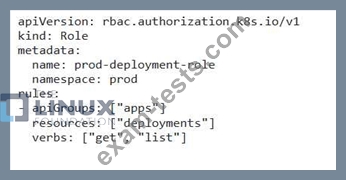
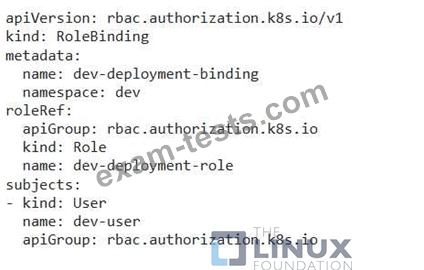
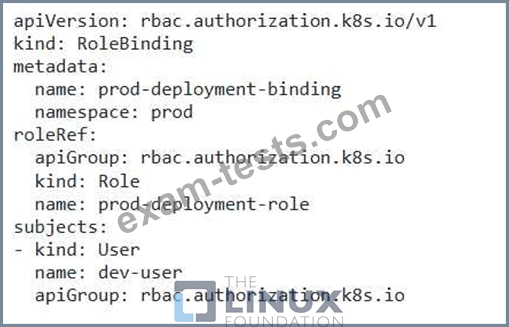
You are tasked with securing a Kubernetes cluster by implementing RBAC. Your cluster has two namespaces: 'dev' and 'prod'. You need to create a role that allows users in the 'dev' namespace to create, delete, and list deployments, but only read-only access to deployments in the 'prod' namespace. Additionally, these users should have access to create and manage ConfigMaps within both namespaces.
Create the necessary RBAC resources (Role, RoleBinding) to implement this access control policy.
Create the necessary RBAC resources (Role, RoleBinding) to implement this access control policy.


Question 49
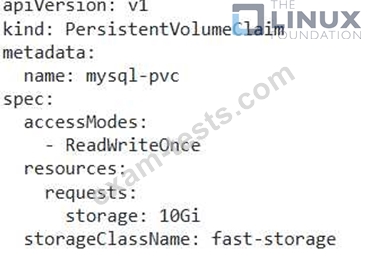
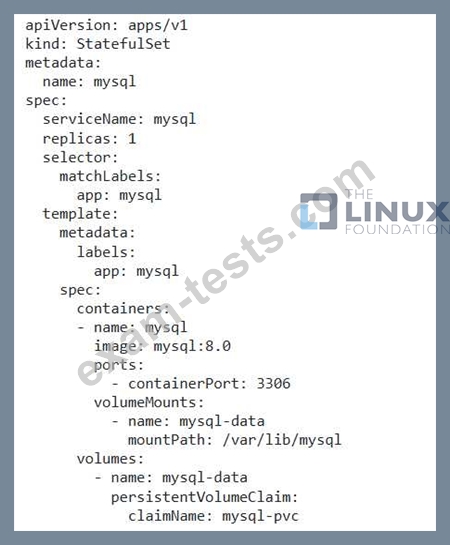
You are running a MySQL database on a Kubernetes cluster. You want to ensure that your database data is persistent even if a pod is deleted or restarted. You need to create a PersistentVolumeClaim (PVC) to request a specific storage class with a 1 OGB capacity, access mode of 'ReadWriteOnce', and storage class of 'fast-storage'. Explain the configuration and how to create the PVC and then use the PVC to create a StatefulSet for your MySQL deployment.
Question 50
List all the pods showing name and namespace with a json path expression