Patient is diagnosed with dacryocystitis, which is the inflammation of?
Correct Answer: B
Question 47
A 65-year-old man had a right axillary block by the anesthesiologist. When the arm was totally numb, the arm was prepped and draped, and the surgeon performed tendon repairs of the right first, second, and third fingers. The anesthesiologist monitored the patient throughout the case. What anesthesia code is reported?
Correct Answer: D
Question 48
Patient is diagnosed with dacryocystitis, which is the inflammation of?
Correct Answer: D
Dacryocystitis is the inflammation of the lacrimal sac, which is part of the tear drainage system located in the inner corner of the eye. The lacrimal sac is connected to the nasolacrimal duct, which drains tears into the nasal cavity. Inflammation in this area can cause pain, redness, and swelling near the inner corner of the eye. References: ICD-10-CM, medical dictionaries
Question 49
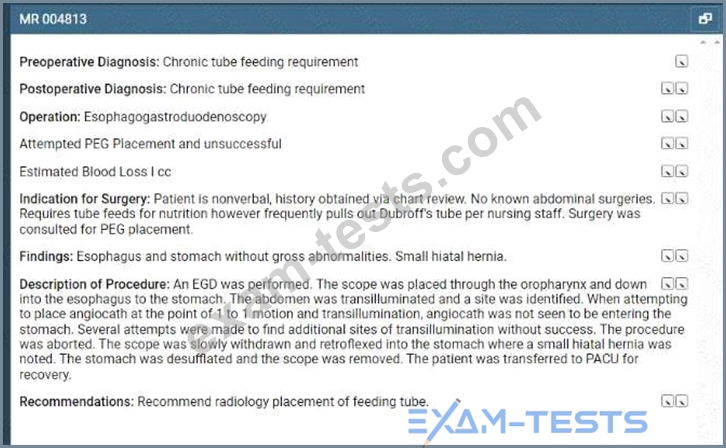
Refer to the supplemental information when answering this question: View MR 004813 What CPTand ICD-10-CM codes are reported?
Correct Answer: D
* CPT Code 43246: Esophagogastroduodenoscopy, with transoral insertion of intra-abdominal tube (e.g., gastrostomy or jejunostomy) * This code describes the attempted PEG tube placement. * Modifier -52: Reduced services. This modifier is appended because the procedure was aborted and the PEG tube was not successfully placed. * ICD-10-CM Code K94.29: Other specified disorders of digestive system * This code captures the patient's chronic feeding requirement, which is the reason for the attempted PEG tube placement. * ICD-10-CM Code K44.9: Diaphragmatic hernia without obstruction or gangrene * This code reports the small hiatal hernia that was found during the procedure. References: * CPT Code 43246: Esophagogastroduodenoscopy, with transoral insertion of intra-abdominal tube (e.g., gastrostomy or jejunostomy) * Modifier 52: Reduced services * ICD-10-CM Code K94.29: Other specified disorders of digestive system * ICD-10-CM Code K44.9: Diaphragmatic hernia without obstruction or gangrene * AAPC Coder's Desk Reference: This resource provides detailed information on coding guidelines and procedures.
Question 50
According to the ICD-10-CM Guidelines, what code is reported as an additional code when the blood pressure of a patient with hypertension remains above goal in spite of the use of antihypertensive medications?
Correct Answer: C
According to ICD-10-CM Guidelines, I11A.0 (Resistant hypertension) is used to indicate hypertension that remains uncontrolled despite the use of multiple antihypertensive medications. Resistant hypertension is coded to highlight the severity of the patient's condition and the difficulty in managing their blood pressure. This code is added as a secondary code to reflect the persistent elevation of blood pressure despite medication. A: I10 (Essential hypertension) is a general code for primary hypertension but does not specify resistance to treatment. B: A code from category I27 is related to pulmonary heart diseases, not directly related to hypertension management issues. D: A code from category I16 (Hypertensive crisis) is used for hypertensive emergencies or urgencies, which are acute episodes, not persistent uncontrolled hypertension despite treatment. Thus, the correct answer is C. I11A.0, Resistant hypertension.