

Question 26
A system is defined by the following reliability block diagram.
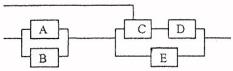
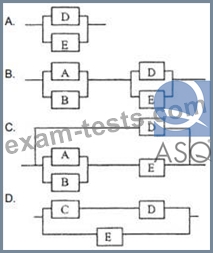
Which of the following block diagrams MOST simply represents the system reliability when Unit C is functioning?
Response:
Which of the following block diagrams MOST simply represents the system reliability when Unit C is functioning?
Response:
Question 27
Preliminary hazard analysis:
I. Is a review of safety problems prior to production.
II. Is normally done at a time when there is little design detail.
III. Can be used to identify the principal hazards when the product is first conceived.
Response:
I. Is a review of safety problems prior to production.
II. Is normally done at a time when there is little design detail.
III. Can be used to identify the principal hazards when the product is first conceived.
Response:
Question 28
A fault tree analysis (FTA) is a design analysis technique constructed from a "top event". A basic problem with this technique in comparison to a FMECA would be which of the following?
Response:
Response:
Question 29
Product safety is a concern in today's environment. If a risk assessment is performed near the end of the design stage, consideration should be based on:
I. Hazard probability.
II. Hazard severity.
III. Risk impact.
IV. Cost impact.
Response:
I. Hazard probability.
II. Hazard severity.
III. Risk impact.
IV. Cost impact.
Response:
Question 30
The following reliability block diagram shows components A, B, C, D and E with reliability Ra, Rb, Rc, Rd and Re, respectively. A or B are system entry points.

On the basis of this information, what is the reliability of the system?
Response:
On the basis of this information, what is the reliability of the system?
Response: