

Question 191
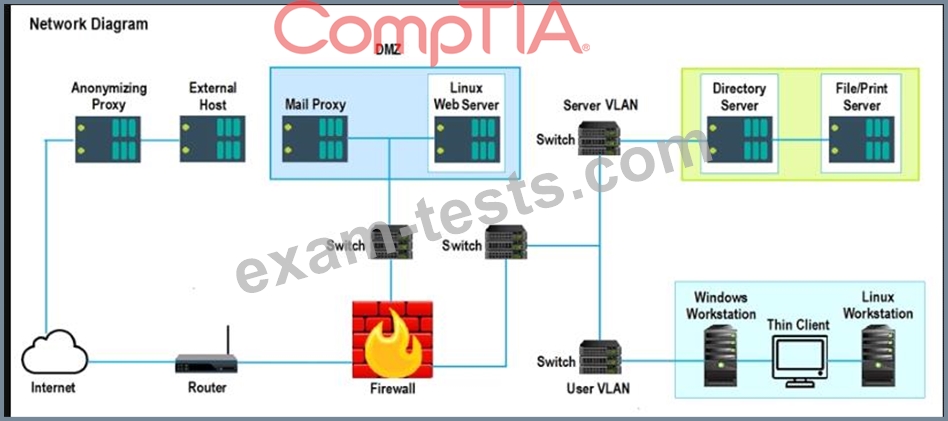
A security analyst performs various types of vulnerability scans. Review the vulnerability scan results to determine the type of scan that was executed and if a false positive occurred for each device.
Instructions:
Select the Results Generated drop-down option to determine if the results were generated from a credentialed scan, non-credentialed scan, or a compliance scan.
For ONLY the credentialed and non-credentialed scans, evaluate the results for false positives and check the findings that display false positives. NOTE: If you would like to uncheck an option that is currently selected, click on the option a second time.
Lastly, based on the vulnerability scan results, identify the type of Server by dragging the Server to the results.
The Linux Web Server, File-Print Server and Directory Server are draggable.
If at any time you would like to bring back the initial state of the simulation, please select the Reset All button. When you have completed the simulation, please select the Done button to submit. Once the simulation is submitted, please select the Next button to continue.

Instructions:
Select the Results Generated drop-down option to determine if the results were generated from a credentialed scan, non-credentialed scan, or a compliance scan.
For ONLY the credentialed and non-credentialed scans, evaluate the results for false positives and check the findings that display false positives. NOTE: If you would like to uncheck an option that is currently selected, click on the option a second time.
Lastly, based on the vulnerability scan results, identify the type of Server by dragging the Server to the results.
The Linux Web Server, File-Print Server and Directory Server are draggable.
If at any time you would like to bring back the initial state of the simulation, please select the Reset All button. When you have completed the simulation, please select the Done button to submit. Once the simulation is submitted, please select the Next button to continue.

Question 192
A security analyst is creating ACLs on a perimeter firewall that will deny inbound packets that are from internal addresses, reversed external addresses, and multicast addresses. Which of the following is the analyst attempting to prevent?
Question 193
A security analyst is investigating a malware infection that occurred on a Windows system. The system was not connected to a network and had no wireless capability Company policy prohibits using portable media or mobile storage The security analyst is trying to determine which user caused the malware to get onto the system Which of the following registry keys would MOST likely have this information?
A)

B)

C)

D)

A)
B)
C)
D)
Question 194
An organization is conducting penetration testing to identify possible network vulnerabilities. The penetration tester has received the following output from the latest scan:

The penetration tester knows the organization does not use Timbuktu servers and wants to have Nmap interrogate the ports on the target in more detail. Which of the following commands should the penetration tester use NEXT?
The penetration tester knows the organization does not use Timbuktu servers and wants to have Nmap interrogate the ports on the target in more detail. Which of the following commands should the penetration tester use NEXT?
Question 195
As a proactive threat-hunting technique, hunters must develop situational cases based on likely attack scenarios derived from the available threat intelligence information. After forming the basis of the scenario, which of the following may the threat hunter construct to establish a framework for threat assessment?