

Question 1
A simple drinks machine is described in the following state transition diagram:
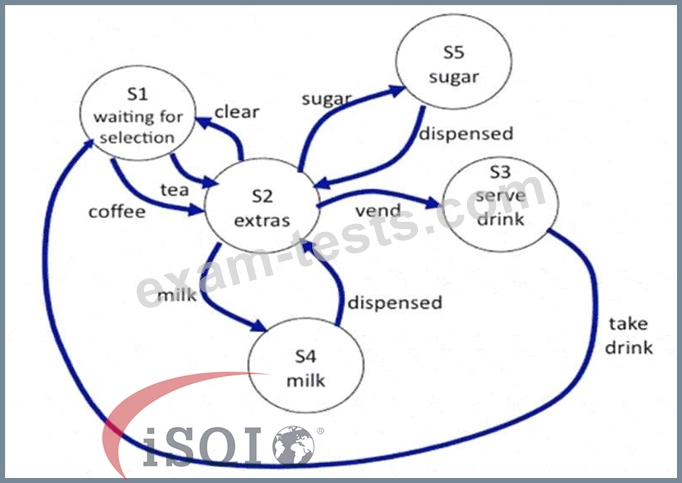
How many test cases will be needed for Chow's 1-switch coverage?
How many test cases will be needed for Chow's 1-switch coverage?
Question 2
The following use case diagram shows the process of raising a Purchase Request (PR) and getting it authorized. Details are entered in batches; any that fail validation will be rejected and must be re-entered. The details will indicate whether the request is a normal one or an emergency one. Normal requests must be authorized by the department manager, who may refuse to do so. Emergency requests will be automatically authorized and reported to the manager.
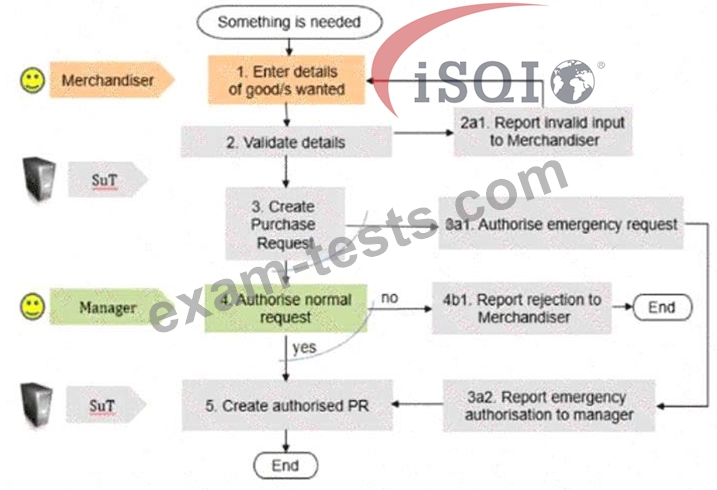
The test strategy states that:
* all combinations of extensions and exceptions, as well as the main scenario, shall be tested
* loops shall get simple loop coverage where the maximum number of iterations for validation exceptions is 3 and the typical number is 2.
What is the minimum quantity of test cases that will be needed to obtain this coverage?
Question 3
You are working on a project to build an application that will handle insurance claims. The main requirements for the system are that it shall:
* Allow users to enter details of claims that have been submitted by insured customers.
* Take each claim through a workflow that will allow an assessor to approve the request, reject it or request clarification from the claimant.
* Send approved requests to the accounts payable system for payment.
The solution is being developed according to the company's standard V-model methodology. The requirements are clearly documented and include a business process model. Operational profiles have been created to guide performance testing.
A risk-based approach to testing is used; frequency of use and role of the user are major factors in feature risk assessment.
System testing has almost finished but a major change to the approval workflow is just about to be delivered.
A standard regression test pack has not yet been established, but ad-hoc regression testing has already been performed on earlier builds.
As a TA. you have updated the list of product risks and must now decide the scope of the regression testing.
Which pair of techniques will be MOST effective for selecting the regression tests?
a) History-based, driven by the results of the regression tests run so far b) Risk-based, driven by the updated list of product risks and its traceability to the tests c) Operational profile-based, driven by the likely patterns of use of the relevant transactions d) Requirement traceability matrix-based, driven by the links from affected requirements to related tests e) Impact analysis, driven by consultation with technical stakeholders to identify what might be affected.
Question 4
You are defining key words to test an application which will create a Purchase Request (PR) from details of goods that a Merchandiser wants their organization to buy. When valid details have been entered, the resulting PR will be sent to the Merchandise Manager for authorization.
You have a diagram in Business Process Modeling Notation and this section shows the initial steps in this process:
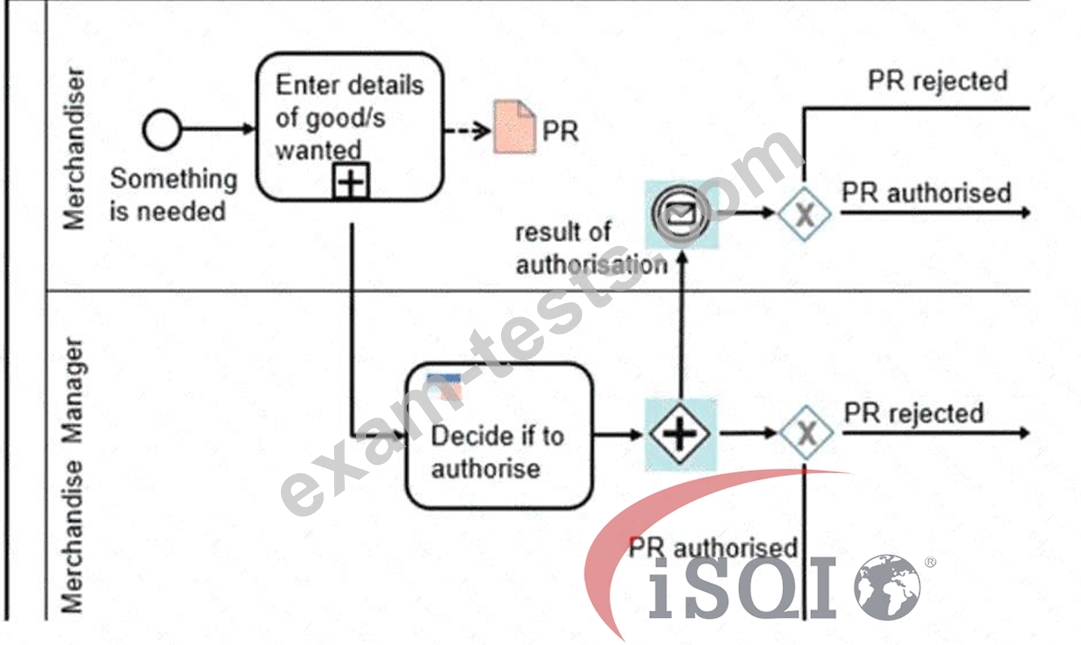
For the first process, when "Something is needed" , which option contains the MOST appropriate keywords for action and verification?
You have a diagram in Business Process Modeling Notation and this section shows the initial steps in this process:
For the first process, when "Something is needed" , which option contains the MOST appropriate keywords for action and verification?
Question 5
Your project is developing an application to generate quotes for motor insurance. The calculation requires a wide range of input data and a reliable model of it has been built in a spreadsheet. There will not be enough time to get adequate functional correctness coverage from the base choice or pairwise techniques, so you have decided to do some random testing based on a probability distribution of variable values that is weighted towards their business criticality.
Which limitation of random testing should you be MOST concerned about?
Which limitation of random testing should you be MOST concerned about?