Which of the following would NOT be a common metric used for monitoring test preparation and execution?
Correct Answer: B
Question 37
Which one of the following statements about testing techniques is TRUE?
Correct Answer: A
Explanation Exploratory testing can replace black box techniques when testing time is very limited, because it is a type of experience-based technique that allows testers to design and execute tests based on their intuition, knowledge, and skills, without following a predefined test plan or test cases13. The other options are false statements about testing techniques. Option B is false, because test execution scheduling should give priority to specification-based or structure-based techniques, which are more systematic and objective than experience-based techniques13. Option C is false, because specification-based techniques cannot be used as a substitute for a poorly defined test basis, but rather require a clear and complete test basis to design effective test cases13. Option D is false, because experience-based techniques are not systematic and do not produce detailed test documentation, but rather rely on the tester's judgement and creativity
Question 38
What is a defect density?
Correct Answer: D
Explanation Defect density is a metric that measures the number of defects identified in the system under test divided by the size of the system. The size of the system can be measured in different ways, such as lines of code, function points, or modules. Defect density can be used to compare the quality of different systems or different versions of the same system. References: [Certified Tester Foundation Level Syllabus], Section 8.3.1
Question 39
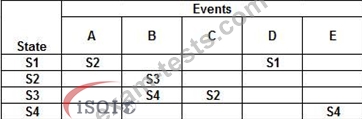
In the above State Table, which of the following represents an invalid transition?
Correct Answer: D
Question 40
Which of the following best describes the Black-box technique?
Correct Answer: D
Explanation It can be done without reference to the internal structure of the component or system. Black-box testing techniques are based on the external behavior and functionality of the system, not on its internal structure or code. Black-box testing techniques include equivalence partitioning, boundary value analysis, decision table testing, state transition testing, use case testing, etc. A detailed explanation of black-box testing techniques can be found in A Study Guide to the ISTQB Foundation Level 2018 Syllabus, pages 25-601.